

Author: Peter Green

  • Why and How to Invest in Digital Platform Updates (Instead of Complete Overhauls)

    It’s relatively easy for your organization’s decision makers to understand the need to build a new website or app, or rebuild an existing one. The results of these projects are visible to all; the ROI is conspicuous. 

    Investing in work that doesn’t have that obvious ROI, on the other hand, can be harder for leadership to stomach. 

    And yet, putting time and resources behind three such “hidden” initiatives—incremental UX improvements, behind-the-scenes system modernization, and bug fixes—is paramount to the long-term success of your organization and its online presence. 

    Let’s explore why and how to get the buy-in you need on updates (not overhauls) to your digital platform.  

    App and Site Updates Can Be Unpopular. Do Them for Your Organization Anyway.

    The three areas we want to encourage your decision makers to invest in (UX improvements, system modernization, and bug fixes) are not usually the initiatives that generate the most donations—let alone excitement. Remember: Few people care about unseen upgrades. But you’re still stuck needing to communicate the value of work that isn’t adding new features or apps. 

    Here’s what you must focus on to garner the support you need…

    A modern platform with few bugs will effectively reach your organization’s audience today. What’s more, it’ll be robust enough, thanks to modern tech, for further development in the future. 

    After all, you can’t always build a new thing (although there’s a time and place to do so, of course). Creating a fresh organization site or app takes upwards of 18 months, so you’re leaving your constituents high and dry with a faulty platform in the interim. More importantly, you can’t (or shouldn’t) build a new thing on top of an outdated, poorly functioning old thing. That’s just lipstick on a pig. 

    For a Modern Platform, Seek Support for These 3 Initiatives 

    Keeping your platform up to date and easy to use is the best course of action. When it is time for something new, your existing tech will be able to support modern dev tools and practices. In the meantime, you have a platform your organization’s constituents can enjoy using, thanks to investing in the three initiatives below. 

    1. UX Improvements 

    It’s perhaps easiest for your organization’s decision makers to understand the need to invest in your platform’s user experience. The UX of your site or app matters to your users, your donors, and, as such, to your organization as a whole. You may even receive less donations if, for example, one of your constituents can’t locate your donation page because of a poor UX. 

    Even though everyone generally accepts that a quality UX is important, you might need to help your internal stakeholders understand that UX improvements are incremental. Working on your UX is a process—not a one-off project. You need resources to support the UX of your platform on an ongoing basis, which is why we include incremental UX improvements as an update or modernization initiative you must undertake. 

    To get started with UX improvements, look at your site or app’s navigation and accessibility (you could check that the color contrast is okay for people with low vision). Both are low-hanging fruit when it comes to bettering your UX. 

    2. System Modernization 

    For lack of a better term, the fear of missing out (FOMO) is real in the nonprofit space! You and your decision makers alike want to keep up with your peers when it comes to the tech they’re employing. 

    But remember, you can’t effectively build a new platform atop an old one. Systems fall out of date, and your developers rely on outdated methods and software. From there, maintaining your app’s codebase becomes increasingly difficult because these older methods fall into disuse and the older software lacks support resources. It’s also harder to find staff to work in older coding languages and environments. 

    All to say, it’s a slippery slope when you fail to keep your systems modern, which is why doing so is critical. We’ve had clients spend an entire quarter just paying down their technical debt, which could’ve been avoided by making iterative updates. Modernizing, however unglamorous it may seem to your decision makers, is worthwhile. 

    3. Bug Fixes

    Bugs and deficiencies never fix themselves and often come back to bite your users. It seems obvious that a software bug never just goes away, right? But your development practices may demonstrate that, in fact, that’s exactly what you (or your internal stakeholders) think happens. You’re not fixing the issues that pop up—perhaps because you lack the resources to do so. 

    Here’s why you must advocate for support in fixing bugs…

    Unfortunately, when you ignore bugs or deficiencies, more and more of your users will encounter them over time. Eventually, they could become disillusioned with your organization. Buggy platforms also rely on band-aid workarounds to attempt to avoid buggy behavior, so you’re accruing tons of technical debt. 

    Intentionally addressing bugs and deficiencies, even if they aren’t particularly apparent to your users, ensures that you have the bandwidth to develop the features you want instead of working around the problems you don’t want.

    Tip: Keep track of your platform’s most common and problematic issues through your support department or inbox. Work first on the bugs and deficiencies your users are reporting most often. 

    Go Forth and Update Your App

    There are no downsides to keeping your systems modern and making iterative improvements. We know you already have your eye on your app or site’s deficiencies. And you probably have a long list of optimizations you’d like to make. We hope this article helps you justify how crucial UX tweaks, system updates, and bug fixes are to maintaining a user-friendly platform.


  • Choosing Between A Values-Based Agency or Individual to Build Your Ministry’s App

    Enlisting an individual to build your ministry’s web or mobile application might seem like a good idea, at least on the surface. You can likely find someone in your network (through your church, in your community, via a trusted friend, etc.) who can quickly stand up a serviceable app. However, the benefits of partnering with an established, missionally compatible agency quickly outweigh any potential pros of working with an individual. 

    From their breadth of technical expertise to their deep bench of diverse experts, agencies are able, in the long run, to provide significantly more value for your ministry than any one person could.

    When Is a Freelance Developer Sufficient for Your Ministry?

    As noted, your ministry will need to partner with an agency for your development needs in the long run. But there are some scenarios where hiring an individual is okay, particularly in the short term. 

    If your ministry is new and simply needs a business card website or proof-of-concept, an individual developer can probably get you online faster and cheaper than an agency can. You can then use your basic site (or app) to garner additional funding and make your mission known more widely. Again, this is a good use of a freelancer. 

    How Do You Know When It’s Time for an Established Agency?  

    Every ministry intent on stability and growth will reach a point where they require an agency to build and nurture their digital presence. Working with an established agency is the only way to holistically strategize your hallmark app—one with the functionality and flexibility you need long-term. 

    How will you know your ministry has outgrown working with an individual contractor? When you’re in need of implementers and maintainers, not just visionaries. Here’s what we mean:

    Organizations are made up of visionaries, implementers, and maintainers. Visionaries do big-picture thinking. They pursue goals aggressively, and they pursue aggressive goals. Implementers come in behind visionaries and systematize the vision. They make things repeatable and pleasant to look at, generally concerning themselves with more practical details. Finally, maintainers keep the systems implementers established running forevermore. Each of these groups is important. 

    If your ministry is in a visionary stage, you can likely get away with hiring a visionary individual who can take the idea and run far and fast to build the app you need at the moment. But that’s no way to pave a perennially serviceable road. 

    Once you realize your ministry needs an honest-to-goodness web or mobile app rooted in a project with guardrails, safety valves, and strategy, you’re ready for an agency. 

    3 Benefits of Working with a Missionally Aligned Agency

    Again, every ministry can benefit from using an agency eventually. It’s simply a matter of when their tech requirements call for more resources. When you bring an agency on board, you’ll realize so many benefits, including the three that follow. 

    As a ministry, partnering with the right external development firm can mean even more than just getting the app your org needs. It can mean finding a group that’s an extension of your team from a mission perspective. One that holds space for the same values as you and desires a fruitful relationship that yields technology capable of spreading your ministry’s message far and wide. And not just for the sake of a solid day’s work, but for kingdom-oriented purposes, too. 

    1. Deep and Varied Technical Expertise  

    An individual can only know so much about app development. Even if they’re extremely experienced, they’re still just one person. 

    A well-established agency, on the other hand, has multiple experts with varying specialities. Consequently, an agency tends to be more well-rounded from a technical perspective. They simply have more employees, which means more experiences with a wider array of tech solutions. Quality agencies staff folks who understand: 

    • App and web accessibility
    • Responsive design 
    • APIs and their integrations with consumable services 
    • How to avoid or minimize technical debt 

    An added benefit of having more employees? The work on your ministry’s project doesn’t stop just because someone goes on vacation or leaves the agency. Others are able to cover in the event of employee absence. The same can’t be said for working with an individual. If they’re absent, work halts. 

    2. Diverse and Experienced Employees

    It’s not just that the best agencies have multiple employees. It’s that these employees come from diverse walks of life, especially in the world of Christian-based agencies like Agathon. 

    Why should staff diversity matter to you? The diversity of the employees’ experiences gives them particular insight into your ministry’s unique needs. The employees can draw on their backgrounds and learnings from serving other ministries in the same space, other ministries in different spaces, and even for-profit or enterprise companies. 

    All the diverse experiences employees bring to the table lead to the best possible outcomes for your organization. Conversely, one person only brings one perspective to the table, which might not be enough to ideate the effective tech solutions your ministry needs. 

    3. Values You Can All Agree On 

    As we touched on before, the right agency to serve your org’s development needs will also be aligned with your ideals, which is critical to maintaining the sacredness of your mission and ministry. 

    Many individual contractors lack an online presence that speaks to their prior work (if they have any) in the Christian ministry space. Further, an individual might be associated with your ministry through a friend, or a friend of a friend, as mentioned. But in today’s day and age, that unfortunately does not guarantee their values are aligned with your ministry’s. 

    An agency that’s right for you is already operating in your ministry’s orbit and the Christian non-profit space. Importantly, their website provides proof of their alignment with your values through case studies and purpose statements. Their social media presence is also a good indicator of their values. 

    It comes down to the fact that the right agency is more intentional about pursuing work that matters. For your ministry, that means your Kingdom-building work is understood and amplified. 

    A Boutique Agency for Your Ministry’s Development Needs 

    Agathon can be the values-based agency you need to build your website or app. We staff technical experts from various walks of life. And we care deeply about furthering your mission. Because ultimately it’s our mission, too.

  • Why You Should Find a Missionally Aligned Partner for Your Ministry’s Digital Needs

    As a Christian ministry, your mission is your most valuable asset. It’s your duty and joy to spread that mission to your constituents and beyond. But communicating your mission is complex, especially given the ever-expanding array of technologies you must use to do so. And especially with the wrong digital strategist in your corner. 

    That’s why it’s wise to work with a digital agency that shares your values to maximize collaboration and facilitate a more fruitful, values-based partnership. 

    The Challenge of Contracting Work as a Christian Organization   

    It’s not easy to enlist the right outside contractor. Ministry’s often default to hiring either: 

    1. A large, well-known firm with an impressive roster of clients, or 
    2. An individual, independent contractor who they know personally or from word of mouth. 

    Each of these scenarios works out some of the time. But too often, these partnerships prove problematic. 

    A large contractor likely has the bandwidth, tools, and experience to serve your digital needs well. But they almost certainly do not share the values of your ministry. As a result, they might have unsavory clients that could rub your constituents the wrong way. And you’ll probably find yourself explaining a lot of your vernacular just so they can properly wrap their minds around your mission, which is time-consuming. 

    Someone who comes recommended by a colleague or church member, on the other hand, will intuitively understand your lexicon. But a single person might not have the capability to deliver everything your ministry needs. 

    3 Reasons to Seek an Agency that Shares Your Ministry’s Values 

    There is a third option when it comes to outsourcing your ministry’s digital projects. You can partner with an organization like Agathon.

    Our firm was built to do good. In fact, the Greek word “agathon” means “good” in a holistic sense: morally, aesthetically, and functionally. We strive to do good work, providing elegant solutions to thorny problems, while intentionally serving organizations like yours that are doing good in the world. Consequently, we share your ministry’s values and vision—and vernacular. And critically, we retain sufficient talent to provide you with the high-quality solutions you need. 

    Let’s dive deeper into the top three benefits of working with an external firm that is aligned with your ministry’s ideals:  

    1. A Single Lexicon Allows for a More Efficient Engagement 

    As we’ve said a few times now, contracting with an organization that shares your values and supports your mission means you also share a common vocabulary. But how does that truly impact your work together for the better? It comes down to how mutual understanding streamlines your working relationship with your external partner. 

    As you know, the Christian world is full of specific language. When you and your contractor both know that language, you can use it as a kind of shorthand. You won’t have to explain everything having to do with your mission multiple times, slowing down your project’s progress. And your contractor readily internalizes your values and can almost automatically express them effectively through their work for you. 

    2. Shared Morals Give You Peace of Mind  

    You can rest easier when you hire an organization with the same ideals as yours. Why? Because you needn’t worry about what this contractor will say or do on your behalf or on behalf of your ministry. Or if they’ll offend your employees, volunteers, board, or constituents. Remember, they are morally aligned with you and your org. 

    Additionally, the right, missionally sympathetic partner is just as selective about the clients they take on as you are (or would like to be) about the contractors you’re able to work with. There’s virtually no risk the agency’s other clients are unsavory, which is critical for your ministry. Imagine if your loyal donors found out about a less-than-ideal client your contractor supports. That’s the kind of thing that can irreparably damage your ministry’s reputation—even your personal reputation—whether you knew about said client or not. 

    Lastly, when you work with a fellow Christian organization, you don’t have to worry about getting fleeced or saddled with shoddy work. The right partner will do everything they can to foster a fruitful engagement simply because it’s the right thing to do. 

    3. Working from the Same Foundation Maximizes Your Efforts

    Speaking of preserving your ministry’s reputation, selecting an external partner with a comparable moral compass shows your board and constituents that you are so dedicated to your mission, even your contractors are aligned with its message. That will go a long way to not just upholding your reputation, but buoying and amplifying it. 

    What’s more, the right contractor is a force multiplier. Together, you can produce results that are greater than the sum of your component organizations. And you can feel good about investing in a contractor who is rowing in the same direction toward Kingdom-oriented purposes. 

    Let Us Lift Up Your Ministry’s Mission Alongside You 

    At Agathon, our value proposition for prospective clients differs significantly from that of a “mainstream” agency; we lead with our shared values. Always. Whether that looks like convening an on-site discovery session with a prayer or empathizing with your plight to seek a more just world, you will instantly know we’re cut from the same cloth. 

    We believe strongly that these shared values—in addition to our plentiful technology and team resources—are what leads to a mutually successful engagement. And, of course, an optimized platform from which to spread your ministry’s vital mission.

  • Why Authentic Content Is Key to Combining Your Ministry’s Mission with Sales

    Why Authentic Content Is Key to Combining Your Ministry’s Mission with Sales

    Does your ministry run a store of sorts, selling products or even services? Perhaps you sell Christian-based books or host conferences. 

    It’s fairly common for organizations like yours to have this type of commerce branch. And, of course, you want to bring traffic to your website to encourage purchases or attract new constituents.

    But how?

    The answer is through content. Write excellent, helpful content that authentically supports your mission and dovetails with your paid offering. The sales will follow.

    The Basic Benefits of Selling Goods or Services for Ministries 

    Not every ministry needs a sales arm to be successful—far from it. But if you’re reading this article, you’ve likely quelled the internal struggle between pursuing your mission and building a sustainable business and come to the conclusion that selling a product or service is right for you. 

    We want to empower you to take it a step further and actually realize its benefits. 

    When done effectively, growing your sales puts your ministry on more solid footing and makes it more robust. You can stress less about getting enough donations quarter to quarter. In turn, you can focus on what brought you into business in the first place—spreading your mission. 

    For Ministries, Content Is the Answer to Selling with a Conscience  

    There’s a right and a wrong way to merge your mission with sales. If you focus solely on sales, your mission will get lost in the marketing. And inundating site visitors with sales messaging stands to alienate them. 

    That’s where the right content comes in to combine spreading your mission with growing your sales. Specifically, zeroing in on content that is real, valuable, and relevant—and finding ways to incorporate products or services into that content after the fact—is the best way to maintain fidelity to your ministry’s mission. While simultaneously building the business side of your online presence. Let’s delve into exactly why content is the way to do just that. 

    Content Delivers Your Mission to More Readers 

    Content is king. A cliche saying, but true nonetheless. The right content can deliver on your ministry’s goals in two main ways:

    1. Good content feeds good SEO, which drives website traffic and therefore sales. 
    2. Content has a unique ability to tell your ministry’s story, connecting with your audience and, again, driving sales. 

    Let’s dive deeper into each to ensure your content delivers both your mission and offerings to your audience.

    Quality Content Boosts SEO and Attracts New Users

    Search engines have long been sophisticated enough to detect when you’re attempting to game the system. Keyword-stuffed content, for example, doesn’t get you any SEO equity. Worse, you might actually be penalized for it. Quality content, on the other hand, can help you rank higher on search engines. 

    Your human readers can tell when your content is legitimately good, too. When you write useful content your constituents care about, they’ll become loyal readers. What’s more, SEO and organic traffic work in tandem. If your search engine rank goes up, readers are more likely to find your content. And if your organic traffic goes up, so does your SEO equity. 

    Tell Your Story Through Content and Draw in Devoted, Sales-Ready Constituents   

    Stories (and the content that tells those stories) are a huge part of getting people to understand your mission and feel emotionally connected to it. When they’re emotionally connected, they become missionally aligned with your ministry. With missional alignment naturally comes sales—and then more financial stability for your organization. 

    Perhaps most important, constituents who read your content and become believers in your mission will evangelize your mission to others. And isn’t your ultimate goal to reach as many people with your message as possible? You can’t do that without a content-first strategy. 

    Prove Your Ministry’s Authenticity through Content. Loyal Leads Will Follow. 

    The old adage that it’s easier to sell to an existing customer than to win a new one is apt here. Good content keeps readers engaged, and engaged readers are more likely to purchase goods or services from your organization. We’ve already established that. 

    But the importance of content to boost your ministry’s sales goes beyond pushing people up your sales funnel. Remember, your ultimate goal is to establish an ever-deepening relationship with your constituents so they embrace your mission so fully, they can’t help but spread it. You can only build those sorts of relationships by being authentic in your own commitment to your mission. And how do you convey your authenticity? You certainly can’t buy it. It has to be earned—and content can help you earn it. 

    With content, you can demonstrate that you’ve put deep thought into your mission. You can prove—through quality, story-focused writing—that you care about this purpose beyond gaining conversions or new donors. 

    When you show your passion authentically in writing, your readers will become engaged and loyal, which we already know pushes them deeper and deeper into your ministry’s mission. Once they’re invested and you’ve earned their stamp of authenticity, you have the opportunity to present new ways for your constituents to partner with your organization, i.e., through the purchase of products or services that help further your mission and enrich their lives. 

    You Can’t Fail When You Focus on Your Mission 

    At the end of the day, your online presence does not exist to sell goods or services. Yes, adding sales to your ministry has its benefits. But attempts to incorporate products or services should always be to enhance your ministry’s mission. Therefore, your products or services should never stand alone or steal the spotlight from your mission. Put another way: Your ministry’s outreach methods—including your content—must act in service of your mission, not the other way around. 

    Just as your mission should stand on its own regardless of your goods or services, so should your content. When you come from a place of wanting to produce content that’s actually useful to your constituents and aligned with your mission, your sales offering will naturally mesh with that messaging. Product (or service) viability comes when you have an authentic mission that’s captured in authentic content.

  • 4 Tips to Authentically Merge Mission and Business to Sustain Your Ministry

    Selling products or services is a meaningful way to fund and fuel your ministry’s mission without relying solely on donations. This could take the form of a faith-based organization with a publishing arm that sells books. Or maybe a missionary team that accepts paid public speaking engagements to subsidize its outreach work. 

    It’s relatively common for ministries to engage in sustaining activities such as these—even if they aren’t directly tied to their missions. And yet you might be apprehensive about selling to your own constituents.  

    Fear not: The apostle Paul relied on the trade of tentmaking to support his second missionary journey. So too can you balance your own ministry’s “tentmaking” (or business) and its higher missional calling. 

    Why There’s Reluctance to Add Sales to Service

    There are a few reasons non-profit sales might feel untoward or even sound like an oxymoron to you. 

    For one, you’ve likely experienced ministries selling goods and services with little taste or tact. They take advantage of their loyal following, misusing email lists to aggressively sell what the industry has deemed “Jesus junk” (products with no real value to the purchaser). You certainly don’t want to be seen this way—as a business with a side of ministry instead of the other way around. 

    What’s more, ministry leaders like you are often (admirably) idealistic. You’d prefer to deal exclusively with the holy work of your mission and keep your hands clean of making money. You might even find it unsavory to ask for donations, which are, in a sense, one rung above sales on the secular to sacred ladder. 

    All to say, you’re in good company if you worry business will detract from the important work you do. And maybe even drive members away. 

    How Business Can Complement Your Mission 

    Any misgivings about folding sales into the mix at your ministry are completely understandable. But you might miss out on key benefits of conducting business, such as: 

    • Financial stability to sustain your ministry
    • A wider net to reach new constituents thanks to products or services that appeal to prospects with a specific need as opposed to donors
    • Increasingly satisfied existing members who find real value in your products or services and connect more deeply with your mission 

    Benefits aside, it’s important to look at the idea of business and sales with clear eyes. Because business is at worst neutral. In fact, it’s only bad when it’s exploited. Conducting business in a way that honors God is therefore entirely possible. You just need the right strategy. 

    Here are four tips to successfully incorporate sales into your ministry:

    1. Plan Your Website Navigation to Tastefully Feature Your Sales Offering  

    There’s a fine line between burying the navigation link to your ministry’s store and elevating it above content- and mission-related links. Burying the link makes it look like you’re surreptitiously sneaking it in because you have something to hide. But promoting your store front-and-center on your site makes it seem like you care more about sales than service. 

    So where should you put the link to your store? The recommended positioning is within the top-level navigation on the far right hand side of the homepage. That way, it’s out of a visitor’s initial view when they’re scanning your site from the top down. But it’s in their peripheral as well as where they’d naturally scan if they were looking for a “My Account” button. 

    You should also make sure the link is an organic part of your menu. Design it so it’s the same colors and font weight of the rest of the buttons in the top-level navigation. This will help it blend into the natural look-and-feel of your site without being either elevated above or buried under your ministry content.

    2. Produce Content-Driven Thought Leadership, Not Product-Driven Sales Pitches   

    As discussed, one of the concerns about selling something when you’re running a faith-based organization is it’ll come across like you’re hawking products instead of driving an important mission forward. 

    To avoid giving members the wrong impression, you must create articles that are content-driven—not product- or service-driven. 

    How? It starts with your mindset. Never ask yourself, “What do I want readers to buy?” when you’re brainstorming topic ideas. Instead, have it in your head that you’re going to craft content that serves your readers and comes from a place of passion. Content that solves your reader’s problems or answers their questions. When that’s your goal, mission-serving content flows more easily. 

    Besides, if your products or services were developed with your mission in mind, they’ll dovetail from your content naturally. You won’t have to force a link just to add a sales opportunity to an article. 

    3. Employ Deep Linking to Share Relevant Resources with Readers

    It’s absolutely okay to promote your products or services at the end of your content when you’ve done the work to create content-driven, authentic pieces. In fact, you’ll be helping readers further educate themselves on a topic they’ve proven they care about by reaching the end of your article in the first place. 

    Just be sure the links or CTAs are both relevant and deep. A relevant link is evidence you’ve thought through the topic thoroughly. It also shows the intentionality of your strategy—your content matches your products or services. 

    Deep linking is the practice of linking to a specific, topical resource—not just the homepage of your virtual storefront. It’s important because it saves the reader the work of figuring out the next step on their journey through your site. This reinforces the idea that the reader is in a partnership with you. You’re not just hawking products: you’re out to educate and aid your constituents. 

    Let’s look at an example. Imagine you wrote an article about domestic violence awareness. At the bottom of the article (after offering ample “free” information to the reader) you add a CTA to purchase the book you wrote on the same subject. This is a relevant and deep link. It’s relevant because, again, the book features the same subject matter as the article. And it’s deep because it links directly to a landing page to purchase the topically appropriate book instead of a sales page with all of your book options your reader has to filter through. 

    4. Avoid Pushing Sales Content on Trusting Ministry Members 

    Your most devoted ministry members have given you their trust along with their email addresses. The worst thing you can do is abuse this trust by pedaling content only meant to sell your products or services. That’s a good way to lose your following. 

    That said, it’s occasionally acceptable to email your subscribers with a sales offer. For instance, an email rounding up your most popular gift items makes sense right around Christmas. Your readers will be looking for gift inspiration, so it’s helpful and timely. But use sales emails extremely sparingly. 

    Effective software can assist you in sending sales content to the right people. Be sure your tech allows you to segment your contact lists so only the most engaged people (those who have previously purchased something or interacted with lots of webpages) receive your business-focused messages. 

    Let Sales Support Your Ministry So You Can Meet Your Mission  

    When it comes to selling something to support your ministry, be an “Etsy” over an “Amazon.” Etsy sells highly targeted, hand-crafted, high-quality goods created by passionate individual artisans. And Amazon, well, need we say more? 

    You too can create highly targeted offerings that meet your users’ needs because they seamlessly stem from your ministry’s mission. These valuable products or services will enhance your customers’ understanding of your ministry and the mission you hold dear. They’ll also allow you to keep the proverbial lights on—spreading your message for years to come.

  • Why (and How) Your Ministry Should Adopt an Innovation Mindset in the Face of Uncertainty

    Why (and How) Your Ministry Should Adopt an Innovation Mindset in the Face of Uncertainty

    Whether we’re at the tail end of the pandemic or simply learning to live with it, we face ongoing unrest and other uncertainties: inflation worries, housing market bubbles, gas prices, war, and wildfires. All of these disruptions over the past two-plus years have stimulated innovation at some ministries and stifled it at others—leaving everybody looking around and wondering, “What now?”

    In this troubling context, you may feel there are countless reasons to postpone your plans and push innovation to the back burner. But when you look at the world through a lens of what could go wrong, you’ll always find some reason to stick with what’s worked in the past and avoid innovating.

    Innovation doesn’t have to be scary—even in times of uncertainty and struggle. In fact, having an innovation mindset is the best way to move forward through uncharted waters, break out of old routines, and succeed.

    Innovation becomes more important as your ministry is called to respond to fluid needs among your users and ministry partners. Having a healthy understanding of and approach to innovation will help secure your ministry’s future by embracing change in your ministry’s present.

    Innovation can help your ministry pivot, reach a new milestone or decide what to build next.  Let’s look at some proven ways you can start your organization along an innovation journey.

    Doing What You’ve Always Done Won’t Accomplish New Goals

    One of the most common barriers we see to innovation is, “Well, we’ve never done it that way.” And to be fair, this is a reasonable concern! You worry if you take a different approach, you’re inviting danger. Why risk wasting precious time and money for an uncertain reward? Or maybe you have a sense that God has ordained a specific plan for you. If your programs deviate from that, you might risk veering outside of His will.  

    These are obstacles that can be overcome when you view innovation as a frame of mind. Innovation is looking for ways—both large and small—to optimize whatever it is you’re doing. It invites you to lean into what your users are asking for, what they’re doing, what they’re seeing.

    That piece about users gets at the heart of innovation: to innovate in the right direction, you must always be aware of what your users are looking for. That can include everything from design elements to information flows to finding a new way of doing things nobody else has. 

    Use Innovation to Build Your Ministry’s Long-Term Stability 

    Innovation is critical to the ongoing health of any ministry. That’s especially true for ministries facing a shrinking population of older members and donors. The time has arrived to revitalize your constituents and attract a new generation of engaged users. Instead, less forward-thinking ministries wring their hands and worry about what’s next without strategically planning for the future. 

    The same old approach won’t turn the tides of a deep-seated problem. But neither will quick fixes, like building a glitzy new website and hoping new visitors will show up. In fact, that sort of thing—”just do something and hope it works!”—is not the kind of innovation we’re talking about. We’re talking about much more intentional innovation with a purpose that drives results and serves your users.

    Here’s an example of innovation with purpose. One of our clients was considering adding PayPal as a form of payment for donations. They received a quote to integrate the payment app into their existing platform, and there was some skepticism as to whether it would pay off in the end. 

    They decided to go ahead and it ended up paying off multiple times in the first month alone. And it increased donations: these were not donors who used PayPal instead of a credit card. Rather, these were people who weren’t donating at all and started once PayPal was a familiar option.

    Innovation often takes that form—adding a simple feature, reimagining menus—where the idea doesn’t have to be extraordinary to see extraordinary results.

    In this next section, we’ll show you how your ministry can look at innovation in the right light.

    3 Essential Innovation Practices for Ministries

    Ministries unaccustomed to operating with an innovation mindset can follow some simple guidelines to make innovation more effective and less intimidating. 

    1. Innovation must be purposeful. 

    We touched on this above, but it warrants repeating: you’re operating from a limited budget, so you can’t just throw money at solving a problem without understanding the problem itself. If you want to attract or expand your audience, you need to know what that crowd of people is actually looking for. Then there’s the added layer of justifying your plans to a board and to key donors who want to know exactly where their money is going. The best way to do that is to innovate with purpose. Being purposeful means knowing with some certainty where you’re going, having a roadmap in place, and being intentional about getting there.

    2. Innovation doesn’t have to be massively transformational. 

    In all but the rarest cases, innovation won’t make your organization unrecognizable next year. It’s meant to push your organization forward, not necessarily turn it inside out. In fact, taking an incremental approach to innovation is generally the more responsible path.  After all, the further you get from iterative to revolutionary, the more risk you absorb. Instead of avoiding risk, you can lean into it by minimizing it, mitigating it, and finding ways to do things in a slightly different way to work through that risk. More incremental steps build confidence in your own processes, in your own people. So that if the day comes when you have to look at revolutionary change, you say, “Okay, we’ve proven we can do this. Innovation is not a new concept to us anymore.”

    3. Innovation is a way of life. 

    Innovation shouldn’t be viewed as something that’s nice to have, but rather a necessity. It’s not something you do every once in a while; innovation should be baked into your organization so that everybody is on board. It’s not something they learn about after the fact. It’s in your statement of values or your mission statement. It actually becomes a driving force of what you do. It propels the very Christian notion that God is constantly renewing, remaking, and reforming things into what He intends them to be in the end. The same thing should be true of how you run your ministry, as well.

    Ready, Set, Innovate: Simple Ways to Get Started

    If you’re ready to adopt an innovation approach in your ministry, here are some steps you can take right now: 

    • Work Your Way Up. Start internally by talking to people with boots on the ground and work all the way up to leadership. They’re bound to have different ideas of where innovation can breathe life into your ministry.
    • Focus on the Solution. Instead of asking ‘What are our problems?” ask “Where are our opportunities?” That will generate more positive discussions that begin with, “Wouldn’t it be cool if…?” 
    • Seek Guidance. In some instances it is more effective to engage outside help. Having a neutral, expert third-party partner weigh in can enable you to see your ministry’s work—and future—in a completely new light. 

    Taking these steps now primes your team to develop an innovation mindset. This way, future efforts toward innovation will be a matter of course, not a seismic shift within your organization. 

    Use Innovation to Move Your Ministry Forward and Prepare for Whatever Comes Next 

    Remember when Joseph interpreted Pharaoh’s dream about an approaching famine? He didn’t just talk about his interpretation; Joseph pressed Pharaoh for a solution. And once Pharaoh put him in charge, Joseph put in motion his plan to store up food in preparation for what was to come. When the famine struck, they were ready and able to provide people with the food and sustenance they needed.

    Innovation is a lot like Joseph’s prudent preparation. We don’t always have strong indicators of when something is going to go terribly wrong. COVID’s a great example of that.

    But adopting an innovative mindset futureproofs your ministry’s strategy and technology against known challenges and unknown curveballs alike. Doing so builds your organization into something strong, even during the good times. And when times get tough, you’re prepared not only to weather the storm—but to thrive in it.

  • 7 Digital Project Strategy and Discovery Blunders Impeding Your Ministry’s Success

    Discovery allows your ministry to explore a digital project’s goals and define what success would look like so you can build the right solution for your users. It’s a powerful, essential tool. 

    But only when done right. 

    The Discovery phase requires rigor, forethought, and expertise for its results to be truly meaningful. Unfortunately, there are far too many ways to get Discovery wrong that can threaten a project’s ultimate success. And even derail your ministry from pursuing its mission. 

    The good news? There are seven common Discovery blunders you can learn to avoid to set your organization up for impactful project strategizing. 

    A Cautionary Tale of Discovery Gone Wrong 

    Imagine a (fictional) example of Discovery gone wrong. There’s a ministry that’s been around since the 1960s. This ministry relies mostly on 1960s methods of reaching its constituents. They have no choice but to modernize or risk the organization’s long-term health. 

    Because this ministry is at a crossroads, time is of the essence. They move quickly, building a digital product that’s drastically different from anything they’ve ever created. In the process of moving quickly, they skip Discovery altogether. 

    When the product is launched, users aren’t sure what to make of it, so they don’t use it. Without Discovery, the ministry never grasped user needs. 

    The organization isn’t agile or well-funded enough to fully recover from their misstep, so they must play it safe with every subsequent project to remain afloat. They never get the 21st-century makeover they so desperately need—and the ministry is stagnant. Even the team’s leaders feel the effects of bypassing Discovery. The project’s failure follows them from position to position; the world of Christian nonprofits is just so small.

    7 Blunders to Avoid for Fruitful Digital Projects 

    You might think that’s an extreme example (although we’ve seen it happen). But regardless of how an ineffective Discovery phase (or even skipping Discovery) affects you specifically, you stand to waste irreplaceable resources like time, money, focus, energy—even trust.  

    Avoiding the following seven blunders is your ticket to being a good steward of your resources and, ultimately, an effective leader within your ministry.

    1. Skipping Discovery Outright  

    Organizations skip the foundational step of Discovery for many reasons:

    • They have meeting bloat and don’t want to block more time on their calendars to complete Discovery. 
    • They think they already know what needs to be built. 
    • They lack familiarity with or understanding of what Discovery is and why it matters.
    • They underestimate just how many project “nooks and crannies” need to be discussed upfront. 
    • They perceive Discovery as too expensive or lacking value. 

    Those are all understandable reasons—until you complete Discovery. We’ve never had an organization regret an effective Discovery session or continue thinking it’s a waste of time and budget. 

    And remember, if you do skip Discovery, you risk building something your constituents—the people you serve—won’t use. You also risk internal misalignment and avoidable roadblocks. 

    2. Rushing Through Discovery 

    It’s tempting to rush through Discovery for the same reasons it’s tempting to skip it altogether. Additionally, you might be in a hurry to get your ministry’s website or app live because you’re at a crossroads, like in our example, or under some other pressure. 

    Many organizations in this category half-heartedly agree to conduct Discovery. But only because they want to check the box, get the project blueprint, and move forward. 

    But sprinting through Discovery is almost worse than not doing it in the first place. If you move too quickly, you’re once again betting your organization’s ideas will turn into a product your users want—without the evidence to continue confidently. 

    3. Conducting Discovery Internally

    Your team’s knowledge of your ministry and its mission is invaluable to the success of your project. But there’s a reason doctors don’t operate on themselves. 

    Understandably, you (and your team) can’t get the distance from your ministry or project necessary to truly challenge your assumptions and evaluate each aspect of your operation without bias. You might also be biased toward the way your organization has always gotten things done and loyal to the charismatic leader at the helm. 

    That’s all a perfectly natural and even laudable part of working for a harmonious organization with a worthy mission. But for Discovery to be useful, you need a fresh set of eyes. A partner on the outside looking in can help you see the best parts of your ministry and keep those intact. But they can also help you optimize the parts that could and should be working better. 

    Finally, completing the Discovery process is more technical than you might think. An external partner with lots of experience will facilitate an expert-level Discovery phase customized to your ministry. 

    4. Neglecting the User Perspective 

    Christian nonprofits like yours typically have a founder and board full of influential, wonderful, visionary people. These people have awesome ideas for digital products they want to implement ASAP. 

    But you must keep in mind that your ministry exists to serve your constituents, not to build what your president or board wants. You must filter all ideas through the lens of these constituents—your users—so they’re satisfied with the final product and your ministry is faithfully pursuing its mission. 

    During Discovery, you’ll use tools (like empathy maps and personas) to ensure an idea that looks great on paper will translate to a user-centered product your constituents love. 

    5. Treating Discovery as a One-Time Endeavor 

    Imagine you’re building a few new digital products for your ministry’s 100th anniversary. The anniversary isn’t for a few years, but you need to start planning right away since it’s such a pivotal milestone. 

    Of course, you should start with Discovery. However, it would be a mistake to think one Discovery process is sufficient for a multi-year, big budget project! (For the record, one Discovery session is enough for many projects.)

    Just consider how much changed in our world between 2019 and 2022! You can’t assume all of your Discovery findings from today will hold up in a few years when the celebration finally arrives. It’s okay to deviate from early plans if it’s justified by changes in society or your ministry’s landscape.

    The bottom line? With an expansive project, you should count on intermediate stages and an appropriate number of additional Discovery sessions to ensure your initial findings are holding true as time marches on. Discovery isn’t always one and done. And you’re never finished thinking about your product(s), even as you’re building.

    6. Losing Sight of Discovery Findings 

    As mentioned, it is okay to deviate from your initial Discovery results if you have a good reason, like societal changes that demand adaptation. Or new user research that suggests your product is slightly off course. 

    But there’s a difference between deviating for a good reason and losing sight of Discovery findings completely. 

    Sometimes, shiny trends present themselves midway through a project. It can be tempting to jump ship and incorporate a trend into your product instead of taking the product you ideated during Discovery across the finish line. However, following a trendy idea is generally not a good enough reason to veer.

    You may also be presented with a new idea (trend or not) post-Discovery, perhaps from a teammate. Use your Discovery blueprint to test this new idea. If it doesn’t fit your plans, put it in the backlog to be revisited. Having your objective Discovery blueprint makes it easier to “reject” off-course ideas—or, often, simply postpone them—without it seeming like a personal affront.

    Neglecting to reference your Discovery findings can also harm project continuity—especially when there’s turnover in staff or leadership. On the flip side, with Discovery findings in hand, new hires can easily pick up where past staff left off. Everything is beautifully documented, so your project is future-proofed. 

    7. Omitting Measurable Definitions for Success

    An often overlooked Discovery to-do is coming up with tangible measures of success for your project and digital product. 

    We get it. It’s difficult to meaningfully measure success, so many ministries assume simply launching the product is victory enough. They further assume that their constituents are happily using their app or website—without proof. Besides, you’re zeroed-in on getting to the build or pleasing your board. Setting success metrics takes a backseat.

    But what’s the point of creating something if it doesn’t provide your constituents with what they need and therefore advance your ministry’s mission? And how will you ever optimize your product (or build a new, better one) if you don’t know what’s working—and what’s not? 

    So, it’s clear you should implement measures of success. Some common ones include tracking user and/or donor engagement. There are others; whatever metrics you use, it’s important that they are meaningful to your ministry.

    Engagement doesn’t necessarily translate to conversions like it does in the for-profit world. But it’s still immensely valuable. It might mean users are reading more Bible passages, streaming more sermons, or just generally interacting with scripture more often, all thanks to your app. Because users are taking advantage of your app, donors are more likely to support you. And your board will be thrilled you’re meeting your mission.  

    Impact Your Ministry’s Mission with Effective Discovery 

    Discovery is worth its weight in gold—if you do it right. Bypass these seven blunders and you’re on your way to a digital product that meets user needs, elicits donations, pleases your board, and, most importantly, drives your ministry’s mission forward.

  • How to Know if You’ve Outgrown Your Ministry’s Current Tech Stack

    When you first launched an online presence, whether through a website or mobile app, you probably sought out and used technology that was either free or low-cost and could be easily personalized to your ministry. And it’s awesome to have simple, plug-and-play tech stacks available, especially if you have a young church or ministry.

    But is the tech stack you started with keeping up with your current demands and needs? Or are you confining yourself to their limited capabilities? Suppose you have bigger, bolder, and more ambitious strategies for your digital ministries. If that’s the case, it could be time to evaluate your current tech stack… and discover what’s possible with customized technology solutions.

    When Should You Evaluate Your Tech Stack?

    Photo by Michael Burrows from Pexels

    It’s often easy to set up the technology, then forget it, assuming what was fine last year or even five years ago is still adequate. But adequate is not the goal. Take a moment to remember why you first integrated technology into your ministry—to reach people where they are. The world is increasingly digital and populations from each generation are plugging in. As new digital capabilities become commonplace, people will expect your digital properties to have them.

    If you are running on an antiquated or outdated platform, you are not effectively reaching your audience. For example, MySpace was revolutionary in its day. Napster? There had never been anything like it. Yet those platforms have given way to other social media networks and music streaming apps and sites. You can’t stick with your tech stack just because it was once cutting edge. Your ministry’s continued growth and effectiveness rely on constant evaluation and progress in your digital presence.

    So when should you evaluate your tech stack? The most common evaluation is annual. Add “tech stack evaluation” to your yearly to-do list, alongside budget and ministry calendar reviews. You may find it coincides perfectly with the other annual reviews and can even roll the results of your tech stack evaluation into your budgetary and ministry focuses. 

    However, if you are growing rapidly or a tech-heavy ministry, you may find that a quarterly tech stack evaluation better suits your needs. And if you’re in the midst of a large build, it’s okay to postpone the tech stack evaluation. After all, the last thing you want to do is halt or disrupt progress on a current project or build.

    How Should You Do a Tech Stack Evaluation?

    Now that you’re on board with the idea of evaluating your current products, what exactly are you looking for? How do you even start? A great place to start, especially if you haven’t evaluated your technology versus your needs in a while, is through a tech audit.

    Instead of assuming the plug-and-play option is sufficient, analyze:

    • what technology you’re using,
    • how you’re using it,
    • how many options you’re utilizing,
    • if you have overlaps or redundancies, and
    • how end-users and target audiences are using your technology.

    Do you have multiple platforms doing the same task? Do you find yourself frequently fixing or cleaning up the tech side of your ministry? Or have you noticed your relationship with your tech vendor beginning to sour because of their inability to meet your new or ongoing needs? If you seem to be more focused on playing catch-up or cleaning up your app or website instead of fostering real growth, you may have outgrown your tech stack.

    Outgrowing Your Tech Stack Is Actually a Good Thing

    Most general-purpose tech stacks support some personalization for your ministry. However, you might be using one of these and, after you’ve analyzed things, you feel like there must be something better. If you’re sensing that for your ministry, it’s actually a really good thing!

    Your ministry should be growing and expanding, and that will naturally cause you to outgrow your current technologies. Bringing in fully-customizable technology to support your growth is often the next logical step.

    What Next? Why a Technology Partner Might Be Your Best Bet

    At the end of the day, the technology is not the ministry. It is there to support the ministry and the mission statement. God has called you to that very specific mission, one that He has prepared you for, laid upon your heart, and empowered you to do. But that doesn’t necessarily mean every aspect of your ministry has to remain your sole responsibility.

    Outsourcing projects that support your mission and ministry, such as a necessary tech stack replacement, allows you to focus on the vision God gave you. It also allows you to be good stewards of your resources. Instead of hiring new full-time people for a project, find an organization filled with people God has called to a similar mission, but who also have the expertise and experience you need to get the job done.

    How to Evaluate a Partner to Update Your Tech Stack

    When you decide that hiring an agency will be the best approach for your ministry, you’ll want to find an organization that fits your mission and tech needs. The technology begins and ends with the focus on God and what He is doing to reach people in a fallen world. While there are numerous options of companies that focus on non-profit sectors, there are fewer companies with the talent and ability to take you from strategy through design and development whose passion is for God and the ministries of their clients.

    Other considerations in choosing your new partner for technology collaboration include Time to Market (how quickly can the project be ready for the user), Scalability (the ability to easily adapt to support traffic and easy upgrades), Measurability, and Forward-Looking.

    Time to Market

    It’s important to have realistic expectations of the time it takes to get your product to the user. Remember, this is a customized tech stack designed specifically for your ministry. Therefore, you need clear communication about what is feasible and what to expect. If it takes too long, the fire in your belly for the new project can wane into a few glowing embers, or the technology can be outdated before it’s had a chance to launch. But if you rush the project, it may be insufficient or inadequate to meet your current and future needs. Finding the balance between too long and rushed can be found by spending time with your tech stack agency in strategy sessions. Before a project begins, the heavy lifting of planning is critical to ensure the project’s success, particularly in the time-to-market deliverable.

    Scalability

    Your ministry and your mission field deserve a user interface that is, well, usable. If you don’t have scalability built into your project, your app or site may not be able to meet your future needs. In that case, you would find yourself back at square one as your traffic increases or your users’ needs change.

    Measurability

    If your ministry is paying for a custom digital app or website, it’s important to know if it’s reaching your target audience or doing what you intend it to do. You might be interested in having the ability to use metrics to see things like:

    • the use of the app to foster donations,
    • increase in pageviews,
    • increase in new users, or
    • sermon or podcast audiences.

    Be sure to figure out what you want to measure and communicate those needs to your tech partner early in your relationship.

    Forward-Looking

    Just twenty years ago, mobile apps were largely limited to calculators and calendars. Just as we’ve come a very long way in a short time, it would be arrogant to assume technology won’t continue to grow and change. Your partner agency needs to be able to grow and change as well in order to futureproof your tech investment.

    Be wary of agencies that sell a set list of solutions and force you to fit into their model; this is exactly the situation you’re trying to leave behind with non-custom platforms! Rather, listen for cues that the agency you’re considering uses modern technology and ask them for examples of technology they’ve used in the past. Comparing the two should give you an idea of how they incorporate new technology and, thus, how forward-looking they are.

    Take the Leap of Faith

    The parable of the talents spoke to the reward of those who took risks. It still speaks to those who take what God has laid upon their hearts and invest in it, pouring into the future. It is often tempting to be risk-averse. After all, you don’t want to be foolish with that which has been entrusted to you by both God and those who contribute to your ministry.

    But God has called you to be a good steward of what He has given, to be risk managers, not risk avoiders. Taking on the daunting task of evaluating your tech stack can feel like too great a risk. Instead, consider that it is an innovation that prevents your ministry from stagnating and ensures you’re doing everything you can to be a good steward and faithfully answering God’s call.

  • The Best Way to Invest Your Budget and Improve Ministry Outcomes

    The hard part is done: you presented your budget to the board and they approved it. You’ve got (some) money and you’ve got (LOTS of) ideas… so now what?!

    How do you ensure you’re spending the budget on the right projects? When next year’s budget meetings roll around, how can you provide clear evidence your projects impacted your ministry? There are plenty of pitfalls in getting started that can lead to delays or waste in your projects and budget. We think there’s a better way to make the most of your budget and impact your ministry by focusing on outcomes instead of outputs.

    3 Common Pitfalls to Avoid

    Before we discuss how to maximize your budget, we should recognize some of the most common pitfalls when starting to figure out how to spend your budget. These aren’t the only dangers out there, but you’ve likely experienced, or considered, each one of them. That’s okay—my goal is not to shame you! Indeed, we’ve all made these mistakes at some point. Identifying them allows us to both recognize when we’re pursuing them and avoid them in the future.

    1. Meeting of the minds

    Who knows your ministry better than you and your team? Nobody, that’s who! So why not get around a table, discuss your options, and decide how to turn your budget into ministry outcomes? After all, you’re smart and capable: you should be able to figure this out!

    Apart from the potential concern for calling “yet another meeting”, the reality is that we all have real blind spots when we look at our own organizations. What we think we know about our users doesn’t always match what our users think. We often overestimate our internal resources apart from the budget. We get stuck in an organizational “way of doing things.” All of these can make it difficult to see what’s best for your ministry from within the organization. It seems counter-intuitive, but it’s true!

    That’s not to say you and your team aren’t important in the planning process. Indeed, as I joked earlier, no one really does know your ministry as well as you! But it’s rare to be able to step outside of oneself for long enough to readily identify the best ministry strategy. And without an effective and practical strategy, you won’t have a roadmap for moving forward. You risk building something your users don’t want or starting something you can’t finish. Either way, you waste your budget in the process.

    2. RFPs are Requests For Poorly fitting solutions

    Let’s say you avoided taking an insular approach and you hired a consultant to help figure out what you wanted to build. How do you find someone to design and build your project?

    You might consider writing a Request For Proposal (RFP) to describe the project. You disseminate the RFP among colleagues, coworkers, family, and friends. Maybe you upload the RFP to a contractor website. But how can you be sure you’re getting it in front of the right eyeballs? And how can you be sure the responses are an accurate reflection of what an agency can provide? The truth about both is: you can’t.

    RFPs give the appearance of a project definition that is in stone. They often codify details that are unimportant or distracting at early stages in the process, like a specific platform or coding technology. As such, they often attract development shops that want to churn out projects with little consideration for why they’re building what they’re building.

    These shops want to receive input (i.e., the RFP), match it against their internal skills, stick it into their development black box, and return the output (i.e., something akin to a widget). They are ill-equipped to deal with custom, complex projects; unless you have a simple, discrete project, you do not want to work with such a shop. Otherwise, the resulting false start may leave you with a depleted budget and incomplete project.

    As with the first pitfall, that’s not to say RFPs are totally useless, especially when you can capture strategic goals without jumping to technical solutions. And you should capture and document project requirements at appropriate times. But that’s also not a one-time task; project specifications can flex and change throughout a project’s life cycle. It’s also not something that you can do in a sequestered committee apart from your design and build team, whether they’re internal or with an agency.

    3. “Ready, FIRE, aim!”

    I stumble into the final pitfall as much as anyone. I have over 20 years of experience as a systems engineer, imagining and building computer systems and networks on grand scales. As such, I have a tendency to jump into building something—anything—even before the problem is fully defined. I usually assume we will be able to make midcourse corrections as we discover problems along the way. But it’s never that simple and usually not cheap.

    The politician’s syllogism restates this challenge in another way:

    1. We must do something.
    2. X is something.
    3. Therefore, we must do X.

    You can probably see how that plays out in the political arena. But it applies to your ministry strategy as well, and especially as it affects your budgetary decisions. We all feel the urgency to “do something” in ministry. That sense of urgency may even be why you’re in ministry in the first place! The problem arises in defining which X you want to pursue. Getting started in building before you’ve done the planning does not solve that problem. Or if it brings some clarity, it does so at great cost to team consensus and your budget as you test projects that don’t lead to organizational success.

    1 Key Technique to Maximize Your Ministry Budget

    To maximize your ministry budget, you must make sure you are pursuing goals that bring success to your ministry. You can define specific success metrics in many ways, but ultimately it means capturing and pursuing your organization’s vision. That vision is probably not based in projects, but rather in people. So to maximize your ministry budget, you must ensure your projects serve your ministry’s purpose. And to serve your ministry’s purpose, you must focus your goals around ministry outcomes, not project outputs.

    Discovery—the process of turning ministry needs into an action plan—can help you do exactly that.

    Discovery is not brainstorming about outputs

    Earlier we discussed the danger of sitting around a table and trying to think about what projects you should pursue. Brainstorming at that stage can lead to less clarity, not more, about how to spend your budget. That’s because the most common phrase uttered in brainstorming sessions is, “Wouldn’t it be great if…?” What follows is someone’s idea of what a project should entail, or what features could be neat, or what users might want. Those conditionals muddy the water and give the authority for making decisions over to “gut feelings”. You might come out of that brainstorming session saying, “That project or feature sounds good, so we’ll pursue it.”

    Discovery minimizes gut feelings in the decision-making process by shifting the focus away from outputs like projects and features. It changes the question from, “Wouldn’t it be great if…?” to, “How does this serve our users and, thus, pursue our ministry vision?” It allows you to use metrics, research, and rubrics to test every project against your vision and ruthlessly assess whether it serves that vision. It emphasizes the outcomes and de-emphasizes the outputs; after all, the means should serve the end, not vice versa.

    Discovery is an investment in outcomes

    We identified two big problems with building before planning: weak team consensus and expensive shifts in project focus. Discovery gives you the tools to invest in building team consensus and establishing a project roadmap earlier in the process. By focusing on organizational outcomes, staff and leadership feel purposeful in their involvement and supportive of the goals. Similarly, project managers can revisit the key question—“How does this serve our users and, thus, pursue our ministry vision?”—throughout the project life cycle.

    But starting early with Discovery requires resolve. You will need to establish consensus and a roadmap at some point in the process, but it can feel like wasted money at the beginning. It may feel like spending a lot of time and having little to show for it. It may feel redundant or hard to justify (especially when a budget update is requested!).

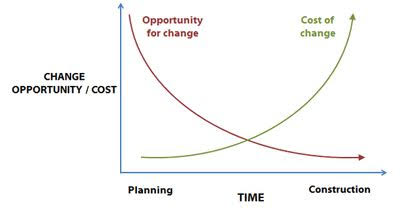
    However, leaving those tasks until later can cost even more. Any change costs something, but changes that happen mid-stream and threaten to distract the focus from ministry outcomes will cost far more. Consider a rough time-cost graph that shows this relationship:

    Discovery doesn’t just keep the focus on outcomes: it also happens earlier in the process. This outcome-based focus does not end with Discovery; rather, it is part of the User Experience (UX) investment throughout the project. Indeed, industry studies have shown that “every dollar [invested in] UX brings in between $2 and $100 dollars in return”!

    Starting earlier—actively planning at the outset—means that investment has more time to pay dividends. Those dividends include building the right product, serving your users well, and helping your ministry pursue its vision. It will pay further dividends, beyond the planning stage and into execution, as you use UX to continually maintain focus on your organization’s desired outcomes.

    —————

    Agathon has helped ministries maximize their budget through Discovery for over two decades. If you’re interested in learning more about how Discovery works or how to make some of these recommendations work for your ministry, feel free to drop me a line below, and let’s chat about it!

  • Integrating Mobile Giving into Your Donor Strategy

    Integrating Mobile Giving into Your Donor Strategy

    Mobile engagement has exploded in the last ten years and shows no sign of slowing. With the move to mobile, the internet has become ubiquitous. And with ever-present internet comes increased opportunities to reach your audience and help them move from curious passerby to committed donor. Mobile giving more than tripled (9% -> 28%) as a percentage of all online giving between 2014 and 2020! Ministry fundraising needs to keep up or risk being left behind.

    Inspirations to give take any number of forms. Your audience may have loved what they heard in your ministry’s radio spot. Maybe your ministry’s presentation at a church or convention moved them. Maybe they were chatting with a friend, and your organization came up in conversation. Whatever the prompting, a mobile donation solution can lead your audience to pick up their phone and become a donor when the mood strikes without the friction of traditional models of giving.

    Implementing a mobile donation solution is not as straightforward as it seems. Much of the tech and attitudes around mobile giving continue to lag behind overall mobile adoption. We’ll look at a few options for serving your ministry’s existing donors and making new ones.

    Illustration of a person with a thought bubble, "thinking" about getting to their laptop to donate

    A simple option: your website

    Practically every mobile device has a web browser built into it. So why not point users to your current website to make donations from their tablet or phone? This might present the simplest option, but it’s not necessarily the best one. What will those users actually see on their mobile device when they load your existing website?

    Ten years ago, many websites weren’t designed with mobile in mind. Visiting a website on a mobile device often meant reading tiny text, pinching to zoom, and hunting to find anything. Design trends started shifting from “desktop, and also mobile” to “desktop and mobile equally” with responsive design. As mobile traffic continues to pull away from desktop, attitudes in the design community have evolved further. Today, many websites are designed as “mobile first” and many websites displaying on larger screens look like big versions of the mobile site design!

    These design trends increase the likelihood you can point mobile users to your site to allow them to donate. However, at the risk of stating the obvious, your website has to have been designed and built with mobile design in mind. Otherwise, you’re sending your users back ten years to squint and hunt for your “Donate Now” button.

    Illustation of a person with arrows pointing toward two mobile phones with the text-to-give and text-to-donate workflows on them

    Old school: SMS

    Even before mobile phones could access the internet, there was SMS. Decades later, it’s easy to overlook SMS in favor of websites or mobile apps. But SMS can provide a familiar avenue to help funnel users into your donation process. Using SMS to turn users into donors presents both opportunities and challenges.

    SMS alone is insecure

    SMS is a point-to-point communication tool. Even so, there is no security built into the communication, and text messages should never be used to transmit financial information. As such, SMS alone is insufficient to process donations. You still need to invest in other donation solutions and use SMS as a way to reach your donors.

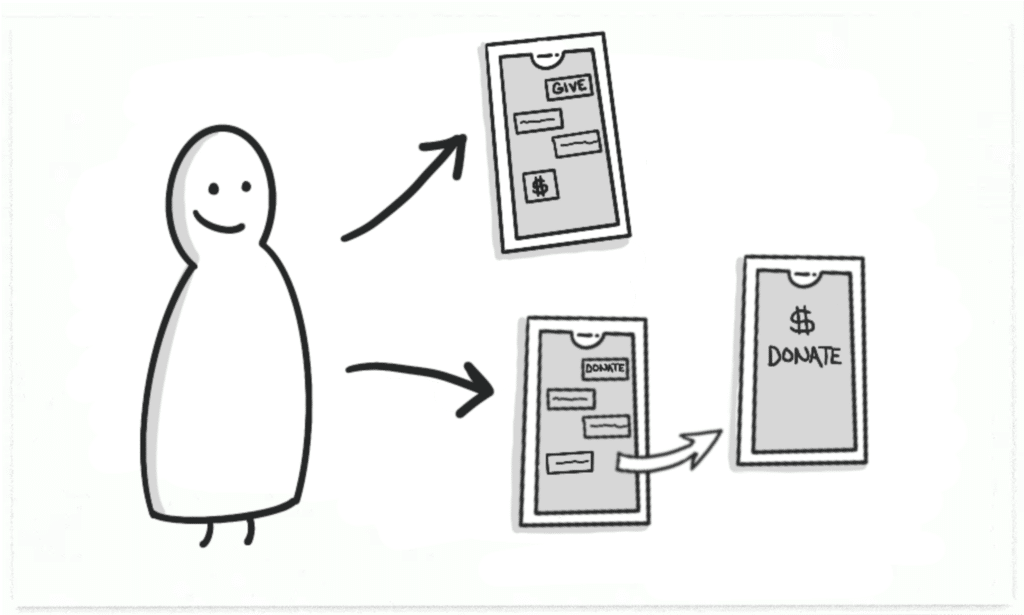
    The two primary ways to use SMS are “text-to-give” and “text-to-donate”. The approach you choose depends on the size of your ministry and whether you wish to focus on the donation or the donor.

    “Text-to-give” is simple, but also complicated

    If you’ve ever seen or heard a large mobile giving campaign, especially around a natural disaster, you probably already know roughly how “text-to-give” (T2G) works. Those campaigns usually sound something like, “Text ‘GIVE’ to 12345 to donate now!” It prompts you for an amount, and your phone bill reflects that donation. You pay your phone bill, and the phone company sends the donation part of your bill to the non-profit. This is how massive organizations cast an extremely wide net to prompt giving toward a cause. It’s easy, it’s memorable, and it’s effective.

    Unfortunately, T2G is not ideal for most ministries. The key benefit of T2G—its simplicity—means the donor uses their mobile provider to give money to the ministry. This practice introduces a mediator between you and your (potential) donor. This buffer makes it very difficult, if not impossible, for continued donor engagement with those who give via T2G.

    There are other challenges with the T2G approach. Those convenient 5- or 6-digit numbers (aka “shortcodes,” like “12345” above) are wildly expensive and require significant lead time to set up. In the past, organizations were able to rent these shortcodes through other businesses for a fraction of the cost. However, those shortcode “landlords” seem to have all but disappeared. This leaves ministries with the choice of paying significantly for a shortcode or pursuing a different approach.

    “Text-to-donate” is an investment that pays off

    The “text-to-donate” (T2D) approach starts off similarly to the T2G approach. With T2D, your users send an SMS keyword (e.g., “DONATE”) to a phone number, usually a local or toll-free 10-digit number.

    After that initial message, T2D begins to diverge from T2G. The T2D response includes a URL the user can click to open in a mobile browser to complete their donation.

    The donor then fills out the donation page on your site, including their credit card information and any account details with your organization. They submit their donation, and you receive it in near-real time. You can send a followup email or SMS thanking them for their donation, inviting them to further interactions, and so on.

    While T2D is slightly more complicated for your donors at first, it’s still preferable for almost all ministries. It costs far less to set up and maintain than T2G. Text-to-donate usually uses a donation page that (almost certainly) already exists on your website. It fosters direct engagement with your donors and ensures you have all of their information. This allows you to not only thank them directly for their gift but to contact them in the future. Direct contact will help encourage them to go from user to donor; ongoing contact will drive them from donor to advocate, bringing new donors of their own.

    “Text-to-donate” gives your donors more options for repeated gifts

    T2D also gives your donors a smoother path to repeat mobile giving via SMS. Where the initial contribution cannot happen entirely over SMS, follow-up donations can. If your donors’ phone numbers and credit cards are saved with their accounts, you can build a system that allows them to repeat a donation with a couple of SMS messages. For example, they might text “GIVEAGAIN” to your 10-digit phone number. Your system can respond asking them to send an SMS to confirm. Once confirmed, it charges their credit card the same amount as their last gift.

    This requires a little more engineering than even the initial T2D interaction where the system receives a keyword and simply returns a URL. Indeed, in some ways this might sound unbelievable or unattainable! But it’s well within the realm of possibility and only requires some investment. The payoff is giving your existing donors one more smooth process to donate on a mobile device when they are inspired.

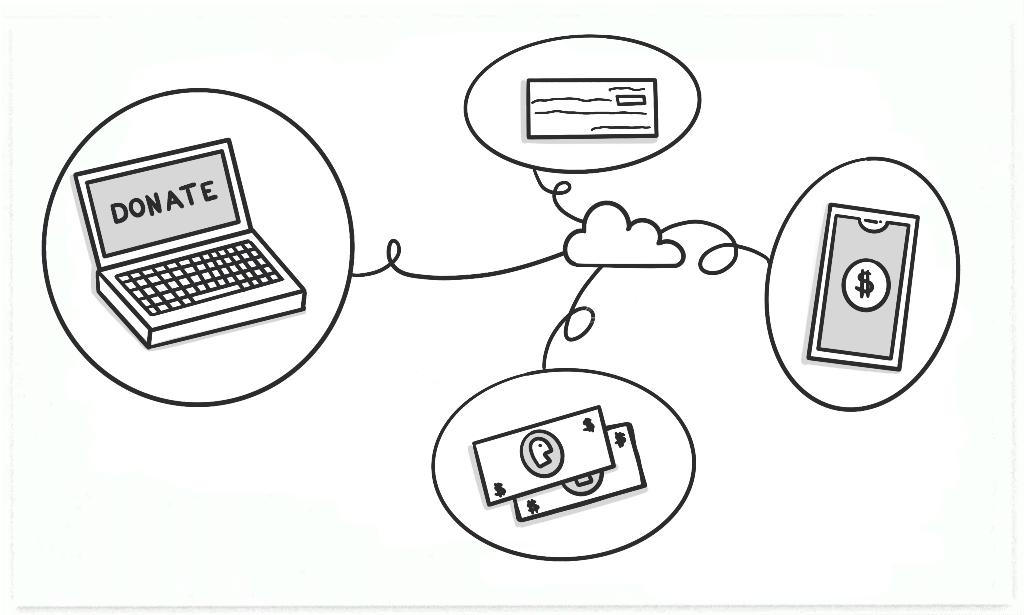
    Illustration of a cloud app that enables mobile, web, cash and check giving in one place

    Shoulders of giants: donation platforms

    As with most operational aspects of your ministry, you have the option to outsource mobile donations. There is a growing number of third-party tools that can help process donations and give your users mobile options for donating. The question comes down to what’s most important to you and whether there’s a good match in a provider.

    Options can be valuable, but overwhelming

    With providers like Tithe.ly or Donorbox, the feature list can seem nearly endless. If you’re looking for a comprehensive system that solves all sorts of problems, you might consider an all-in-one solution like these. But if you’re only looking for a mobile donation piece to drop into your existing setup, these could be a bad match. And they might also require that you use their other tools in order to use their mobile giving tool.

    The best way to navigate an overwhelming list of options is to contact the product’s sales team. They’ve often streamlined the evaluation process for ministries like yours to ensure they can provide only what you need. As an added benefit, you get a chance to work with their sales and solution engineering teams to get a good feel for their company.

    A focus on integration

    The best third-party service providers will have focused on how easily you can integrate their tools into your existing toolkit. They will also have a solution engineering team that can solve almost any new integration problem. They know their mobile donation feature is only a good solution for you if it will integrate into your workflow. Their experience with integrating their tool into many different environments gives them insight into how to best do that for you.

    General solutions can be weak solutions

    When someone else is providing the solution you’re using, they may not have the same goals or requirements as you. A general tool meant to serve tens of thousands of users might not provide exactly the functionality you need. When you’re looking at donation platforms, you might end up running into some of these weaknesses.

    Maybe accepting eCheck donations is important to your ministry, but a platform’s mobile donation solution doesn’t support them. Maybe the mobile app they supply isn’t customizable and gives your users a generic experience. If the app is unreliable for you but functional for other customers, the vendor may not be invested in fixing the problem. When it’s someone else’s tool you’re using, you’re at their mercy to develop and maintain it.

    Donation platforms often offer other features beyond mobile donations: a website, event management, an SMS sending platform, and more. These extra features may not be “best in class”; they can leave you frustrated, yet more “locked in” with a vendor’s bundle of tools. You should evaluate the mobile offering outside of any other features to get an accurate sense of its value to your ministry.


    The question of whether to offer your users options for donating via mobile is settled. With an ever-increasing percentage of donations coming from mobile, your ministry is missing an opportunity without a mobile donation strategy. If you’re not sure how to develop your mobile donation strategy, or if you’re not sure if yours is effective, don’t panic. It’s never too late to get started: contact Agathon below and we’d love to discuss it with you!