

Tag: Funding

  • 6 Ways to Make Online Giving Easier for Your Ministry’s Donors

    6 Ways to Make Online Giving Easier for Your Ministry’s Donors

    A woman's hands holding a pile of coins and a small handwritten note that says "make a change"

    We limit the potential of electronic giving when we regard it merely as a technical solution to technical problems.

    Lewis Center for Church Leadership

    The growth of digital giving continues to accelerate, with a 42% increase over the three year period of 2019-2021. Online giving now represents 12% of all giving. Notably, faith-based organizations see the highest percentage of digital giving, at 16.8% of their total donations. This is true both for older, existing donors who are moving their giving online. But it’s also true for a new generation of donors who do virtually everything on their devices. 

    As a ministry organization in this day and age, you must embrace digital fundraising as part of your donor development process in order to continue connecting with your supporters. But just as years of experience have developed best practices for offline donor development, it’s important to consider both the technical and user experience (UX) approaches that can impact online giving.

    Digital or online giving includes donations through a website, app, mobile device, or SMS. The considerations for each are different, of course, but many of these principles will apply across them all.

    Let’s take a look 6 considerations for growing your online giving:

    1. An easy win: accept many methods of payment

    We’re leading with the headline: If you’re only accepting donations through a single credit card form, you’re missing out.

    Today’s donors use Venmo, PayPal, Cash App, and other payment platforms. Grabbing a debit or credit card in order to input the 16 numbers on the front, the expiration date, and the 3-digit CVV code on the back could generate enough friction to keep someone from moving forward. Having additional payment options increases the likelihood that donors can use their favorite app to donate at the moment they feel called to do so.

    Incorporate a credit card updater

    A credit card updater is a program offered by credit card companies that automatically updates subscription customer card data. Adding a credit card updater to your payment processing platform can help ensure that automatic payments continue even when a donor needs a replacement card because they lost it or their info is out of date. Having an updater like this is a small step you can take to seamlessly decrease ministry donor churn.

    A woman sitting with a MacBook on her lap, holding a credit card in her hand

    2. Focus on the user experience

    User experience (UX) design is the process design teams use to create products that provide meaningful and relevant experiences to users. This involves the design of the entire process of acquiring and integrating the product, including aspects of branding, design, usability and function.

    Interaction Design Foundation

    Traditional donor development teams strategize on the best messaging for communicating with prospective and existing donors, including scripts to use and timing for those communications. Similarly, user experience designers focus on the usability and desirability of digital tools. A focus on UX helps reduce or eliminate friction or frustration for prospective donors to make it easier for them to give.

    Optimize for mobile

    The most important of these UX principles is to optimize your giving platform for mobile. Whether it’s a website or an app, chances are high that donors will interact with you on a mobile device. If your site is outdated or optimized for large screens, this process can be frustrating (if not impossible) and result in lost donations.

    Offer smart recurring and one-time donation options

    Many donors will appreciate the opportunity to set up a recurring donation, even if they won’t hunt for that option on their own. Set up your donation forms to make this selection obvious and easy. If possible, adjust the dollar amounts to reflect the recurring or one-time donation selection. You’re less likely to have a donor who wants to give $500 on a monthly basis, but someone who is moved to give a one-time donation might be excited about that option.

    Offer 1-click donations

    Make financial contributions easy for existing donors. If a donor has an existing account with you, enabling 1-click donations from an email campaign can make it easy to give during the current campaign rather than requiring them to hunt down their login information and navigate to the correct spot on your website for that donation.

    3. Create personalized experiences

    Similarly, look for ways to create personalized experiences for your donors so they don’t feel like faceless, nameless donors.

    Personalize communication

    Personalization can be as simple as including the donor’s name in the greeting of an email communication. Or it can be tailored further to highlight other details of their donation history:

    • “Thank you for your gift of $X!”
    • “You’ve been a donor for X years.”
    • “Your donation helped us XYZ.”

    This personalization helps build stronger relationships with donors. It demonstrates an organization’s appreciation. And it encourages donors to continue giving.

    Prefill information whenever possible

    As with enabling 1-click donations, prefilling information for donors is another way to personalize the experience and remove friction from the donation process. Using first-party cookies, email merge tags, or account settings, you have the opportunity to prefill forms for returning users so that submitting a form or making a donation requires minimal work on their part.

    Automate follow-ups

    Email follow-ups, or drip campaigns, are another opportunity for personalization. Tailor donor emails to each recipient’s interests and activities. This will show your organization cares for them as an individual, while also increasing their engagement.

    A woman holding a phone in her hands

    4. Be transparent and make info easy to find

    Transparency is a key part of building trust with new and ongoing donors. Make it easy for donors to find the information they need to feel good about supporting your ministry. And look for ways to address the questions and concerns they may have.

    Demonstrate the impact of donations

    Share case studies, photos, and statistics that demonstrate the impact donations have on the work your organization is doing. It’s one thing to talk about the work you’d like to do. But highlighting the work you’ve already done—and tying that to donor giving—is just as important.

    Highlight the benefit of recurring gifts often & explicitly

    Prospective donors may not realize that becoming a recurring donor at a lower amount provides more value than making a larger one-time donation. Look for ways to highlight the impact of recurring gifts and use explicit callouts to encourage these recurring donations. This could be through banners, through the options available on your donation form, and in various other communications.

    Share financial disclosures, charity ratings, etc.

    Finally, help prospective donors feel good about giving to your ministry. Make it easy for them to find financial disclosures, charity ratings, and endorsements from reputable organizations and individuals. Don’t make people hunt for these. Instead, put them front and center so they’re easy to find!

    5. Avoid dark patterns

    Dark Patterns are tricks used in websites and apps that make you do things that you didn’t mean to, like buying or signing up for something.

    DarkPatterns.org

    Chances are you’ve come across dark patterns in the last 24 hours if you’ve spent any time at all browsing the internet. These tricks are used on a variety of sites to encourage sign-ups and upgrades and to make unsubscribing or canceling difficult. To be clear, we’re not saying conversion rate optimization (CRO)—or the practice of testing and iterating to see which wording or layout better appeals to users—is bad. Not at all! We’re specifically talking about those dark patterns that are designed to trick people into doing something they wouldn’t otherwise do.

    Where it gets tricky is that some dark patterns have become common enough that we may not realize CRO has crossed into this dark pattern territory. This includes things like making the signup button big and bold while the cancel button is small and hard to find.

    As a Christian organization, it’s especially important to avoid this type of trickery. Dark patterns can leave donors feeling disillusioned or conned, which hurts not only your organization’s reputation—but also Christ’s.

    Avoid dark patterns around recurring donations

    We talked earlier about making monthly or recurring giving easily accessible for donors. In doing that, it’s important to be sure you avoid dark patterns.

    For example, if you’re defaulting to a monthly giving option on your form, you will likely find that some donors proceed with that option unintentionally. Your goal, then, is to look for ways to make the monthly default obvious so that you’re still encouraging those recurring donations without tricking people into proceeding. Here are a few ways to do that:

    • Include “per month” or “/monthly” following each dollar amount
    • Use “Donate Monthly” as your button text
    • Have an obvious toggle button between monthly or one-time donations
    • Take the opposite approach and make one-time giving the default while requiring a positive movement to monthly giving

    In addition to avoiding dark patterns on your donation form, you should make it easy for donors to pause or cancel their recurring gifts from their account. And always send emails before each donation is processed. The goal each step of the way is to encourage donors to give while building trust with them.

    A woman sketching wireframes of a mobile website or app

    6. Continue to test and iterate

    When it comes to technology and the user experience, there’s no set-it-and-forget-it approach. Technology changes, user expectations change, and your approach to digital donor development will need to change alongside them.

    User research is an invaluable tool for this process. Talk to your users and observe their behavior. Then, create a hypothesis and test it. Take what you’ve learned from that test to create your next hypothesis. And so on.

    Begin collecting data now for future initiatives

    Along the way, you should also keep your eye out for data you can collect for future initiatives. For example, you can include an option for donors to opt in to SMS updates even if you don’t yet have an SMS program. This not only helps you gauge the interest of your donors in this type of program but also helps you begin building a database for when you’re ready to launch.

    If you don’t get much of a response, that may guide your decision to continue delaying an SMS program. But if you notice that donors are excited about the idea, you’ll not only have data to demonstrate that excitement but also have the literal data needed to launch it well.


    It’s cliche, but the future really is now. Donors expect robust digital giving and donor management options. These are broad strategic conversations you should be having with your team, of course. But there are also easy, immediate changes you can make. Both will help facilitate online giving now and for the future. 

    Want to talk through these ideas and their implications for your organization in more detail? Conversations at Agathon are always free, and we’d love to chat!

  • 4 Tips to Authentically Merge Mission and Business to Sustain Your Ministry

    Selling products or services is a meaningful way to fund and fuel your ministry’s mission without relying solely on donations. This could take the form of a faith-based organization with a publishing arm that sells books. Or maybe a missionary team that accepts paid public speaking engagements to subsidize its outreach work. 

    It’s relatively common for ministries to engage in sustaining activities such as these—even if they aren’t directly tied to their missions. And yet you might be apprehensive about selling to your own constituents.  

    Fear not: The apostle Paul relied on the trade of tentmaking to support his second missionary journey. So too can you balance your own ministry’s “tentmaking” (or business) and its higher missional calling. 

    Why There’s Reluctance to Add Sales to Service

    There are a few reasons non-profit sales might feel untoward or even sound like an oxymoron to you. 

    For one, you’ve likely experienced ministries selling goods and services with little taste or tact. They take advantage of their loyal following, misusing email lists to aggressively sell what the industry has deemed “Jesus junk” (products with no real value to the purchaser). You certainly don’t want to be seen this way—as a business with a side of ministry instead of the other way around. 

    What’s more, ministry leaders like you are often (admirably) idealistic. You’d prefer to deal exclusively with the holy work of your mission and keep your hands clean of making money. You might even find it unsavory to ask for donations, which are, in a sense, one rung above sales on the secular to sacred ladder. 

    All to say, you’re in good company if you worry business will detract from the important work you do. And maybe even drive members away. 

    How Business Can Complement Your Mission 

    Any misgivings about folding sales into the mix at your ministry are completely understandable. But you might miss out on key benefits of conducting business, such as: 

    • Financial stability to sustain your ministry
    • A wider net to reach new constituents thanks to products or services that appeal to prospects with a specific need as opposed to donors
    • Increasingly satisfied existing members who find real value in your products or services and connect more deeply with your mission 

    Benefits aside, it’s important to look at the idea of business and sales with clear eyes. Because business is at worst neutral. In fact, it’s only bad when it’s exploited. Conducting business in a way that honors God is therefore entirely possible. You just need the right strategy. 

    Here are four tips to successfully incorporate sales into your ministry:

    1. Plan Your Website Navigation to Tastefully Feature Your Sales Offering  

    There’s a fine line between burying the navigation link to your ministry’s store and elevating it above content- and mission-related links. Burying the link makes it look like you’re surreptitiously sneaking it in because you have something to hide. But promoting your store front-and-center on your site makes it seem like you care more about sales than service. 

    So where should you put the link to your store? The recommended positioning is within the top-level navigation on the far right hand side of the homepage. That way, it’s out of a visitor’s initial view when they’re scanning your site from the top down. But it’s in their peripheral as well as where they’d naturally scan if they were looking for a “My Account” button. 

    You should also make sure the link is an organic part of your menu. Design it so it’s the same colors and font weight of the rest of the buttons in the top-level navigation. This will help it blend into the natural look-and-feel of your site without being either elevated above or buried under your ministry content.

    2. Produce Content-Driven Thought Leadership, Not Product-Driven Sales Pitches   

    As discussed, one of the concerns about selling something when you’re running a faith-based organization is it’ll come across like you’re hawking products instead of driving an important mission forward. 

    To avoid giving members the wrong impression, you must create articles that are content-driven—not product- or service-driven. 

    How? It starts with your mindset. Never ask yourself, “What do I want readers to buy?” when you’re brainstorming topic ideas. Instead, have it in your head that you’re going to craft content that serves your readers and comes from a place of passion. Content that solves your reader’s problems or answers their questions. When that’s your goal, mission-serving content flows more easily. 

    Besides, if your products or services were developed with your mission in mind, they’ll dovetail from your content naturally. You won’t have to force a link just to add a sales opportunity to an article. 

    3. Employ Deep Linking to Share Relevant Resources with Readers

    It’s absolutely okay to promote your products or services at the end of your content when you’ve done the work to create content-driven, authentic pieces. In fact, you’ll be helping readers further educate themselves on a topic they’ve proven they care about by reaching the end of your article in the first place. 

    Just be sure the links or CTAs are both relevant and deep. A relevant link is evidence you’ve thought through the topic thoroughly. It also shows the intentionality of your strategy—your content matches your products or services. 

    Deep linking is the practice of linking to a specific, topical resource—not just the homepage of your virtual storefront. It’s important because it saves the reader the work of figuring out the next step on their journey through your site. This reinforces the idea that the reader is in a partnership with you. You’re not just hawking products: you’re out to educate and aid your constituents. 

    Let’s look at an example. Imagine you wrote an article about domestic violence awareness. At the bottom of the article (after offering ample “free” information to the reader) you add a CTA to purchase the book you wrote on the same subject. This is a relevant and deep link. It’s relevant because, again, the book features the same subject matter as the article. And it’s deep because it links directly to a landing page to purchase the topically appropriate book instead of a sales page with all of your book options your reader has to filter through. 

    4. Avoid Pushing Sales Content on Trusting Ministry Members 

    Your most devoted ministry members have given you their trust along with their email addresses. The worst thing you can do is abuse this trust by pedaling content only meant to sell your products or services. That’s a good way to lose your following. 

    That said, it’s occasionally acceptable to email your subscribers with a sales offer. For instance, an email rounding up your most popular gift items makes sense right around Christmas. Your readers will be looking for gift inspiration, so it’s helpful and timely. But use sales emails extremely sparingly. 

    Effective software can assist you in sending sales content to the right people. Be sure your tech allows you to segment your contact lists so only the most engaged people (those who have previously purchased something or interacted with lots of webpages) receive your business-focused messages. 

    Let Sales Support Your Ministry So You Can Meet Your Mission  

    When it comes to selling something to support your ministry, be an “Etsy” over an “Amazon.” Etsy sells highly targeted, hand-crafted, high-quality goods created by passionate individual artisans. And Amazon, well, need we say more? 

    You too can create highly targeted offerings that meet your users’ needs because they seamlessly stem from your ministry’s mission. These valuable products or services will enhance your customers’ understanding of your ministry and the mission you hold dear. They’ll also allow you to keep the proverbial lights on—spreading your message for years to come.

  • Integrating Mobile Giving into Your Donor Strategy

    Integrating Mobile Giving into Your Donor Strategy

    Mobile engagement has exploded in the last ten years and shows no sign of slowing. With the move to mobile, the internet has become ubiquitous. And with ever-present internet comes increased opportunities to reach your audience and help them move from curious passerby to committed donor. Mobile giving more than tripled (9% -> 28%) as a percentage of all online giving between 2014 and 2020! Ministry fundraising needs to keep up or risk being left behind.

    Inspirations to give take any number of forms. Your audience may have loved what they heard in your ministry’s radio spot. Maybe your ministry’s presentation at a church or convention moved them. Maybe they were chatting with a friend, and your organization came up in conversation. Whatever the prompting, a mobile donation solution can lead your audience to pick up their phone and become a donor when the mood strikes without the friction of traditional models of giving.

    Implementing a mobile donation solution is not as straightforward as it seems. Much of the tech and attitudes around mobile giving continue to lag behind overall mobile adoption. We’ll look at a few options for serving your ministry’s existing donors and making new ones.

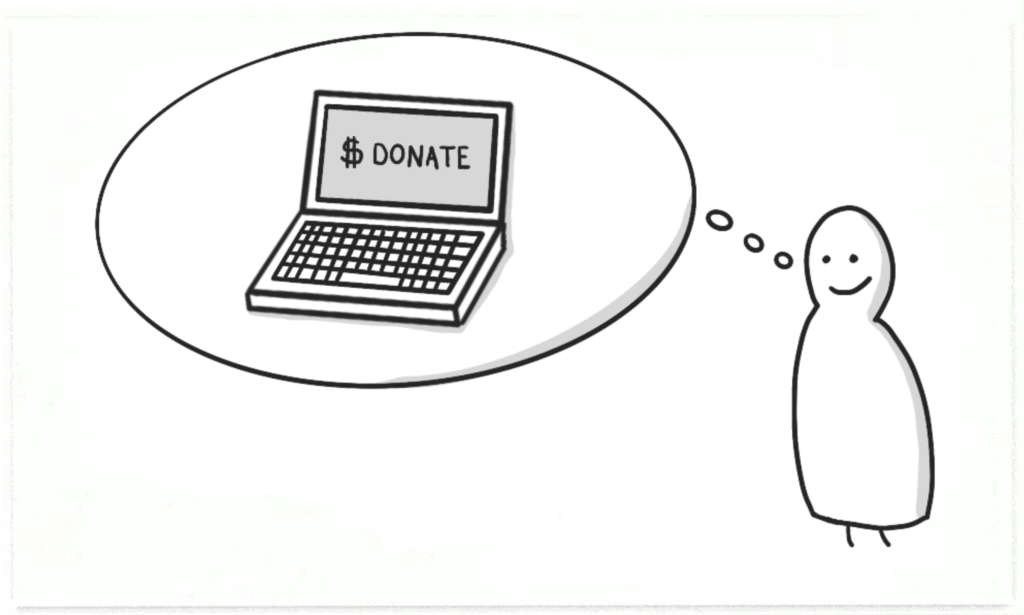
    Illustration of a person with a thought bubble, "thinking" about getting to their laptop to donate

    A simple option: your website

    Practically every mobile device has a web browser built into it. So why not point users to your current website to make donations from their tablet or phone? This might present the simplest option, but it’s not necessarily the best one. What will those users actually see on their mobile device when they load your existing website?

    Ten years ago, many websites weren’t designed with mobile in mind. Visiting a website on a mobile device often meant reading tiny text, pinching to zoom, and hunting to find anything. Design trends started shifting from “desktop, and also mobile” to “desktop and mobile equally” with responsive design. As mobile traffic continues to pull away from desktop, attitudes in the design community have evolved further. Today, many websites are designed as “mobile first” and many websites displaying on larger screens look like big versions of the mobile site design!

    These design trends increase the likelihood you can point mobile users to your site to allow them to donate. However, at the risk of stating the obvious, your website has to have been designed and built with mobile design in mind. Otherwise, you’re sending your users back ten years to squint and hunt for your “Donate Now” button.

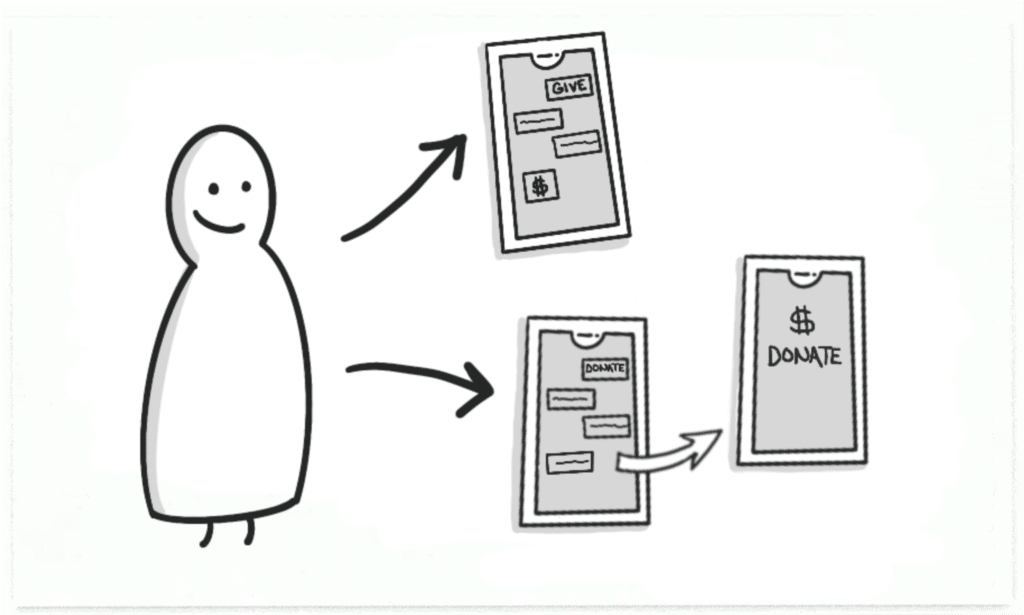
    Illustation of a person with arrows pointing toward two mobile phones with the text-to-give and text-to-donate workflows on them

    Old school: SMS

    Even before mobile phones could access the internet, there was SMS. Decades later, it’s easy to overlook SMS in favor of websites or mobile apps. But SMS can provide a familiar avenue to help funnel users into your donation process. Using SMS to turn users into donors presents both opportunities and challenges.

    SMS alone is insecure

    SMS is a point-to-point communication tool. Even so, there is no security built into the communication, and text messages should never be used to transmit financial information. As such, SMS alone is insufficient to process donations. You still need to invest in other donation solutions and use SMS as a way to reach your donors.

    The two primary ways to use SMS are “text-to-give” and “text-to-donate”. The approach you choose depends on the size of your ministry and whether you wish to focus on the donation or the donor.

    “Text-to-give” is simple, but also complicated

    If you’ve ever seen or heard a large mobile giving campaign, especially around a natural disaster, you probably already know roughly how “text-to-give” (T2G) works. Those campaigns usually sound something like, “Text ‘GIVE’ to 12345 to donate now!” It prompts you for an amount, and your phone bill reflects that donation. You pay your phone bill, and the phone company sends the donation part of your bill to the non-profit. This is how massive organizations cast an extremely wide net to prompt giving toward a cause. It’s easy, it’s memorable, and it’s effective.

    Unfortunately, T2G is not ideal for most ministries. The key benefit of T2G—its simplicity—means the donor uses their mobile provider to give money to the ministry. This practice introduces a mediator between you and your (potential) donor. This buffer makes it very difficult, if not impossible, for continued donor engagement with those who give via T2G.

    There are other challenges with the T2G approach. Those convenient 5- or 6-digit numbers (aka “shortcodes,” like “12345” above) are wildly expensive and require significant lead time to set up. In the past, organizations were able to rent these shortcodes through other businesses for a fraction of the cost. However, those shortcode “landlords” seem to have all but disappeared. This leaves ministries with the choice of paying significantly for a shortcode or pursuing a different approach.

    “Text-to-donate” is an investment that pays off

    The “text-to-donate” (T2D) approach starts off similarly to the T2G approach. With T2D, your users send an SMS keyword (e.g., “DONATE”) to a phone number, usually a local or toll-free 10-digit number.

    After that initial message, T2D begins to diverge from T2G. The T2D response includes a URL the user can click to open in a mobile browser to complete their donation.

    The donor then fills out the donation page on your site, including their credit card information and any account details with your organization. They submit their donation, and you receive it in near-real time. You can send a followup email or SMS thanking them for their donation, inviting them to further interactions, and so on.

    While T2D is slightly more complicated for your donors at first, it’s still preferable for almost all ministries. It costs far less to set up and maintain than T2G. Text-to-donate usually uses a donation page that (almost certainly) already exists on your website. It fosters direct engagement with your donors and ensures you have all of their information. This allows you to not only thank them directly for their gift but to contact them in the future. Direct contact will help encourage them to go from user to donor; ongoing contact will drive them from donor to advocate, bringing new donors of their own.

    “Text-to-donate” gives your donors more options for repeated gifts

    T2D also gives your donors a smoother path to repeat mobile giving via SMS. Where the initial contribution cannot happen entirely over SMS, follow-up donations can. If your donors’ phone numbers and credit cards are saved with their accounts, you can build a system that allows them to repeat a donation with a couple of SMS messages. For example, they might text “GIVEAGAIN” to your 10-digit phone number. Your system can respond asking them to send an SMS to confirm. Once confirmed, it charges their credit card the same amount as their last gift.

    This requires a little more engineering than even the initial T2D interaction where the system receives a keyword and simply returns a URL. Indeed, in some ways this might sound unbelievable or unattainable! But it’s well within the realm of possibility and only requires some investment. The payoff is giving your existing donors one more smooth process to donate on a mobile device when they are inspired.

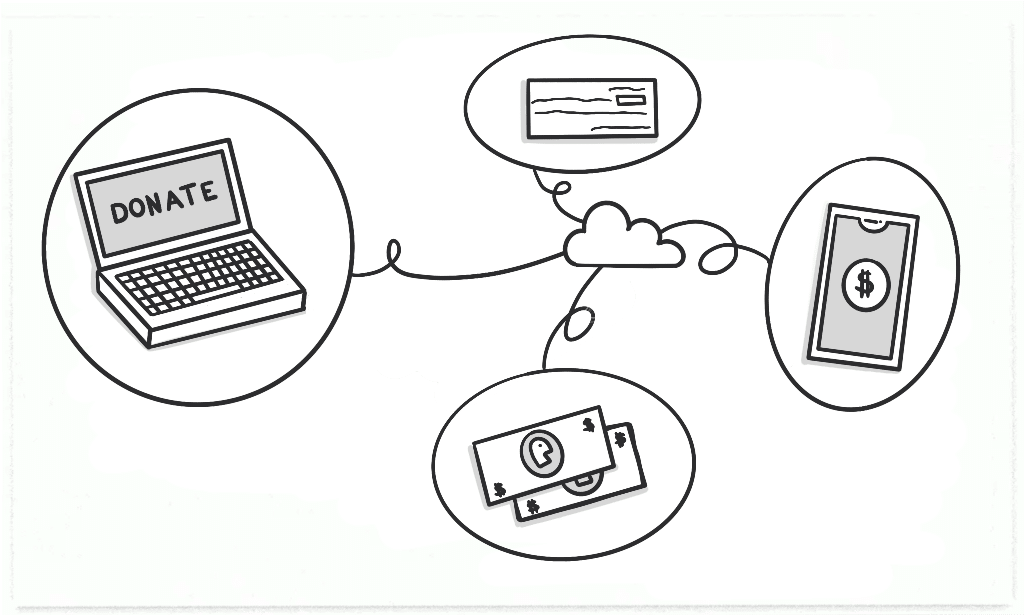
    Illustration of a cloud app that enables mobile, web, cash and check giving in one place

    Shoulders of giants: donation platforms

    As with most operational aspects of your ministry, you have the option to outsource mobile donations. There is a growing number of third-party tools that can help process donations and give your users mobile options for donating. The question comes down to what’s most important to you and whether there’s a good match in a provider.

    Options can be valuable, but overwhelming

    With providers like Tithe.ly or Donorbox, the feature list can seem nearly endless. If you’re looking for a comprehensive system that solves all sorts of problems, you might consider an all-in-one solution like these. But if you’re only looking for a mobile donation piece to drop into your existing setup, these could be a bad match. And they might also require that you use their other tools in order to use their mobile giving tool.

    The best way to navigate an overwhelming list of options is to contact the product’s sales team. They’ve often streamlined the evaluation process for ministries like yours to ensure they can provide only what you need. As an added benefit, you get a chance to work with their sales and solution engineering teams to get a good feel for their company.

    A focus on integration

    The best third-party service providers will have focused on how easily you can integrate their tools into your existing toolkit. They will also have a solution engineering team that can solve almost any new integration problem. They know their mobile donation feature is only a good solution for you if it will integrate into your workflow. Their experience with integrating their tool into many different environments gives them insight into how to best do that for you.

    General solutions can be weak solutions

    When someone else is providing the solution you’re using, they may not have the same goals or requirements as you. A general tool meant to serve tens of thousands of users might not provide exactly the functionality you need. When you’re looking at donation platforms, you might end up running into some of these weaknesses.

    Maybe accepting eCheck donations is important to your ministry, but a platform’s mobile donation solution doesn’t support them. Maybe the mobile app they supply isn’t customizable and gives your users a generic experience. If the app is unreliable for you but functional for other customers, the vendor may not be invested in fixing the problem. When it’s someone else’s tool you’re using, you’re at their mercy to develop and maintain it.

    Donation platforms often offer other features beyond mobile donations: a website, event management, an SMS sending platform, and more. These extra features may not be “best in class”; they can leave you frustrated, yet more “locked in” with a vendor’s bundle of tools. You should evaluate the mobile offering outside of any other features to get an accurate sense of its value to your ministry.


    The question of whether to offer your users options for donating via mobile is settled. With an ever-increasing percentage of donations coming from mobile, your ministry is missing an opportunity without a mobile donation strategy. If you’re not sure how to develop your mobile donation strategy, or if you’re not sure if yours is effective, don’t panic. It’s never too late to get started: contact Agathon below and we’d love to discuss it with you!

  • How to Pitch a Comprehensive Strategy to a Reluctant Board

    How to Pitch a Comprehensive Strategy to a Reluctant Board

    Most projects don’t require board level or top leadership approval. When they do, it’s because they’re ambitious and require strategic decisions and/or exceptional funding. And because the stakes are high, boards can be cautious or downright reluctant to proceed. Let’s talk about how to get past this reluctance to approval because chances are you’ve been approaching it wrong.

    It’s not actually a pitch.

    Although it may feel like it, your job isn’t to convince or pitch the board (or leadership team, or steering committee, etc.) on the merits of your project. This isn’t some presentation out of Mad Men with a slick dog and pony show to make those in the room swoon. Your job is to provide the board with the information they need in order to give support and fund your project. You already share the same mission and are talking together about how to achieve it. This realization changes how we prepare and what we say. Polish and pretty slides are less important than preparation and honest dialogue. Help board members truly understand so they can give their complete backing.

    I used to referee youth soccer and during our training we were advised how to talk with a problem coach or parent. Instead of walking right up to them, we were encouraged to come stand beside them, facing forward and leaning in slightly. This communicated to the coach or parent that we weren’t adversaries, but rather partners playing for the same team. When you’re working with your board, you’re all partners playing for the same team as well. I just love this posture of standing shoulder to shoulder looking the same direction, even metaphorically. It communicates we’re working together.

    Step into their shoes.

    Non-profit boards tend to be comprised of members who’ve been successful in their careers or ministry over a long period of time. They didn’t grow up as digital natives, but they have been living with glass interfaces for decades, and although they don’t “make tech things”, they certainly understand why it matters for their future. They see the changing world around them and recognize how vital it is to adapt. The board knows they need to lean on experts to help them understand the importance and consequences of the decisions they’re being asked to make. That’s why you’re here! They’re relying on you to clearly explain and guide them to take responsible—sometimes bold—investments into their future.

    So how do you guide instead of pitch?

    Explain the impact.

    Keep your eye on what's ultimately important.

    Everyone in the room shares this in common: we want to see ministry multiplied. The differences surface when we talk about how to accomplish ministry because saying yes to one project means saying no to others. Budgets are a zero sum game after all; investing in one area means less to go around for others. Why will this project make a bigger impact than all other options? Exactly how will it move the needle? Spell it out for them, and explain how it fits into their bigger comprehensive strategy.

    Boards need to see the big picture of how it unfolds in specific, concrete ways, so they become excited and support the work.

    Talk about money.

    Speaking of budgets, you may be familiar with the story from the New Testament of the Parable of the Talents. In that account, Jesus speaks of the importance of investing the resources entrusted to us. It’s not just a case of choosing this project over another, but also leveraging those resources wisely. As a matter of stewardship, we need to ensure that we are making the best possible use of every dollar.

    Boards feel this tension more keenly and need to trust that you’re operating from the same sense of stewardship. Boards want to know what you’re delivering, by when, and for how much. Without getting too deep into the details, you have to be able to give estimates and explain the variables that could impact those. In most cases the specific features are flexible but the budget is capped. In others though, the details of the features are paramount and the budget can flex if needed. You need to know at the outset which situation is a likely fit and speak to that.

    Talk about failure.

    One of the most instructive exercises when guiding towards a decision is to be transparent about the various ways this project could fall short or outright fail. Again, this isn’t a one-sided pitch where the only goal is to get a “yes.” Discussing failure helps us plan to avoid it and then get to a clear-eyed decision, well aware that all projects carry risk.

    Some examples of possible failures include misunderstanding user needs and wants, focusing on the wrong features, or trying to do too much at once and then going over budget. Doing nothing is also a risk and could lead to failure of a different kind.

    Come prepared, for your users’ sake.

    It’s a safe bet that neither you nor the board is identical to the target audience, whether that’s in terms of demographics, interests, or felt needs. The only way to be confident your project will resonate with those you serve is to talk to them through interviews, surveys, direct observation, or third-party research. This is true even for organizations that are fairly dialed into their users’ behavior. We always find new insights and even surprises when we connect with those we serve, and there really are no reliable shortcuts. Yes, it’s hard work, but you should do it anyway.

    In some cases, the budget for this kind of user research itself requires board approval. If that’s true, then explain how research is important to the plan, and how it might lead to a realignment of goals based on what you find.

    If you’ve been able to do some research in advance, it might be information overload to present it now and that’s okay. It’s still wise to be able to cite it when a board asks why the organization should consider a mobile app when a website might be a better option, or why it’s time to leverage a third-party platform.

    Dream big and work together.

    You wouldn’t be talking to the board if you weren’t pursuing ambitious projects. Do the work to prepare, come alongside the board as partners, and give them all of the information and tools to make the best decision for your ministry.