

Tag: Strategy and Planning

  • How Product Pricing Works (and Why It Shouldn’t Scare You)

    How Product Pricing Works (and Why It Shouldn’t Scare You)

    If your ministry is considering a new initiative or product, one of the first questions you’ll ask any potential development partner is, “How much is this going to cost?”

    The answer is: It depends. 

    Think about product pricing the way you might budget for a vacation. If you only ask how much a vacation costs, you won’t get a valid answer because the answers are endless. You have to ask clarifying questions.

    Where are you going? Overseas or within your own country or state? Traveling by plane, car, boat, or train? What kind of accommodations are you looking for? A luxury resort, roadside motel, or a campground? 

    Pricing in the product development industry demands a similar level of inquiry to arrive at a more accurate cost estimate. Do you need a mobile app or a responsive website that works on a phone? Do you want to make it easier for existing donors to contribute or tap a new source of contributions? Do you want to spread the gospel or give your members a new platform to communicate?

    We know you have budget constraints, boards to answer to, and constituents to serve. 

    Agathon’s approach to pricing is to be as transparent as possible to help you overcome any fear, anxiety, or doubt you might have about the cost of a new development project. 

    Let’s examine the considerations that go into determining the cost of a product development project and help dispel some of the confusion and fear that can go along with it. 

    Accurate Product Pricing Requires a Deeper Discussion 

    Conversations around pricing come up in almost every introductory call with clients. “We won’t hold you to this, but how about a ballpark price?” they often ask. 

    Even if we could offer a ballpark price, that’s still just throwing darts at a board. Other companies in the product development sector will often provide an estimate, but that amount frequently balloons, breeding distrust between developers and their clients. 

    If we can continue the conversation in a constructive way, we can arrive at a price that genuinely reflects the goal of the project and the scope involved: What are we building, by when, and for whom? Do we know what we don’t know? We work to figure it out together before hitting on a cost. 

    How Product Pricing is Different From Other Industries 

    To understand the pricing process, you have to appreciate how product development differs from other services and industries.

    We had a leaky toilet seal recently, so we called a plumber. He gave us a quote on the spot, did the work, and charged us the price he gave us. How did he know what it would cost for that repair? Because he’s done the exact same thing a thousand times and knows precisely the cost of parts and labor.

    Our work is never as straightforward, repeatable, or predictable. Every build is different, with its own set of challenges and complexities. There are no off-the-shelf, plug-and-play solutions with standard prices to match.

    Pricing a web or mobile app isn’t like ordering from a set menu. If this were a cookie-cutter business, then perhaps. But that’s not what you’re looking for. Instead, you need something that moves the needle, and that requires doing things that are not the same as what everyone else has done.

    We’re building custom solutions designed to address specific problems for a targeted audience. That level of complexity demands a more rigorous approach to pricing. Before we can put a price tag on anything, we need to know what we’re building. And that requires Discovery, which we’ll discuss more deeply in the next section.

    Discovery Process Helps Set Price and Determine Direction 

    Because product development is not one size fits all, we have to use a process to reach a price. We call that process Discovery. The terminology may change from company to company, but Discovery is essentially a discussion that helps determine what is being built for whom and by when. 
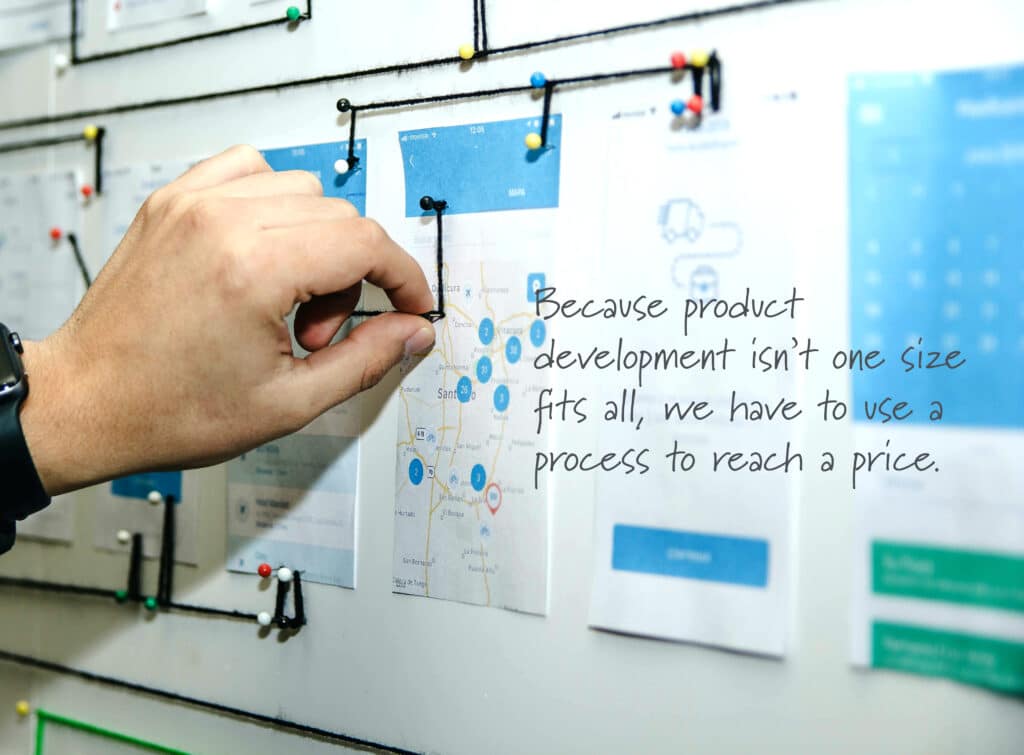
    Quote: Because product development isn't one size fits all, we have to use a process to reach a price.

    That process starts by getting the right people in the room. We gather those who are invested in the outcome, those who have ideas and insights to contribute. And we figure it out together. 

    Discovery also helps uncover what a client truly needs. Frequently a client will come to us with something specific in mind. But in the course of Discovery, we might find that what they actually need is something quite different than what they initially thought. Sometimes that’s a smaller solution. Sometimes it’s something more involved. 

    Either way, Discovery provides us with a roadmap that helps us reach consensus on what needs to be built and allows us to offer a cost estimate.

    What Factors Influence a Final Product Pricing Estimate?

    With our Discovery process complete, we now have a more holistic understanding of what our client needs. 

    But even then we need to determine how a price for that work should be set. Product developers typically use one of two pricing models:

    1. Map out the project requirements, then put time/effort estimates on each, accounting for quality assurance testing, project management, meetings, etc.
    2. Set a budget and define the project to fit within that budgeted amount.

    In our experience, the most successful approach blends the two models above:

    • Prioritize the requirements for the product’s first release as in #1.
    • Determine how far we can get through those initial requirements within the budget constraints as in #2. 

    This approach requires a lot of communication and adjustments along the way to ensure we’re investing time on aspects of the product that matter most. It also creates greater transparency throughout the process.

    3 Essential Elements of Accurate Product Pricing

    Once we’ve settled on a pricing model, we will take a closer look at each of the factors that will go into an estimate:

    • Setting priorities. In almost all cases, a client will come to us with a fixed budget. So we focus on what’s important first. What can we do to get a product to launch and then layer on additional features in response to user needs? We do that within the budget constraints. By delivering the most important features first, you’re in a good spot. And if additional budget becomes available, we can continue to iterate upon and improve that product. 
    • Identifying deliverables. This is about knowing exactly what is being built. The price of a website will be different from the price of a mobile app. The price of a communication platform will differ from one used to collect offerings. 
    • Costs after launch. This isn’t about cost overruns or a bad estimate. The reality of product development is that we come up with new ideas along the way… as we should! The energy around product development sparks unexpected but fantastic insights that we capture for consideration after the initial launch. As a rule of thumb, it’s good to set aside 30 percent of a budget for post-launch development. 

    Don’t Let Uncertainty Over Product Pricing Prevent Your Ministry From Moving Forward 

    We get it. You’re worried you can’t afford it, the budget won’t be approved, or you’ll hear one number and find out later it costs a lot more. 

    Big money and big budgets can make people anxious. There’s a lot on the line for you and your organization when there are so many dollars at stake. 

    But we will work with you to make sure every dollar spent gets you results, and that those results are worth the investment. We’re here when you want to talk. 

  • Why (and How) Your Ministry Should Adopt an Innovation Mindset in the Face of Uncertainty

    Why (and How) Your Ministry Should Adopt an Innovation Mindset in the Face of Uncertainty

    Whether we’re at the tail end of the pandemic or simply learning to live with it, we face ongoing unrest and other uncertainties: inflation worries, housing market bubbles, gas prices, war, and wildfires. All of these disruptions over the past two-plus years have stimulated innovation at some ministries and stifled it at others—leaving everybody looking around and wondering, “What now?”

    In this troubling context, you may feel there are countless reasons to postpone your plans and push innovation to the back burner. But when you look at the world through a lens of what could go wrong, you’ll always find some reason to stick with what’s worked in the past and avoid innovating.

    Innovation doesn’t have to be scary—even in times of uncertainty and struggle. In fact, having an innovation mindset is the best way to move forward through uncharted waters, break out of old routines, and succeed.

    Innovation becomes more important as your ministry is called to respond to fluid needs among your users and ministry partners. Having a healthy understanding of and approach to innovation will help secure your ministry’s future by embracing change in your ministry’s present.

    Innovation can help your ministry pivot, reach a new milestone or decide what to build next.  Let’s look at some proven ways you can start your organization along an innovation journey.

    Doing What You’ve Always Done Won’t Accomplish New Goals

    One of the most common barriers we see to innovation is, “Well, we’ve never done it that way.” And to be fair, this is a reasonable concern! You worry if you take a different approach, you’re inviting danger. Why risk wasting precious time and money for an uncertain reward? Or maybe you have a sense that God has ordained a specific plan for you. If your programs deviate from that, you might risk veering outside of His will.  

    These are obstacles that can be overcome when you view innovation as a frame of mind. Innovation is looking for ways—both large and small—to optimize whatever it is you’re doing. It invites you to lean into what your users are asking for, what they’re doing, what they’re seeing.

    That piece about users gets at the heart of innovation: to innovate in the right direction, you must always be aware of what your users are looking for. That can include everything from design elements to information flows to finding a new way of doing things nobody else has. 

    Use Innovation to Build Your Ministry’s Long-Term Stability 

    Innovation is critical to the ongoing health of any ministry. That’s especially true for ministries facing a shrinking population of older members and donors. The time has arrived to revitalize your constituents and attract a new generation of engaged users. Instead, less forward-thinking ministries wring their hands and worry about what’s next without strategically planning for the future. 

    The same old approach won’t turn the tides of a deep-seated problem. But neither will quick fixes, like building a glitzy new website and hoping new visitors will show up. In fact, that sort of thing—”just do something and hope it works!”—is not the kind of innovation we’re talking about. We’re talking about much more intentional innovation with a purpose that drives results and serves your users.

    Here’s an example of innovation with purpose. One of our clients was considering adding PayPal as a form of payment for donations. They received a quote to integrate the payment app into their existing platform, and there was some skepticism as to whether it would pay off in the end. 

    They decided to go ahead and it ended up paying off multiple times in the first month alone. And it increased donations: these were not donors who used PayPal instead of a credit card. Rather, these were people who weren’t donating at all and started once PayPal was a familiar option.

    Innovation often takes that form—adding a simple feature, reimagining menus—where the idea doesn’t have to be extraordinary to see extraordinary results.

    In this next section, we’ll show you how your ministry can look at innovation in the right light.

    3 Essential Innovation Practices for Ministries

    Ministries unaccustomed to operating with an innovation mindset can follow some simple guidelines to make innovation more effective and less intimidating. 

    1. Innovation must be purposeful. 

    We touched on this above, but it warrants repeating: you’re operating from a limited budget, so you can’t just throw money at solving a problem without understanding the problem itself. If you want to attract or expand your audience, you need to know what that crowd of people is actually looking for. Then there’s the added layer of justifying your plans to a board and to key donors who want to know exactly where their money is going. The best way to do that is to innovate with purpose. Being purposeful means knowing with some certainty where you’re going, having a roadmap in place, and being intentional about getting there.

    2. Innovation doesn’t have to be massively transformational. 

    In all but the rarest cases, innovation won’t make your organization unrecognizable next year. It’s meant to push your organization forward, not necessarily turn it inside out. In fact, taking an incremental approach to innovation is generally the more responsible path.  After all, the further you get from iterative to revolutionary, the more risk you absorb. Instead of avoiding risk, you can lean into it by minimizing it, mitigating it, and finding ways to do things in a slightly different way to work through that risk. More incremental steps build confidence in your own processes, in your own people. So that if the day comes when you have to look at revolutionary change, you say, “Okay, we’ve proven we can do this. Innovation is not a new concept to us anymore.”
    3. Innovation is a way of life. 

    Innovation shouldn’t be viewed as something that’s nice to have, but rather a necessity. It’s not something you do every once in a while; innovation should be baked into your organization so that everybody is on board. It’s not something they learn about after the fact. It’s in your statement of values or your mission statement. It actually becomes a driving force of what you do. It propels the very Christian notion that God is constantly renewing, remaking, and reforming things into what He intends them to be in the end. The same thing should be true of how you run your ministry, as well.

    Ready, Set, Innovate: Simple Ways to Get Started

    If you’re ready to adopt an innovation approach in your ministry, here are some steps you can take right now: 

    • Work Your Way Up. Start internally by talking to people with boots on the ground and work all the way up to leadership. They’re bound to have different ideas of where innovation can breathe life into your ministry.
    • Focus on the Solution. Instead of asking ‘What are our problems?” ask “Where are our opportunities?” That will generate more positive discussions that begin with, “Wouldn’t it be cool if…?” 
    • Seek Guidance. In some instances it is more effective to engage outside help. Having a neutral, expert third-party partner weigh in can enable you to see your ministry’s work—and future—in a completely new light. 

    Taking these steps now primes your team to develop an innovation mindset. This way, future efforts toward innovation will be a matter of course, not a seismic shift within your organization. 

    Use Innovation to Move Your Ministry Forward and Prepare for Whatever Comes Next 

    Remember when Joseph interpreted Pharaoh’s dream about an approaching famine? He didn’t just talk about his interpretation; Joseph pressed Pharaoh for a solution. And once Pharaoh put him in charge, Joseph put in motion his plan to store up food in preparation for what was to come. When the famine struck, they were ready and able to provide people with the food and sustenance they needed.

    Innovation is a lot like Joseph’s prudent preparation. We don’t always have strong indicators of when something is going to go terribly wrong. COVID’s a great example of that.

    But adopting an innovative mindset futureproofs your ministry’s strategy and technology against known challenges and unknown curveballs alike. Doing so builds your organization into something strong, even during the good times. And when times get tough, you’re prepared not only to weather the storm—but to thrive in it.

  • 7 Digital Project Strategy and Discovery Blunders Impeding Your Ministry’s Success

    Discovery allows your ministry to explore a digital project’s goals and define what success would look like so you can build the right solution for your users. It’s a powerful, essential tool. 

    But only when done right. 

    The Discovery phase requires rigor, forethought, and expertise for its results to be truly meaningful. Unfortunately, there are far too many ways to get Discovery wrong that can threaten a project’s ultimate success. And even derail your ministry from pursuing its mission. 

    The good news? There are seven common Discovery blunders you can learn to avoid to set your organization up for impactful project strategizing. 

    A Cautionary Tale of Discovery Gone Wrong 

    Imagine a (fictional) example of Discovery gone wrong. There’s a ministry that’s been around since the 1960s. This ministry relies mostly on 1960s methods of reaching its constituents. They have no choice but to modernize or risk the organization’s long-term health. 

    Because this ministry is at a crossroads, time is of the essence. They move quickly, building a digital product that’s drastically different from anything they’ve ever created. In the process of moving quickly, they skip Discovery altogether. 

    When the product is launched, users aren’t sure what to make of it, so they don’t use it. Without Discovery, the ministry never grasped user needs. 

    The organization isn’t agile or well-funded enough to fully recover from their misstep, so they must play it safe with every subsequent project to remain afloat. They never get the 21st-century makeover they so desperately need—and the ministry is stagnant. Even the team’s leaders feel the effects of bypassing Discovery. The project’s failure follows them from position to position; the world of Christian nonprofits is just so small.

    7 Blunders to Avoid for Fruitful Digital Projects 

    You might think that’s an extreme example (although we’ve seen it happen). But regardless of how an ineffective Discovery phase (or even skipping Discovery) affects you specifically, you stand to waste irreplaceable resources like time, money, focus, energy—even trust.  

    Avoiding the following seven blunders is your ticket to being a good steward of your resources and, ultimately, an effective leader within your ministry.

    1. Skipping Discovery Outright  

    Organizations skip the foundational step of Discovery for many reasons:

    • They have meeting bloat and don’t want to block more time on their calendars to complete Discovery. 
    • They think they already know what needs to be built. 
    • They lack familiarity with or understanding of what Discovery is and why it matters.
    • They underestimate just how many project “nooks and crannies” need to be discussed upfront. 
    • They perceive Discovery as too expensive or lacking value. 

    Those are all understandable reasons—until you complete Discovery. We’ve never had an organization regret an effective Discovery session or continue thinking it’s a waste of time and budget. 

    And remember, if you do skip Discovery, you risk building something your constituents—the people you serve—won’t use. You also risk internal misalignment and avoidable roadblocks

    2. Rushing Through Discovery 

    It’s tempting to rush through Discovery for the same reasons it’s tempting to skip it altogether. Additionally, you might be in a hurry to get your ministry’s website or app live because you’re at a crossroads, like in our example, or under some other pressure. 

    Many organizations in this category half-heartedly agree to conduct Discovery. But only because they want to check the box, get the project blueprint, and move forward. 

    But sprinting through Discovery is almost worse than not doing it in the first place. If you move too quickly, you’re once again betting your organization’s ideas will turn into a product your users wantwithout the evidence to continue confidently. 

    3. Conducting Discovery Internally

    Your team’s knowledge of your ministry and its mission is invaluable to the success of your project. But there’s a reason doctors don’t operate on themselves. 

    Understandably, you (and your team) can’t get the distance from your ministry or project necessary to truly challenge your assumptions and evaluate each aspect of your operation without bias. You might also be biased toward the way your organization has always gotten things done and loyal to the charismatic leader at the helm. 

    That’s all a perfectly natural and even laudable part of working for a harmonious organization with a worthy mission. But for Discovery to be useful, you need a fresh set of eyes. A partner on the outside looking in can help you see the best parts of your ministry and keep those intact. But they can also help you optimize the parts that could and should be working better. 

    Finally, completing the Discovery process is more technical than you might think. An external partner with lots of experience will facilitate an expert-level Discovery phase customized to your ministry. 

    4. Neglecting the User Perspective 

    Christian nonprofits like yours typically have a founder and board full of influential, wonderful, visionary people. These people have awesome ideas for digital products they want to implement ASAP. 

    But you must keep in mind that your ministry exists to serve your constituents, not to build what your president or board wants. You must filter all ideas through the lens of these constituents—your users—so they’re satisfied with the final product and your ministry is faithfully pursuing its mission. 

    During Discovery, you’ll use tools (like empathy maps and personas) to ensure an idea that looks great on paper will translate to a user-centered product your constituents love. 

    5. Treating Discovery as a One-Time Endeavor 

    Imagine you’re building a few new digital products for your ministry’s 100th anniversary. The anniversary isn’t for a few years, but you need to start planning right away since it’s such a pivotal milestone. 

    Of course, you should start with Discovery. However, it would be a mistake to think one Discovery process is sufficient for a multi-year, big budget project! (For the record, one Discovery session is enough for many projects.)

    Just consider how much changed in our world between 2019 and 2022! You can’t assume all of your Discovery findings from today will hold up in a few years when the celebration finally arrives. It’s okay to deviate from early plans if it’s justified by changes in society or your ministry’s landscape.

    The bottom line? With an expansive project, you should count on intermediate stages and an appropriate number of additional Discovery sessions to ensure your initial findings are holding true as time marches on. Discovery isn’t always one and done. And you’re never finished thinking about your product(s), even as you’re building.

    6. Losing Sight of Discovery Findings 

    As mentioned, it is okay to deviate from your initial Discovery results if you have a good reason, like societal changes that demand adaptation. Or new user research that suggests your product is slightly off course. 

    But there’s a difference between deviating for a good reason and losing sight of Discovery findings completely. 

    Sometimes, shiny trends present themselves midway through a project. It can be tempting to jump ship and incorporate a trend into your product instead of taking the product you ideated during Discovery across the finish line. However, following a trendy idea is generally not a good enough reason to veer.

    You may also be presented with a new idea (trend or not) post-Discovery, perhaps from a teammate. Use your Discovery blueprint to test this new idea. If it doesn’t fit your plans, put it in the backlog to be revisited. Having your objective Discovery blueprint makes it easier to “reject” off-course ideas—or, often, simply postpone them—without it seeming like a personal affront.

    Neglecting to reference your Discovery findings can also harm project continuity—especially when there’s turnover in staff or leadership. On the flip side, with Discovery findings in hand, new hires can easily pick up where past staff left off. Everything is beautifully documented, so your project is future-proofed

    7. Omitting Measurable Definitions for Success

    An often overlooked Discovery to-do is coming up with tangible measures of success for your project and digital product. 

    We get it. It’s difficult to meaningfully measure success, so many ministries assume simply launching the product is victory enough. They further assume that their constituents are happily using their app or website—without proof. Besides, you’re zeroed-in on getting to the build or pleasing your board. Setting success metrics takes a backseat.

    But what’s the point of creating something if it doesn’t provide your constituents with what they need and therefore advance your ministry’s mission? And how will you ever optimize your product (or build a new, better one) if you don’t know what’s working—and what’s not? 

    So, it’s clear you should implement measures of success. Some common ones include tracking user and/or donor engagement. There are others; whatever metrics you use, it’s important that they are meaningful to your ministry.

    Engagement doesn’t necessarily translate to conversions like it does in the for-profit world. But it’s still immensely valuable. It might mean users are reading more Bible passages, streaming more sermons, or just generally interacting with scripture more often, all thanks to your app. Because users are taking advantage of your app, donors are more likely to support you. And your board will be thrilled you’re meeting your mission.  

    Impact Your Ministry’s Mission with Effective Discovery 

    Discovery is worth its weight in gold—if you do it right. Bypass these seven blunders and you’re on your way to a digital product that meets user needs, elicits donations, pleases your board, and, most importantly, drives your ministry’s mission forward.

  • Laying the Foundation: 5 Steps to Get Your Ministry’s Digital Project Right

    Laying the Foundation: 5 Steps to Get Your Ministry’s Digital Project Right

    It’s exciting when it’s time for a new website or app for your ministry. So exciting that you might be tempted to dive right into wireframes or even the build itself. 

    But every successful project begins with understanding the needs of the people your product will serve. And identifying the outcome needed to both please your end users and meet your organization’s goals. It begins with Discovery. 

    Let’s explore why Discovery is an essential phase of your next project—and the five steps to do it right. 

    What Is Discovery?  

    You have a project in mind: Your organization needs a new website, app, or other digital solution to move the needle on your mission. You may have even submitted RFPs to a handful of developers. 

    Discovery kicks off your project by getting the right people in a room to figure out precisely what needs to be done and how to do it.

    Importantly, Discovery is always completed from a user-centered perspective to ensure the final product reflects the optimal user experience. 

    When Does Discovery Take Place?

    Kicking off your project implies that Discovery is at the beginning of your work. And that’s true the vast majority of the time. However, larger projects occasionally require an additional Discovery phase partway through the project to validate your path. 

    Ideally, Discovery is its own project phase—independent of any building and optimization that might take place later. We conduct Discovery this way for two main reasons:

    1. It enables a more accurate scope and budget for the rest of your project. 
    2. Discovery is useful in its own right, helping to build consensus and chart a clear path forward. 

    Discovery is the shortest, straightest path from an initial idea to a fully fledged, user-centered concept your whole team feels good about pursuing. That level of detail is required to map out a clear plan—and an accurate budget.

    We can’t say how long it will take to get somewhere until we’ve decided whether we’re popping out to the grocery store or road tripping cross country. The same goes for your ministry’s budget. Discovery is key to solidifying your project’s scope. Only then can we say with certainty how much it will cost. 

    It’s worth noting that Discovery is a valuable tool even if you don’t immediately pursue a project. You’ll receive helpful deliverables post-Discovery (a plan, budget, and takeaways from key session moments) to shop around both internally and externally. 

    Internally, you can garner project buy-in from board members with your Discovery assets in hand. Externally, you can share Discovery findings with other developers to get their take on your project. We’re confident in the results this important phase yields.  

    Why Is Discovery Crucial?

    It’s common to assume everyone in your ministry is on the same page about what your digital project must achieve. In reality, diverse stakeholders naturally have competing priorities. 

    Without Discovery, these varying priorities may never surface—or they’ll surface when you’re too far into your build to pivot easily. With Discovery, you’ll have the discussions necessary to reach internal alignment and foster transparency about your project. You may not agree on every tiny detail but it’s vital that everyone is rowing in the same direction.

    Another downside of bypassing Discovery? You risk building a product users aren’t interested in. Discovery elevates the end user’s perspective. Without it, you might not see the full picture of what your constituents need.

    5 Essential Discovery Steps 

    We’ve found a way to construct Discovery sessions so that even clients unfamiliar with Discovery or lacking confidence in their ability to contribute get meaningful results. 

    This method includes five proprietary steps: Framing, Empathy, Journey, Exploration, and Product Backbone. We’ll detail each below. The order of these steps is very much intentional. Each builds on the last to create a narrative arc that informs your project from start to finish. 

    1. Framing

    The Framing step is all about figuring out what we’re trying to accomplish and how that vision will be brought to life. We’ll frame the challenge in clear and concise terms and set the stage for understanding your organization’s goals and how they relate to your target audience, whether that’s parishioners, volunteers, missionaries, or other pastoral professionals. 

    If you have an RFP, we’ll make sure the entire group is up to speed on what we knew before we even sat down together—and align as needed. We also conduct framing activities, such as card sorting. 

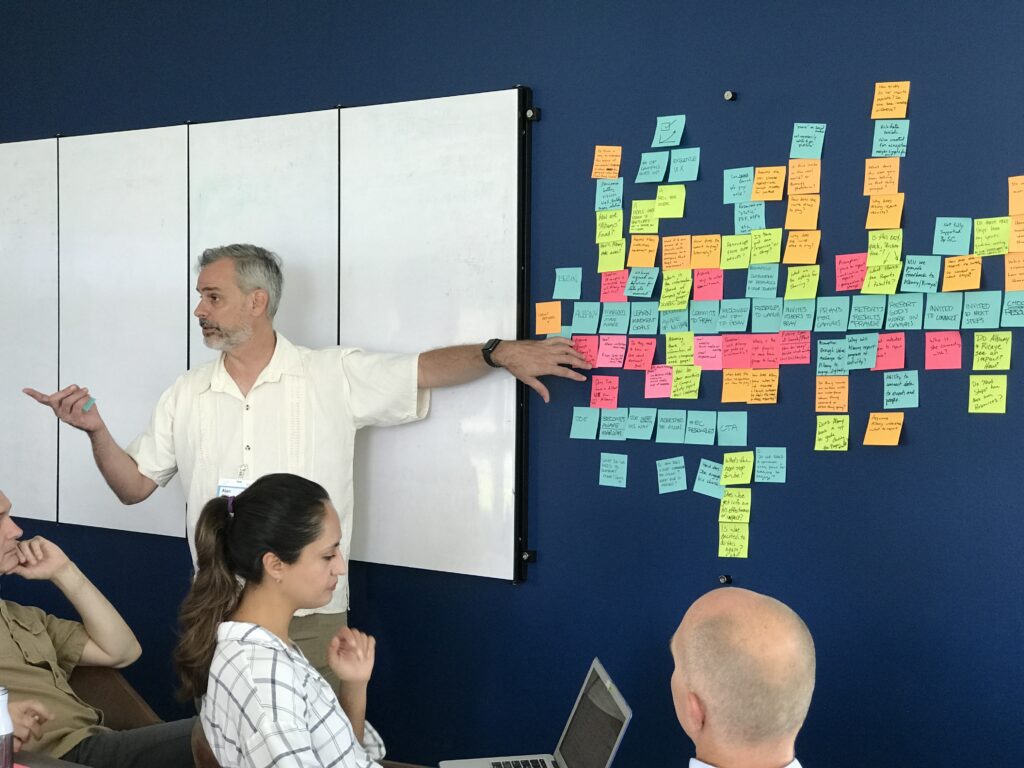
    Card sorting involves writing down proposed project features or concepts on sticky notes. From there, we’ll work together to arrange the notes in four quadrants. The four quadrants indicate which features are the most important and which will be the most difficult to create.   

    This exercise—and the Framing step in general—help surface the true challenges and priorities we need to pay attention to for the rest of our work together. 

    2. Empathy 

    We’re not building a site or app for ourselves. We’re building it for the people your product will serve. The Empathy step of Discovery elevates this critical user perspective, increasing your team’s understanding of and empathy for your constituents.

    In a perfect world, you’d get out into the field for user research. But even if that isn’t in your budget, we will use Discovery to craft personas (profiles describing specific, like-minded groups within your target audience) that capture users as accurately as possible. 

    To develop your personas, we’ll discuss commonalities among your audience, concerns they share, and what makes them unique. We’ll name the personas and refine them as we discover more about your users, ultimately searching for what motivates them. 

    If we sense a disconnect between your organization and your audience, we may also complete an empathy map. We’ll brainstorm each persona’s hopes and what they’re afraid of to put your team squarely in your users’ shoes. 

    You’re driven by a worthy mission. And you’re never trying to make a quick buck. To succeed in that vital mission, you need—and want—to help people. Personas are a useful tool to understand how to help. 

    3. Journey

    During the Journey step, we’ll pinpoint problem areas along a user’s journey (how they get from point to point using your product) that can impede a successful user experience. Then we’ll mitigate these problems. We’ll also spotlight high points of the user journey to identify when users are most open to taking next steps with your organization. We’ll do both by completing a journey map. 

    A journey map describes each interaction—from first contact through to conversion—a user can have with your ministry. It charts an ideal user’s relationship with your organization over time. 

    This Discovery step will help your team grasp just how far-reaching the user journey is. It’s never about a single interaction. You must constantly think about how one touchpoint builds upon another. This holistic understanding of the user journey gives us a more complete picture of your project. 

    4. Exploration

    With your journey map in hand, it’s time to brainstorm how to facilitate each step on the map for the best possible user experience. This exercise tends to be the most divergent in the sense that we encourage everyone to share their ideas without attempting to align right away. We want all those ideas on the table so we can eventually converge on the perfect solution. 

    To get to that perfect solution, we leverage charrettes and dot voting. Your team will get a stack of paper and sharpies to sketch key moments from the user journey map, like when an individual is ready to learn more about your organization. You’ll then sketch possible solutions. 

    Each solution sketch will go on display and dot voting will begin. Your stakeholders can place dot stickers on elements of the sketches they find worthy of further exploration. We’ll rinse and repeat (sketches followed by dot voting) until the best solution(s) bubbles to the top. 

    5. Product Backbone

    The goal of Exploration is to tap into your team’s collective wisdom. The best solution often leads to your Product Backbone. 

    Your Product Backbone is essentially a features list. What does your website or app actually need to include? What do we need to build in order to achieve your vision, reach your goals, and stay true to your mission? 

    Settling on your Product Backbone is the convergence of everything we’ve done to this point. Your Product Backbone will be actionable—the next step is execution—so rest assured all of this Discovery work is worthwhile. 

    How to Customize Discovery for Your Ministry  

    Despite the fact that we outlined the basics of the Discovery phase here, there’s so much more than meets the eye. And it’s not a wholly prescribed process. 

    When you work with Agathon, we customize Discovery to meet you where you are. That means we’ll conduct some of the activities detailed above. But we’ll likely add different exercises to perfectly suit your organization’s needs. 

    Our team has unique expertise completing Discovery sessions just for ministries. We have a wealth of knowledge on your niche and target audience we’ll tap into to advise the best possible Discovery. 

  • How to Know if You’ve Outgrown Your Ministry’s Current Tech Stack

    When you first launched an online presence, whether through a website or mobile app, you probably sought out and used technology that was either free or low-cost and could be easily personalized to your ministry. And it’s awesome to have simple, plug-and-play tech stacks available, especially if you have a young church or ministry.

    But is the tech stack you started with keeping up with your current demands and needs? Or are you confining yourself to their limited capabilities? Suppose you have bigger, bolder, and more ambitious strategies for your digital ministries. If that’s the case, it could be time to evaluate your current tech stack… and discover what’s possible with customized technology solutions.

    When Should You Evaluate Your Tech Stack?

    Photo by Michael Burrows from Pexels

    It’s often easy to set up the technology, then forget it, assuming what was fine last year or even five years ago is still adequate. But adequate is not the goal. Take a moment to remember why you first integrated technology into your ministry—to reach people where they are. The world is increasingly digital and populations from each generation are plugging in. As new digital capabilities become commonplace, people will expect your digital properties to have them.

    If you are running on an antiquated or outdated platform, you are not effectively reaching your audience. For example, MySpace was revolutionary in its day. Napster? There had never been anything like it. Yet those platforms have given way to other social media networks and music streaming apps and sites. You can’t stick with your tech stack just because it was once cutting edge. Your ministry’s continued growth and effectiveness rely on constant evaluation and progress in your digital presence.

    So when should you evaluate your tech stack? The most common evaluation is annual. Add “tech stack evaluation” to your yearly to-do list, alongside budget and ministry calendar reviews. You may find it coincides perfectly with the other annual reviews and can even roll the results of your tech stack evaluation into your budgetary and ministry focuses. 

    However, if you are growing rapidly or a tech-heavy ministry, you may find that a quarterly tech stack evaluation better suits your needs. And if you’re in the midst of a large build, it’s okay to postpone the tech stack evaluation. After all, the last thing you want to do is halt or disrupt progress on a current project or build.

    How Should You Do a Tech Stack Evaluation?

    Now that you’re on board with the idea of evaluating your current products, what exactly are you looking for? How do you even start? A great place to start, especially if you haven’t evaluated your technology versus your needs in a while, is through a tech audit.

    Instead of assuming the plug-and-play option is sufficient, analyze:

    • what technology you’re using,
    • how you’re using it,
    • how many options you’re utilizing,
    • if you have overlaps or redundancies, and
    • how end-users and target audiences are using your technology.

    Do you have multiple platforms doing the same task? Do you find yourself frequently fixing or cleaning up the tech side of your ministry? Or have you noticed your relationship with your tech vendor beginning to sour because of their inability to meet your new or ongoing needs? If you seem to be more focused on playing catch-up or cleaning up your app or website instead of fostering real growth, you may have outgrown your tech stack.

    Outgrowing Your Tech Stack Is Actually a Good Thing

    Most general-purpose tech stacks support some personalization for your ministry. However, you might be using one of these and, after you’ve analyzed things, you feel like there must be something better. If you’re sensing that for your ministry, it’s actually a really good thing!

    Your ministry should be growing and expanding, and that will naturally cause you to outgrow your current technologies. Bringing in fully-customizable technology to support your growth is often the next logical step.

    What Next? Why a Technology Partner Might Be Your Best Bet

    At the end of the day, the technology is not the ministry. It is there to support the ministry and the mission statement. God has called you to that very specific mission, one that He has prepared you for, laid upon your heart, and empowered you to do. But that doesn’t necessarily mean every aspect of your ministry has to remain your sole responsibility.

    Outsourcing projects that support your mission and ministry, such as a necessary tech stack replacement, allows you to focus on the vision God gave you. It also allows you to be good stewards of your resources. Instead of hiring new full-time people for a project, find an organization filled with people God has called to a similar mission, but who also have the expertise and experience you need to get the job done.

    How to Evaluate a Partner to Update Your Tech Stack

    When you decide that hiring an agency will be the best approach for your ministry, you’ll want to find an organization that fits your mission and tech needs. The technology begins and ends with the focus on God and what He is doing to reach people in a fallen world. While there are numerous options of companies that focus on non-profit sectors, there are fewer companies with the talent and ability to take you from strategy through design and development whose passion is for God and the ministries of their clients.

    Other considerations in choosing your new partner for technology collaboration include Time to Market (how quickly can the project be ready for the user), Scalability (the ability to easily adapt to support traffic and easy upgrades), Measurability, and Forward-Looking.

    Time to Market

    It’s important to have realistic expectations of the time it takes to get your product to the user. Remember, this is a customized tech stack designed specifically for your ministry. Therefore, you need clear communication about what is feasible and what to expect. If it takes too long, the fire in your belly for the new project can wane into a few glowing embers, or the technology can be outdated before it’s had a chance to launch. But if you rush the project, it may be insufficient or inadequate to meet your current and future needs. Finding the balance between too long and rushed can be found by spending time with your tech stack agency in strategy sessions. Before a project begins, the heavy lifting of planning is critical to ensure the project’s success, particularly in the time-to-market deliverable.

    Scalability

    Your ministry and your mission field deserve a user interface that is, well, usable. If you don’t have scalability built into your project, your app or site may not be able to meet your future needs. In that case, you would find yourself back at square one as your traffic increases or your users’ needs change.

    Measurability

    If your ministry is paying for a custom digital app or website, it’s important to know if it’s reaching your target audience or doing what you intend it to do. You might be interested in having the ability to use metrics to see things like:

    • the use of the app to foster donations,
    • increase in pageviews,
    • increase in new users, or
    • sermon or podcast audiences.

    Be sure to figure out what you want to measure and communicate those needs to your tech partner early in your relationship.

    Forward-Looking

    Just twenty years ago, mobile apps were largely limited to calculators and calendars. Just as we’ve come a very long way in a short time, it would be arrogant to assume technology won’t continue to grow and change. Your partner agency needs to be able to grow and change as well in order to futureproof your tech investment.

    Be wary of agencies that sell a set list of solutions and force you to fit into their model; this is exactly the situation you’re trying to leave behind with non-custom platforms! Rather, listen for cues that the agency you’re considering uses modern technology and ask them for examples of technology they’ve used in the past. Comparing the two should give you an idea of how they incorporate new technology and, thus, how forward-looking they are.

    Take the Leap of Faith

    The parable of the talents spoke to the reward of those who took risks. It still speaks to those who take what God has laid upon their hearts and invest in it, pouring into the future. It is often tempting to be risk-averse. After all, you don’t want to be foolish with that which has been entrusted to you by both God and those who contribute to your ministry.

    But God has called you to be a good steward of what He has given, to be risk managers, not risk avoiders. Taking on the daunting task of evaluating your tech stack can feel like too great a risk. Instead, consider that it is an innovation that prevents your ministry from stagnating and ensures you’re doing everything you can to be a good steward and faithfully answering God’s call.

  • The Power of Human Connection for Team Success

    The Power of Human Connection for Team Success

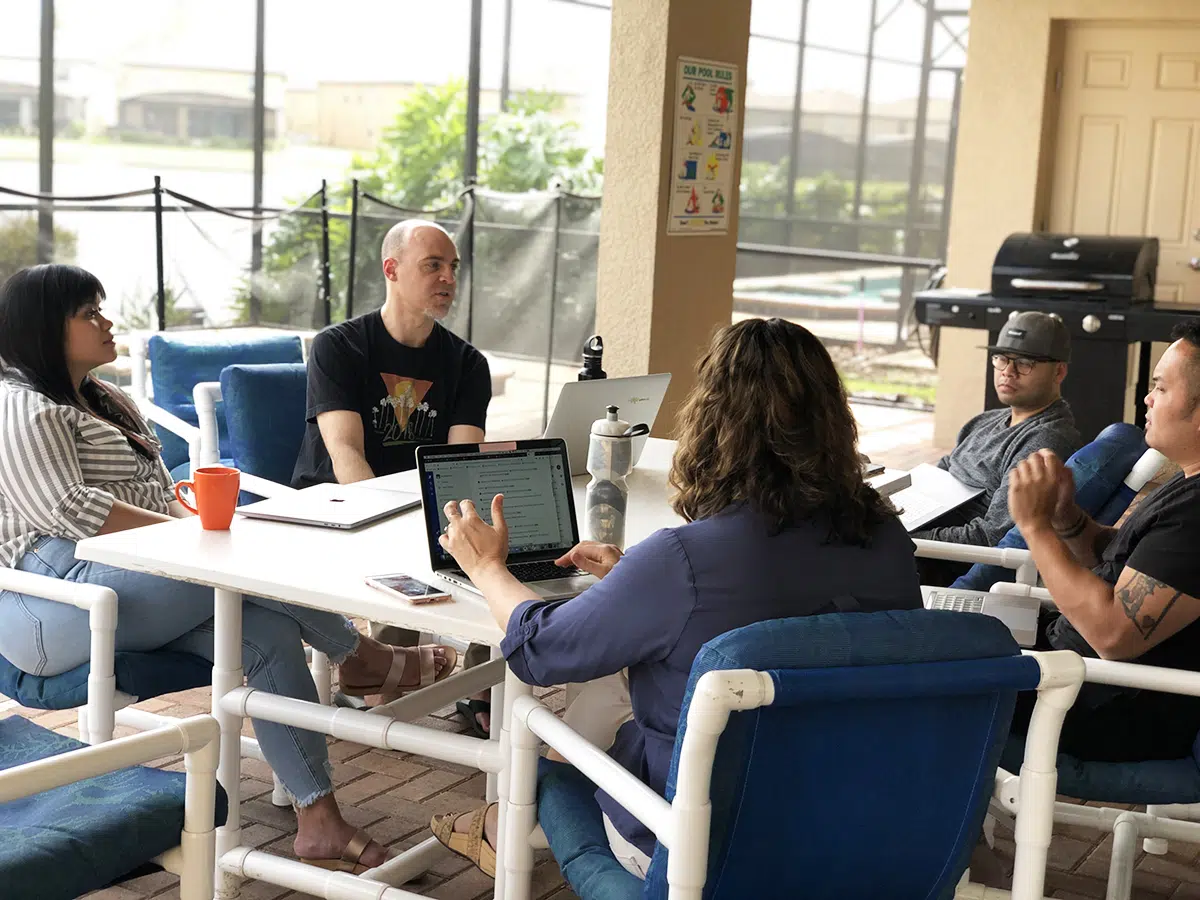
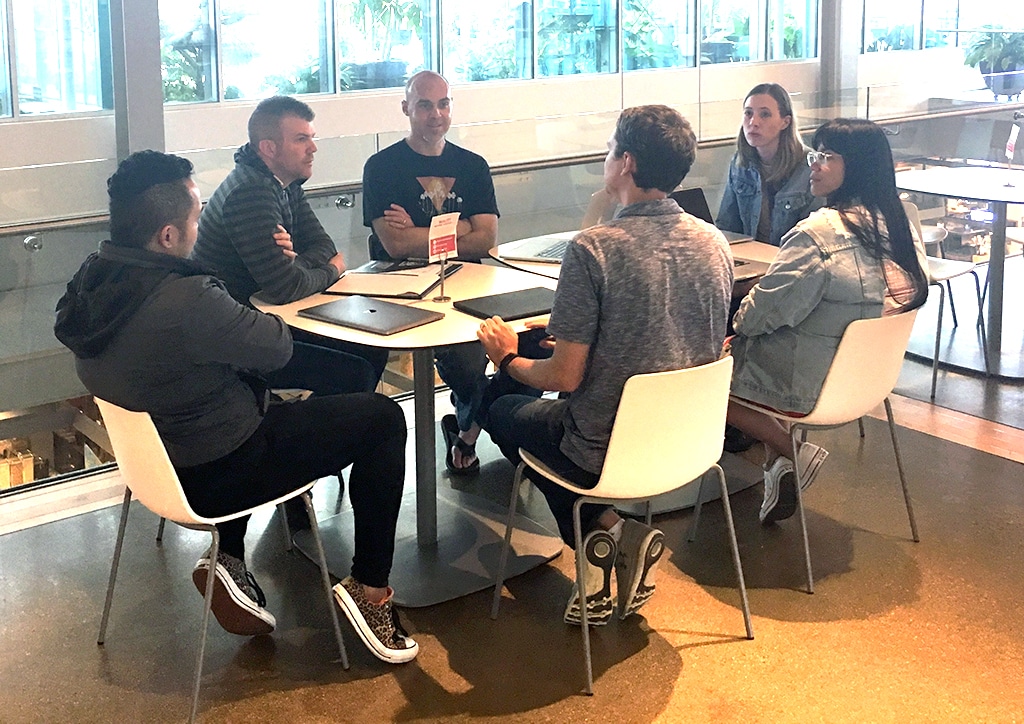
    Members of the Agathon team having a lively discussion around an outdoor table

    You’ll probably never see a project proposal with a line item for “human connection.” And yet, this idea of human connection is one of the intangibles that play an essential part in both the success of a project and the satisfaction of everyone involved.

    What is human connection? For the purposes of this post, we’re talking about fostering strong relationships between people. This helps teams improve communication, align visions and goals, and weather misunderstandings. This connection provides the foundation for successful projects as well as long-term partnerships. And let’s be honest, even the most introverted of us need to connect with others!

    Why Human Connection Matters

    In tech-centered projects, it’s easy to bury human connections. There’s research to do, code to write, and tests to run. And much of this work happens in isolation. Working remotely or with outside teams compounds the issue.

    But in any organization, compassion and empathy play an important role. As you build relationships, each party discovers what motivates the other and can better work together to meet their goals.

    Think of it this way: developing these relationships is like changing the oil in your car. You don’t own a car in order to change the oil, but rather to drive it. However, the more careless you are about regularly changing the oil and nurturing your car, the higher the risk of your car breaking down. And, of course, your car usually seems to break down right when you need it most!

    Just as you own a car to drive it and use it, your ministry exists to faithfully pursue its vision. The amount of intentional care you add to both—whether by changing your oil or building human connection—will affect how smoothly your car, or ministry, will run for years to come.

    For us, getting to know clients through an on-site discovery can be an important part of creating that connection. This time together allows us to dig deep into what drives our clients’ organizations. It also helps us identify their goals for both a specific project and their organization as a whole. And it lays the foundation for open communication and understanding.

    An old rusted silo alone in a field

    The Consequences of a Lack of Human Connection

    Without a focus on interpersonal connection, partnerships will be shallow and fragile. This makes it difficult for individuals to wrestle with ideas and challenges without emotions or conflict. And it can lead to warring factions who fight only for what they need as an individual or group without concern for what the rest of the team needs.

    The lack of connection also leads to a lack of communication and trust. And both of these can slow down and weaken a project. They also lead team members to make poor assumptions and overlook ideas and opportunities.

    It can also leave the people on your team looking toward an exit strategy. This can include trying to catch one another in a mistake or put the blame on the other party. This isn’t healthy for the relationship or the people involved. Not only that, but it also affects the long-term success of the project and the health of the ministry as a whole.

    3 Common Pitfalls That Undermine Human Connection

    Unfortunately, these common pitfalls can undermine your efforts to create human connection among team members, especially as teams grow and work with outside parties:

    1. Siloing different parts of the process.

    There is a temptation to isolate different parts of a project from one another. Some leaders assume the board only needs to sign off on big decisions, or developers don’t need to hear about certain user experience (UX) considerations on the design side, or the overall strategy won’t impact the backend data handling.

    But working in these silos can lead to misunderstandings, wasted time, and extra work.

    2. Sheltering parties from one another

    Similarly, there’s a temptation to shelter different parties from one another. While you don’t want to bombard each person with every little detail or conversation, it’s important to strike a balance. Each person on the team needs a complete enough picture of conversations and decisions to best do their job.

    Whether through a shared Slack channel, Basecamp project, or Jira board, having conversations “publicly” can help facilitate this awareness without overwhelming individual team members with meetings or emails. This keeps everyone aware of what’s happening in other areas of the project so they are better able to ask questions and work together on solutions.

    3. Failing to recognize personality differences, skills, and weaknesses

    On any team, each individual will have specific personality traits, skills, and weaknesses that impact the way we work. Encouraging strong relationships across the team is valuable. But it’s also important to note where two people might struggle to work well together. Similarly, you want to put people in positions that make sense for their skills and experience, i.e. not elevating a junior staff member if it means they’re likely to fail.

    And the opposite is true as well: Putting people together who collaborate well can increase their productivity or creativity. And slotting team members into the roles that fit their skills allows them to shine and benefit the entire team!

    A team hand stack

    4 Ways to Create Human Connection

    There’s no Webster’s definition for “human connection.” For us, it means prioritizing relationships right up there with the work that’s being done. The work is still important (so, so important), but the relationship can’t get lost in the project plan.

    We’ve found these 4 principles help relationships grow into true partnerships:

    1. Involve everyone early and often

    It is not uncommon for a small group of people to lead a project, with others joining on a “need to know” basis. However, involving everyone early—and keeping them engaged throughout the process—benefits the team and the project in many ways. It adds additional perspective and ideation to the work you’re doing. And it helps each person feel more invested in the work they’re doing, not just as individual tasks but in the overall project as a whole.

    That isn’t to say everyone should have an equal say or the team should make decisions by a popular vote. But hearing the perspective of many team members and including everyone in the process that leads to important decisions makes the process and the final project better.

    2. Build a shared understanding of success

    What does success mean for your organization as a whole and for this particular project? Aligning everyone on the team around a shared understanding of success:

    • Creates a bond as everyone works together toward that goal.
    • Centers everyone on the ministry goal rather than just the technical goal.
    • Builds anticipation for how the project will impact that ministry goal.
    • Gives everyone a sense of their role in achieving the larger ministry vision.
    • Helps each team member feel like part of the larger team beyond just the immediate project.

    3. Be real and transparent

    A partnership takes time and effort to build. Anyone can start off a honeymoon phase with a positive attitude and expectations. But you create a high level of trust over time by working together and communicating openly—both in what you say and in how you listen.

    Through this learning period (and beyond!), it’s important to be real, authentic, and transparent. This is the only way the people you work with can trust that what they see is what they get. Being authentic from the very first interaction ensures there are no surprises down the road in how you work or communicate.

    4. Work through conflict

    With a strong foundation, everyone on the team will be better positioned to assume the best of each other at all times. When deadlines are tight, something isn’t working as expected, or there’s an unexpected roadblock, everyone is able to approach it as a team and figure it out together. (And let’s face it, when technology is involved, something will inevitably surprise us.)

    It also means the frustrated party is willing to pick up the phone to bring it to the other party’s attention. For both parties, it means pushing through awkward conversations to resolve the issue and strengthen the relationship. (Most of us don’t enjoy pointing out where someone has messed up or hearing where we ourselves have messed up!)


    Human connection is important to us as a team, but it also impacts the way we work with clients. It’s our focus on human connection that takes our role with our clients from a contracted vendor who delivers code to an active partner in their ministry.

    To learn more about Agathon and the factors that contribute to digital ministry, subscribe to our newsletter.

    "*" indicates required fields

  • The Best Way to Invest Your Budget and Improve Ministry Outcomes

    The hard part is done: you presented your budget to the board and they approved it. You’ve got (some) money and you’ve got (LOTS of) ideas… so now what?!

    How do you ensure you’re spending the budget on the right projects? When next year’s budget meetings roll around, how can you provide clear evidence your projects impacted your ministry? There are plenty of pitfalls in getting started that can lead to delays or waste in your projects and budget. We think there’s a better way to make the most of your budget and impact your ministry by focusing on outcomes instead of outputs.

    3 Common Pitfalls to Avoid

    Before we discuss how to maximize your budget, we should recognize some of the most common pitfalls when starting to figure out how to spend your budget. These aren’t the only dangers out there, but you’ve likely experienced, or considered, each one of them. That’s okay—my goal is not to shame you! Indeed, we’ve all made these mistakes at some point. Identifying them allows us to both recognize when we’re pursuing them and avoid them in the future.

    1. Meeting of the minds

    Who knows your ministry better than you and your team? Nobody, that’s who! So why not get around a table, discuss your options, and decide how to turn your budget into ministry outcomes? After all, you’re smart and capable: you should be able to figure this out!

    Apart from the potential concern for calling “yet another meeting”, the reality is that we all have real blind spots when we look at our own organizations. What we think we know about our users doesn’t always match what our users think. We often overestimate our internal resources apart from the budget. We get stuck in an organizational “way of doing things.” All of these can make it difficult to see what’s best for your ministry from within the organization. It seems counter-intuitive, but it’s true!

    That’s not to say you and your team aren’t important in the planning process. Indeed, as I joked earlier, no one really does know your ministry as well as you! But it’s rare to be able to step outside of oneself for long enough to readily identify the best ministry strategy. And without an effective and practical strategy, you won’t have a roadmap for moving forward. You risk building something your users don’t want or starting something you can’t finish. Either way, you waste your budget in the process.

    2. RFPs are Requests For Poorly fitting solutions

    Let’s say you avoided taking an insular approach and you hired a consultant to help figure out what you wanted to build. How do you find someone to design and build your project?

    You might consider writing a Request For Proposal (RFP) to describe the project. You disseminate the RFP among colleagues, coworkers, family, and friends. Maybe you upload the RFP to a contractor website. But how can you be sure you’re getting it in front of the right eyeballs? And how can you be sure the responses are an accurate reflection of what an agency can provide? The truth about both is: you can’t.

    RFPs give the appearance of a project definition that is in stone. They often codify details that are unimportant or distracting at early stages in the process, like a specific platform or coding technology. As such, they often attract development shops that want to churn out projects with little consideration for why they’re building what they’re building.

    These shops want to receive input (i.e., the RFP), match it against their internal skills, stick it into their development black box, and return the output (i.e., something akin to a widget). They are ill-equipped to deal with custom, complex projects; unless you have a simple, discrete project, you do not want to work with such a shop. Otherwise, the resulting false start may leave you with a depleted budget and incomplete project.

    As with the first pitfall, that’s not to say RFPs are totally useless, especially when you can capture strategic goals without jumping to technical solutions. And you should capture and document project requirements at appropriate times. But that’s also not a one-time task; project specifications can flex and change throughout a project’s life cycle. It’s also not something that you can do in a sequestered committee apart from your design and build team, whether they’re internal or with an agency.

    3. “Ready, FIRE, aim!”

    I stumble into the final pitfall as much as anyone. I have over 20 years of experience as a systems engineer, imagining and building computer systems and networks on grand scales. As such, I have a tendency to jump into building somethinganything—even before the problem is fully defined. I usually assume we will be able to make midcourse corrections as we discover problems along the way. But it’s never that simple and usually not cheap.

    The politician’s syllogism restates this challenge in another way:

    1. We must do something.
    2. X is something.
    3. Therefore, we must do X.

    You can probably see how that plays out in the political arena. But it applies to your ministry strategy as well, and especially as it affects your budgetary decisions. We all feel the urgency to “do something” in ministry. That sense of urgency may even be why you’re in ministry in the first place! The problem arises in defining which X you want to pursue. Getting started in building before you’ve done the planning does not solve that problem. Or if it brings some clarity, it does so at great cost to team consensus and your budget as you test projects that don’t lead to organizational success.

    1 Key Technique to Maximize Your Ministry Budget

    To maximize your ministry budget, you must make sure you are pursuing goals that bring success to your ministry. You can define specific success metrics in many ways, but ultimately it means capturing and pursuing your organization’s vision. That vision is probably not based in projects, but rather in people. So to maximize your ministry budget, you must ensure your projects serve your ministry’s purpose. And to serve your ministry’s purpose, you must focus your goals around ministry outcomes, not project outputs.

    Discovery—the process of turning ministry needs into an action plan—can help you do exactly that.

    Discovery is not brainstorming about outputs

    Earlier we discussed the danger of sitting around a table and trying to think about what projects you should pursue. Brainstorming at that stage can lead to less clarity, not more, about how to spend your budget. That’s because the most common phrase uttered in brainstorming sessions is, “Wouldn’t it be great if…?” What follows is someone’s idea of what a project should entail, or what features could be neat, or what users might want. Those conditionals muddy the water and give the authority for making decisions over to “gut feelings”. You might come out of that brainstorming session saying, “That project or feature sounds good, so we’ll pursue it.”

    Discovery minimizes gut feelings in the decision-making process by shifting the focus away from outputs like projects and features. It changes the question from, “Wouldn’t it be great if…?” to, How does this serve our users and, thus, pursue our ministry vision?” It allows you to use metrics, research, and rubrics to test every project against your vision and ruthlessly assess whether it serves that vision. It emphasizes the outcomes and de-emphasizes the outputs; after all, the means should serve the end, not vice versa.

    Discovery is an investment in outcomes

    We identified two big problems with building before planning: weak team consensus and expensive shifts in project focus. Discovery gives you the tools to invest in building team consensus and establishing a project roadmap earlier in the process. By focusing on organizational outcomes, staff and leadership feel purposeful in their involvement and supportive of the goals. Similarly, project managers can revisit the key question—“How does this serve our users and, thus, pursue our ministry vision?”—throughout the project life cycle.

    But starting early with Discovery requires resolve. You will need to establish consensus and a roadmap at some point in the process, but it can feel like wasted money at the beginning. It may feel like spending a lot of time and having little to show for it. It may feel redundant or hard to justify (especially when a budget update is requested!).

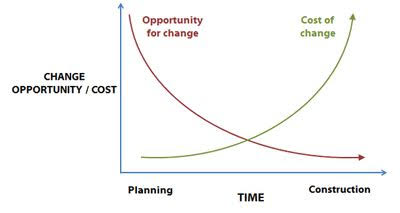
    However, leaving those tasks until later can cost even more. Any change costs something, but changes that happen mid-stream and threaten to distract the focus from ministry outcomes will cost far more. Consider a rough time-cost graph that shows this relationship:

    Discovery doesn’t just keep the focus on outcomes: it also happens earlier in the process. This outcome-based focus does not end with Discovery; rather, it is part of the User Experience (UX) investment throughout the project. Indeed, industry studies have shown that “every dollar [invested in] UX brings in between $2 and $100 dollars in return”!

    Starting earlier—actively planning at the outset—means that investment has more time to pay dividends. Those dividends include building the right product, serving your users well, and helping your ministry pursue its vision. It will pay further dividends, beyond the planning stage and into execution, as you use UX to continually maintain focus on your organization’s desired outcomes.

    —————

    Agathon has helped ministries maximize their budget through Discovery for over two decades. If you’re interested in learning more about how Discovery works or how to make some of these recommendations work for your ministry, feel free to drop me a line below, and let’s chat about it!

  • Futureproof Your Technology for Growth and Transition

    Futureproof Your Technology for Growth and Transition

    Technology is always changing—both its capabilities and the regulations around it. And just as it’s vital to futureproof your ministry’s digital strategy, it’s also important to futureproof the technology itself.

    Futureproofing determines how well you can pivot in the face of change. This is a key, but often undervalued, part of your role as a steward of your organization’s digital ministry.

    Why futureproofing matters

    Because technology is constantly changing, chances are high you’ll encounter one or both of these two pinch points throughout your career:

    • The need to change from one platform to another to upgrade your technology, integrate with another tool, or meet a new ministry objective.
    • Bringing a new technology on board to augment or expand your existing technology as more tools become available.

    Futureproofing prepares for those inevitable changes so your organization can efficiently transition as needed. Ministries who fail to do this will find themselves wasting time and money as they scramble to keep up.

    Who should be futureproofing?

    Boards and leadership play a vital role in futureproofing a ministry’s strategy. But futureproofing the technology usually depends on those with their boots on the ground: product owners and developers.

    As you’re making decisions about data models, writing tests, and documenting processes, you should always have the future use case in mind as well. How easily can someone step into your role in the future? How easily can you transition to a new program or technology?

    How to futureproof

    Knowing why futureproofing is important and who is responsible for it is a good start, but what does futureproofing look like in the real world? We’ve identified seven areas of focus to help you prepare your digital ministry for the future:

    A diagram of a data model or data structure to help you futureproof your technology

    1. Data structure

    You can lay a strong foundation by structuring your data logically from the very beginning. This means considering the diversity of models represented in your data—both the data coming in (the input) and how it’s used (the output).

    For example, let’s consider a volunteer management system. In this case, the granular data you need to collect might include first name, last name, multiple email addresses, multiple shipping addresses, etc. Building a detailed structure for this data—and then sticking to it—will make future migrations easier. You’ll be able to see where you need to connect the dots, which will increase your confidence in the actual migration.

    It’s important to note that while planning upfront is important, the data model will inevitably change as your organization needs data in a new or different way. The ideas you have about your data today represent a very specific viewpoint. Those ideas will change with your organization, technology, and third-party tools, and your model will need to change as well.

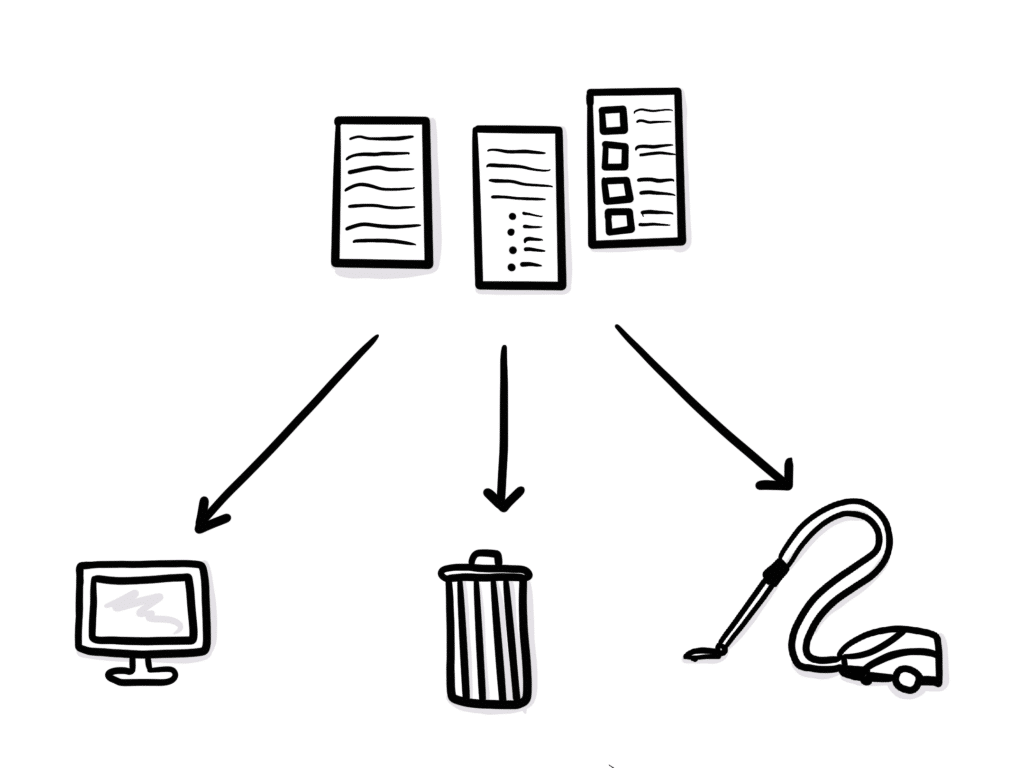
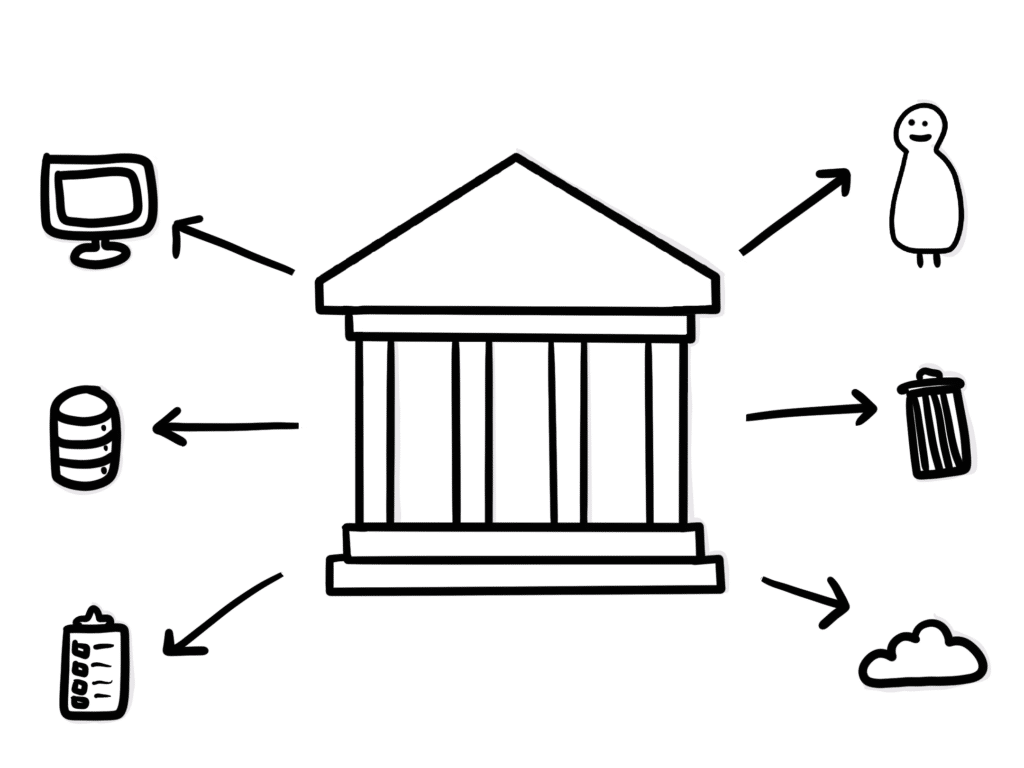
    A diagram showing data ready to be stored, trashed, or cleaned as you futureproof your technology

    2. Data quality

    In addition to modeling data well, the data you collect needs to be “clean.” Data can get dirty if there are no guards or tests in place, i.e., ensuring email addresses are in a valid format.

    When you make updates to the model, you should clean the data to ensure there aren’t unused fields or fields you intended for one thing but used for another. As the data matures, the model also needs to mature with it. For example, consider a broadcast media ministry with hundreds of audio files in the archives. If you want to begin organizing those with tags (Scripture references, spiritual formation terms, topics, etc.), it’s easy to begin tagging files moving forward. But in order to ensure data quality, you will also need to develop a plan for tagging the archives.

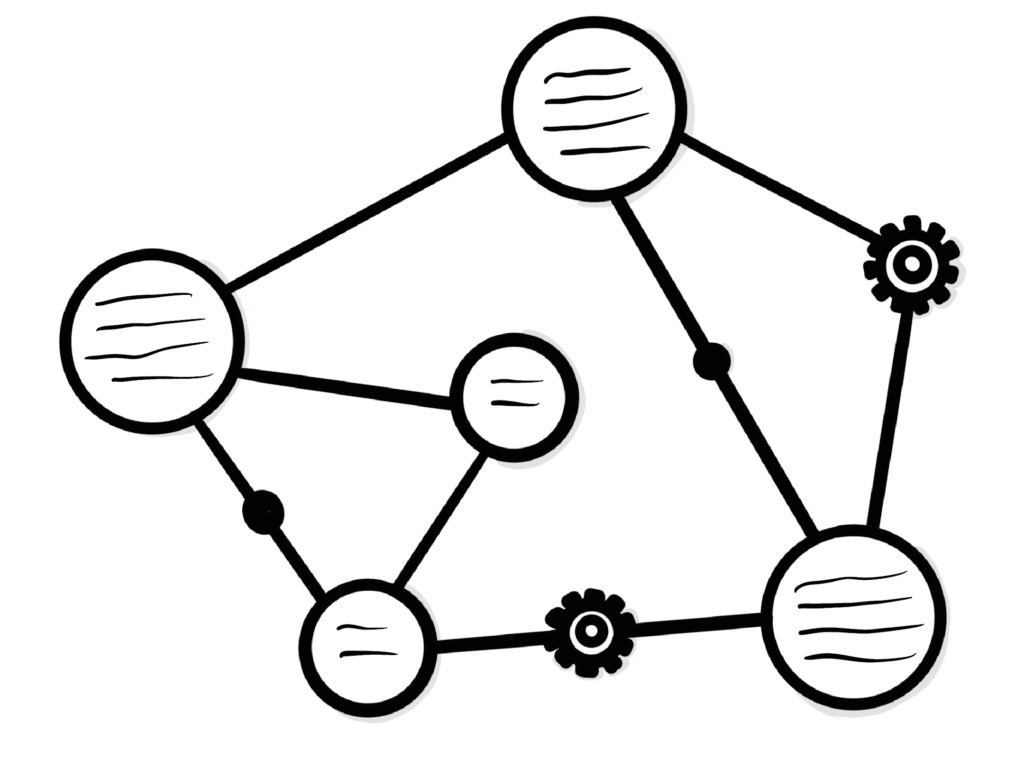
    A diagram showing the interoperability of data (represented by circles connected by lines and gears) as you futureproof your technology

    3. Interoperability

    The next step is to be sure your data is malleable to meet the demands of your ministry goals, both now and in the future. Starting with a solid model and clean data is the first step, but you also need to collect data in a way that is useable in a variety of ways and systems.

    To oversimplify this idea for a minute, think of a single First Name, Last Name field. Let’s say your main purpose for collecting names is for your volunteer database. The single field might work within the volunteer database system just fine. But when you’re ready to begin using that information to send automated emails, you realize the marketing automation system can’t parse it into two separate fields to address your email recipients by first name.

    While that may mean collecting data differently—i.e., separate First Name and Last Name fields—interoperability can also express itself in an API. APIs essentially serve as dispatches that know where to get the data and how to manipulate it for other systems to consume it. So if one system collects First Name, Last Name in a single field, interoperability could mean having an API in place to parse the first and last name for the marketing automation system.

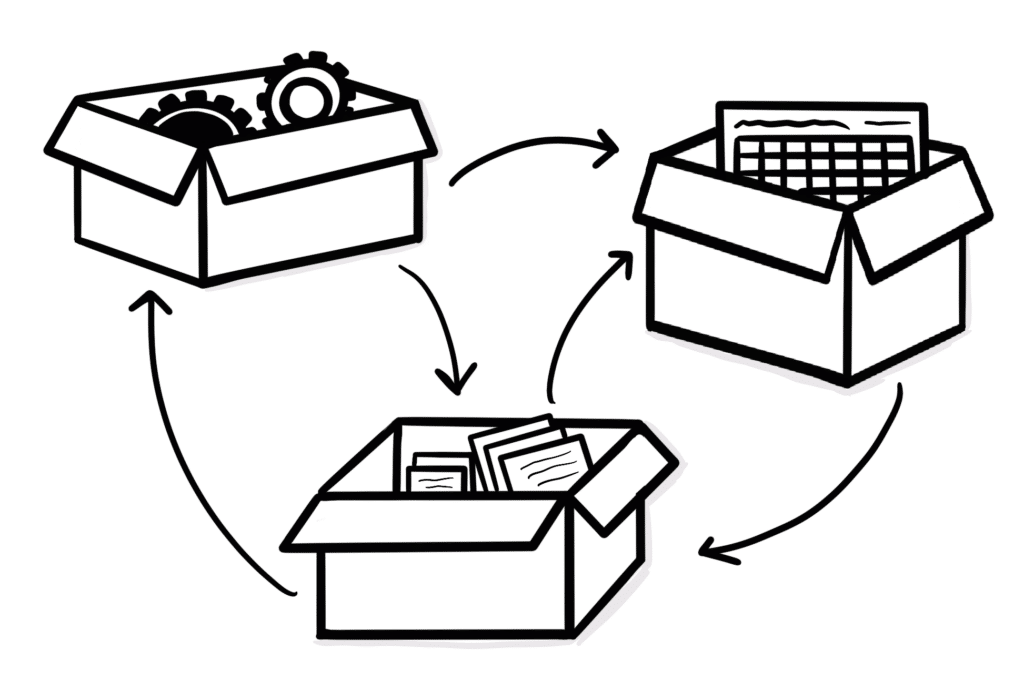
    A diagram showing the compartmentalization of various pieces of a software package (represented by data inside boxes with arrows between them) as you futureproof your technology

    4. Compartmentalize

    Another step you can take to futureproof your technology is to compartmentalize each part of the process. Rather than creating one monolithic application for the entire process, it can be broken down into smaller modules. This allows each piece to stand on its own without being affected by other parts of the process. However, when you compartmentalize something, you have to then be explicit about each of its connections and which parts of the application should be shared.

    Ultimately, this is an IT architecture decision your team should make together. Splitting the workflow into reasonable bits will give you more flexibility downstream but also requires managing each of those connections. Each approach has tradeoffs, and the right answer will vary based on your organizational structure, business logic, and goals.

    A drawing of binders full of documentation for futureproofing your technology

    5. Documentation

    Documentation is a critical part of futureproofing. Good documentation includes the model itself, any manual workflows, and the business logic.

    Documenting the process tells future readers, “When some provocation happens, it goes through this sequence of events to create this result.” For example:

    • Someone signs up to volunteer at an event.
    • The system connects that event to their volunteer record.
    • It fires off an email to the volunteer coordinator.
    • The coordinator initiates a background check.
    • Once that’s done, they manually trigger a response with detailed next steps.

    Documenting the details of what the system does automatically and what humans need to do manually doesn’t happen naturally. Most people on the team will know how the thing works with the way they work. But if it only lives in each individual’s head, it impacts the future of the organization. Instead, you need to be sure there is a clear understanding of the impact of each data point and procedure. The moment the code changes, your documentation will be out of date, so part of documenting well is also keeping it updated.

    A drawing of a laptop with a magnifying glass highlighting a "bug" on the screen to illustrate the importance of tests in futureproofing your technology

    6. Tests

    Writing automated tests is another important part of futureproofing. Done well, testing serves as an additional form of documentation. The tests should be human-readable, and the results should map to the business logic your organization cares about.

    Having good tests in place also creates a safeguard. With automated testing, the system will let you know when a future change breaks something. Tests are the safety net for the inevitable changes the code will go through as your organization’s needs change and grow over time.

    Like documentation, tests are an abstraction from the code. This means any time the code changes, both the documentation and tests need to be updated. This adds a layer of complexity, but automated testing provides safeguards that tend to outweigh that complexity.

    A diagram showing the importance of a governance structure for futureproofing your technology

    7. Governance

    Finally, as data and privacy laws continue to evolve, you should have a clear understanding of the governance of your user data. This includes who has access to the data and when. As the type of data you’re collecting changes and increases, the need for proper governance grows as well. In the case of an audit, you need to show clear accountability for how you manage the data.

    This idea of data governance can span a spectrum from “complicated” to “a legal nightmare.” It includes the data in your customer relationship management (CRM) system, your privacy policy, and how you handle payment information. It can also include data from a wide range of unexpected sources, like web server logs with logged IP addresses. For organizations without the internal expertise to navigate this complicated arena, it may be wise to contract with a specialist who can help you establish governance procedures and avoid legal pitfalls.


    Futureproofing your digital properties requires intention and hard work. But keeping your eye on the future helps ensure your technology can grow with these inevitable changes. This is important for any organization that hopes to continue existing in the future. For ministries, it’s also part of stewarding your donor’s gifts well!

  • How to Conduct an Effective Project Retrospective

    The Agathon team sits around a conference room table for a project retrospective

    When a big project finishes, it’s easy to get caught up in what comes next, quickly shifting gears to focus on the next project. But there’s a cost to doing that too quickly without taking the time to look back at the work you’ve just completed. A project retrospective is an opportunity to discuss what worked, what didn’t, and where improvements can be made.

    Under the agile approach to development, retrospectives are often done weekly or at the end of each sprint. However, we’ve found that meeting as a team at major milestones or the end of each project can be especially valuable. The frequency of retrospectives may vary depending on how your team works, but the value of them remains the same.

    If I have seen a little further it is by standing on the shoulders of Giants.

    Isaac Newton

    To be clear, Agathon didn’t invent the retrospective; however, we’ve adapted this process over time to fit our team as well as the values and needs of the mission-based clients with whom we work. We use this process to celebrate wins and examine where things didn’t go as expected, all with the goal of growing and improving as we move forward.

    We do both internal retrospectives and retrospectives with the client, although rarely both for the same project. It depends on what’s needed most. Internal retrospectives tend to be very tactical, talking about the tools we used or how we divided up tasks. Client retrospectives often discuss process and communication issues. Everything below applies to both types.

    A photo taken in the side mirror of a vehicle, capturing the road, cars, and mountains in the rear

    The value of a project retrospective

    Retrospectives help you answer the question, “What should we learn from this project that we might otherwise forget?” in a number of ways:

    1. Record the things that went well

    Whether a project was a slam dunk or you seemed to encounter challenge after challenge, it’s important to take a moment to identify and record the things that went well. Did your team pivot quickly in the face of new information? Were you able to implement a new procedure that will benefit future projects? These wins are worth noting and celebrating.

    2. Capture the things that didn’t go as well as hoped

    Just as it’s important to capture the things that did go well in the midst of a challenging project, it’s essential to identify the things that didn’t go as well, even if the overall project was a success. In fact, many of your action items (see the third “ingredient” below) will come out of this category. The retrospective provides an opportunity for you to pause and really think about how those challenges can be avoided or overcome in the future.

    3. Examine the things that are still puzzles

    Was there something that didn’t feel like it went smoothly even though objectively it was a success? Are there areas where your team continues to struggle but hasn’t yet come up with a solution? Talking through these things as a team with the project fresh on your mind can help you work toward a solution.

    4. Provide an opportunity to stop and celebrate successes

    A retrospective is a way to stop and acknowledge the completion of a project. It’s also a way to say thank you to the team members who have worked hard to get it to that point. The team as a whole should be celebrated, as should individual team members who demonstrated leadership, perseverance, or creative problem solving.

    5. Reinforces a culture of continuous improvement

    A culture of continuous improvement is one where everyone is looking for ways to work more efficiently, improve processes, and reduce errors. It’s one thing to say you’re committed to this type of culture, but a project retrospective reinforces that commitment by setting aside time to have these conversations and create action items for the future.

    Without a structured project retrospective, the team misses out on the chance to identify both successes and failures and, in turn, the opportunity to grow. Individual team members also miss out on the chance to step back and see the bigger picture of the overall project and evaluate their work within that context.

    [contentupgrade id=”2456″]

    The ingredients of a successful project retrospective

    Running a successful project retrospective requires a commitment from the team. Over time, we have found that these key ingredients bring good ideas to the surface, encourage continued growth as a project team, and set future projects up for success:

    1. A willingness to be honest

    For a retrospective to truly bring value to your team, everyone has to come to the table ready to honestly assess and share both their successes and failures. Just as importantly, each team member must be willing to offer constructive feedback to one another.

    To facilitate a culture that allows for this level of honesty and transparency, there must be trust among the team. We invoke the “cone of silence” during retrospectives, assuring each person that as we process through our thoughts, they can share freely and honestly without blame or consequence.

    2. An opportunity for everyone to share their thoughts

    It can take time for individuals to process their thoughts about how the project went. However, it’s imperative that every team member contributes during the retrospective. Providing notice ahead of time allows each team member to prepare. The moderator then takes responsibility for encouraging everyone to share their thoughts, even if they’re reluctant to speak up.

    A group sits around a conference table with laptops and tablets

    3. A time for creating action items

    Without action items, a retrospective simply becomes another meeting. Pausing to celebrate the completion of a project and the things that went well is encouraging for the entire team and shouldn’t be neglected. But there’s also a practical, operational value that comes from the action items you create at the end of the retrospective.

    As with goal setting, the action items you set should be small, defined, and measurable; they should be able to be checked off when done. Because a project retrospective is done at the end of a project, most of the action items will apply to future projects. Examples might include:

    • Meet every Monday for 15 minutes to review XYZ.
    • Create an accessibility checklist to follow.
    • Schedule meeting to review status of stories.

    4. A template to follow to make sure the right questions are asked.

    Following a template helps the moderator keep the retrospective focused and moving forward so you can get to the point of creating action items. We’ve been using the same basic template for many years now, with only small tweaks as we’ve learned how to tease out insights. That consistency means everyone knows what to expect during the retrospective, which removes any nervousness around the process itself and allows everyone to focus on contributing.


    Taking the time to look back and identify things that have gone well as well as areas where we’ve struggled is an important part of growing as individuals and as a team. Project retrospectives provide the framework for us to do that in a safe, structured environment.

  • 8 Technology Trends Ministries Should Be Paying Attention To

    A colorful infographic highlighting 8 technology trends for ministries with the caption: As you look ahead and consider the role of digital ministry in your organization's vision for the future, these eight technology trends should be on your radar.

    In 1965, Gordon Moore posited that the number of transistors per microchip would double every year. While this prediction has changed over time, it continues to guide forecasts for hardware development. Hardware isn’t our specialty here at Agathon. But it’s easy to see how we can extrapolate Moore’s Law to the advancements in software as well. Just consider the technology available to most home users 30 years ago, 10 years ago, and today.

    For ministries, the past few years meant the accelerated adoption of much of this technology even further due to the challenges and opportunities presented by the COVID-19 pandemic.

    As you look ahead and consider the role of digital ministry in your organization’s vision for the future, we’ve identified eight technology trends that should be on your radar. This is not a call to implement every one of these today. Rather, it’s an opportunity to begin thinking about which ones might impact your ministry in the future.

    Table of Contents
    1. Mobile-First Design
    2. Progressive Web Apps
    3. No-Code Solutions
    4. Artificial Intelligence
    5. Augmented Reality
    6. Automation
    7. Sustainability
    8. Accessibility
    Mobile-first design improves the user experience on screens of all sizes.

    1. Mobile-First Design

    Mobile-first design is a design philosophy that aims to create better experiences for users by starting the design process from the smallest of screens: mobile.

    What does mobile-first design mean for digital designers? Inside Design

    A few years ago we would have called this section “responsive web design.” We knew mobile was important, but it was still secondary to desktop.

    But as the use of smartphones and tablets has become ubiquitous, we’ve realized a responsive design isn’t enough. Instead, it makes sense to design websites for the smallest screen first. Many features that improve the mobile experience—lots of whitespace, large tap targets, etc.—are also beneficial on larger screens.

    This hasn’t always been realistic, especially for ministries working with tight budgets. In the past, web and mobile technologies were decidedly separate and would need two separate development projects. Today, tools such as React and Flutter allow developers to code for several platforms at once. This makes it easier for you to build mobile first while still stretching your digital ministry budget.

    This “write once, deploy everywhere” approach is also beneficial for the teams working on these products. It allows a single team member to service many technologies and creates redundancy across larger teams.

    [contentupgrade id=”2406″]

    PWAs provide an app-like experience for users but live on the web rather than in an app store.

    2. Progressive Web Apps (PWA)

    Progressive Web Apps use modern web capabilities to deliver an app-like user experience. They evolve from pages in browser tabs to immersive, top-level apps, maintaining the web’s low friction at every moment.

    Getting Started with Progressive Web Apps, Google Developers

    While we’re on the topic of mobile, it makes sense to consider progressive web apps (PWAs) as well. PWAs are websites that function like apps on desktop or mobile. These aren’t for simple informational websites but for interactive tools, account management, or internal applications.

    Native apps can be expensive, time consuming to update, and are subject to various app store rules, while creators have complete control over their PWAs. Like a traditional app, users can download PWAs to the home screen of their phone or tablet. And they function like a native app. They also allow push notifications and function better with poor internet. Plus, there are no app store fees to pay. And because they’re built on the web, you can update the content in real time.

    Because there is no central marketplace for PWAs, the app store may still be the answer for public-facing apps. Internal applications, on the other hand, should always function as PWAs. Similarly, apps that are paying exorbitant fees, or those that receive constant updates, may do better as PWAs. And ministries concerned about censorship or the rules governing their app may also find PWAs to be the right solution.

    No-code solutions allow users to do more advanced work with fewer technical skills.

    3. No-Code Solutions

    A no code development platform is a tool for building software applications without coding; a popular and promising alternative to traditional software development for non-technical business users hoping to build their own full-fledged applications.

    What is no code? Codebots

    No-code solutions are around us already: WordPress plugins add functionality with one click; tools such as Airtable or Zapier optimize your communication, processes, and workflow; and website builders like Webflow and SquareSpace allow you to quickly build a site without technical skills.

    The terminology itself can be confusing. “No code” doesn’t mean there is no need for human involvement at all. Rather, these platforms often function through a drag-and-drop interface. This helps team members to do more advanced work with fewer technical skills. Which, of course, allows your ministry to accomplish more with fewer resources and a lower learning curve.

    Does that mean agencies like Agathon will no longer be needed in the future? We sure hope not! Developers will continue to be on the leading edge of these advances. And as good as no-code solutions have become, they aren’t the solution to every problem. We will continue to augment internal teams and guide organizations with strategy and user experience tools to help them best serve their users.

    Artificial intelligence can be used to expand your ministry’s capacity and capabilities.

    4. Artificial Intelligence

    Artificial intelligence leverages computers and machines to mimic the problem-solving and decision-making capabilities of the human mind.

    What is Artificial Intelligence, IBM

    When we hear artificial intelligence (AI), we often jump right to the sci-fi idea of robots taking over the world. But that reality is a lot further off than most people imagine. However, AI in its current form can be a useful tool for the work of most organizations.

    In fact, you’re probably using AI already in your daily work. Think of things like your phone or email’s autocomplete feature, Grammarly’s writing feedback, or your bank’s transaction verification tools. AI is increasingly integrated in our everyday life, and it’s not going anywhere.

    Although there may come a day when ministries build their own AI, you can begin by taking advantage of existing tools now. For example, Answer The Public helps organizations understand what users are searching for on the internet. There are numerous programs that help create blog posts and other content. Tools such as Tableau help organizations jumpstart their reporting efforts by identifying anomalies and reporting against data. And others can help predict or forecast what’s to come based on data trends.

    This type of artificial intelligence helps ministries expand their capacity and capabilities, augmenting their current staff rather than replacing them.

    Augmented reality creates rich content that is more engaging, effective & enjoyable for users.

    5. Augmented Reality

    Virtual reality and augmented reality accomplish two very different things in two very different ways, despite their devices’ similar designs. VR replaces reality, taking you somewhere else. AR adds to reality, projecting information on top of what you’re already seeing.

    Augmented Reality (AR) vs. Virtual Reality (VR): What’s the Difference? PCMag

    Like, AI, virtual reality (VR) and augmented reality (AR) may bring to mind the most extreme examples of these technologies such as “attending” church from home through a virtual reality headset.

    Actually, augmented reality is much more accessible. It can be used, for example, to add interactivity to visual content, whether in-person or digital. (Many of us are familiar with the Pokemon Go craze of a couple of years ago!) This type of rich content is more engaging and can increase both the effectiveness and the appeal for users.

    Imagine the groundbreaking for a new facility, where people can hold up their phones to see an artist’s rendition of the building. Or picture the Bible Project videos brought to life in your living room. Imagine helping your donors experience the sights and sounds of the communities they’re supporting. Or envision online study tools that feel almost like real books and Bibles. It’s hard to anticipate all the ways this technology will be used in the years to come. But you should expect to see many of these ideas brought to life!

    Automation allows you to streamline your processes to be more efficient and effective.

    6. Automation

    The dictionary defines automation as “the technique of making an apparatus, a process, or a system operate automatically.” We define automation as “the creation and application of technology to monitor and control the production and delivery of products and services.”

    What is Automation? ISA

    Automation in general is not a new trend; however, it’s application to digital ministry will continue to increase over time as tools and best practices develop:

    Marketing automation

    You’re probably already familiar with marketing automation: a welcome series for new newsletter subscribers, a drip campaign during fundraising drives, or a tool to manage and schedule your social media messages.

    As this technology advances, you will be able to do even more to personalize the experience of your key stakeholders—whether donors or constituents—based on their demographics and the actions they take.

    Business process automation

    Marketing automation allows you to reach out more efficiently and effectively; business process automation helps you streamline your workflows internally. This includes things like a customer service workflow to help agents route and respond to emails. But it could also include time tracking tools, integrations to streamline data entry, etc.

    Test automation

    Finally, since we’re talking about digital ministry, it’s worth including test automation within this section. Whether developing software or publishing content, every human action creates an opportunity for error. Test automation can reduce friction and human error by scheduling and making processes predictable, automating things such as accessibility check-ins, and facilitating security checks for accountability.

    Sustainability includes being good stewards of creation as our reliance on technology grows.

    7. Sustainability

    Sustainable practices support ecological, human, and economic health and vitality. Sustainability presumes that resources are finite, and should be used conservatively and wisely with a view to long-term priorities and consequences of the ways in which resources are used. In simplest terms, sustainability is about our children and our grandchildren, and the world we will leave them.

    What is sustainability? UCLA Sustainability

    Tech trends often compete with the more human side of ministry. Or, if they don’t compete, they certainly present tradeoffs. We’ve seen this acutely in the last two years: Zoom and other digital platforms provided a way for churches to meet their congregants’ needs during pandemic lockdowns. But this remote access also presented challenges in reconnecting communities as lockdowns ended.

    Sustainability might seem like a strange topic to include on a list of trends. In reality, your ministry cannot ignore the growing importance of sustainability as a whole.

    John Elkington coined the phrase “triple bottom line” as a sustainability framework to measure an organization’s economic, social, and environmental impact. To simplify it in the context of ministries, a sustainable organization will:

    • care for both the people they serve and the people who serve
    • responsibly manage donations and expenses
    • be a good steward of creation

    Sustainability for ministries

    In the context of digital ministry, there are real implications of understanding the energy usage of your systems, websites, and apps. You may not have control over the infrastructure or bandwidth powering your tools. But understanding your site’s consumption and how you can offset that allows you to work toward a more sustainable future.

    For example, there are tools that will tell you what type of resources your site requires just to load. They can even go so far as to make recommendations (e.g., white screens use more energy to render than dark screens) and help you understand the implications of various design decisions.

    While sustainability is a bit nebulous to define, being good stewards of people, planet, and profit (or donations) is likely to become more important—not less—as time passes.

    Online accessibility is an important part of loving and serving people well.

    8. Accessibility

    Web accessibility is the inclusive practice of ensuring there are no barriers that prevent interaction with, or access to, websites on the World Wide Web by people with physical disabilities, situational disabilities, and socio-economic restrictions on bandwidth and speed. When sites are correctly designed, developed and edited, generally all users have equal access to information and functionality.

    Web accessibility, Wikipedia

    At Agathon, we believe accessibility is an important part of loving and serving people well. We also believe accessibility is good for everyone.

    Accessibility impacts:

    • Your ability to provide services,
    • How you connect with supporters and donors,
    • Whether your digital ministry feels welcoming, and
    • How well you can spread awareness of the work you’re doing.

    This is no longer something you can ignore or put off for tomorrow; the importance of building accessible websites and apps is only going to increase.


    It’s unlikely your organization will dive into all of these trends at once. But an important part of setting your ministry’s digital strategy is understanding the big picture trends and envisioning how those might help you to be more effective in ministry.