


Tag: Tech Trends

  • Integrating Mobile Giving into Your Donor Strategy

    Integrating Mobile Giving into Your Donor Strategy

    Mobile engagement has exploded in the last ten years and shows no sign of slowing. With the move to mobile, the internet has become ubiquitous. And with ever-present internet comes increased opportunities to reach your audience and help them move from curious passerby to committed donor. Mobile giving more than tripled (9% -> 28%) as a percentage of all online giving between 2014 and 2020! Ministry fundraising needs to keep up or risk being left behind.

    Inspirations to give take any number of forms. Your audience may have loved what they heard in your ministry’s radio spot. Maybe your ministry’s presentation at a church or convention moved them. Maybe they were chatting with a friend, and your organization came up in conversation. Whatever the prompting, a mobile donation solution can lead your audience to pick up their phone and become a donor when the mood strikes without the friction of traditional models of giving.

    Implementing a mobile donation solution is not as straightforward as it seems. Much of the tech and attitudes around mobile giving continue to lag behind overall mobile adoption. We’ll look at a few options for serving your ministry’s existing donors and making new ones.
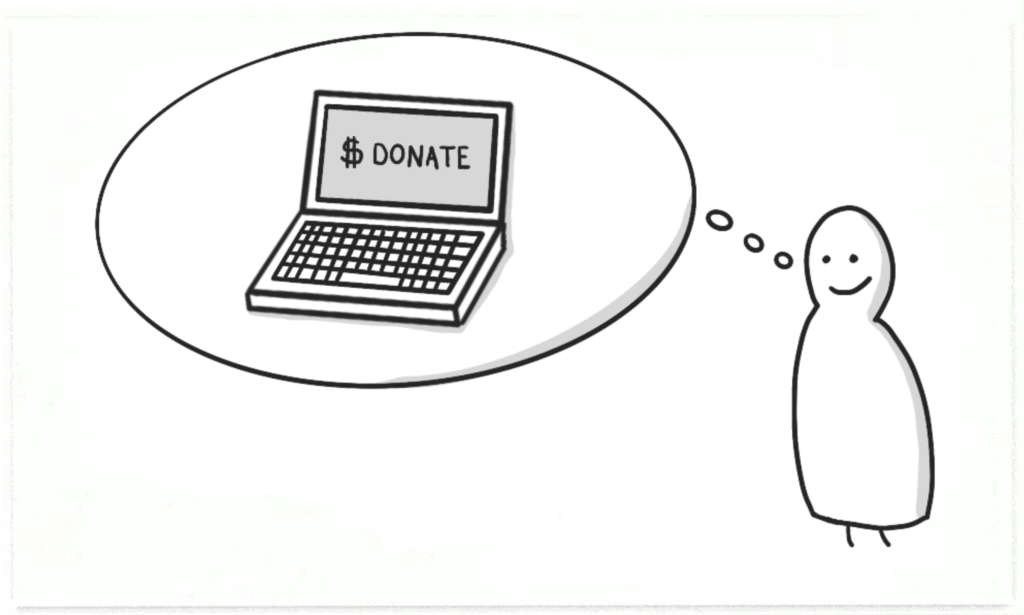
    Illustration of a person with a thought bubble, "thinking" about getting to their laptop to donate

    A simple option: your website

    Practically every mobile device has a web browser built into it. So why not point users to your current website to make donations from their tablet or phone? This might present the simplest option, but it’s not necessarily the best one. What will those users actually see on their mobile device when they load your existing website?

    Ten years ago, many websites weren’t designed with mobile in mind. Visiting a website on a mobile device often meant reading tiny text, pinching to zoom, and hunting to find anything. Design trends started shifting from “desktop, and also mobile” to “desktop and mobile equally” with responsive design. As mobile traffic continues to pull away from desktop, attitudes in the design community have evolved further. Today, many websites are designed as “mobile first” and many websites displaying on larger screens look like big versions of the mobile site design!

    These design trends increase the likelihood you can point mobile users to your site to allow them to donate. However, at the risk of stating the obvious, your website has to have been designed and built with mobile design in mind. Otherwise, you’re sending your users back ten years to squint and hunt for your “Donate Now” button.
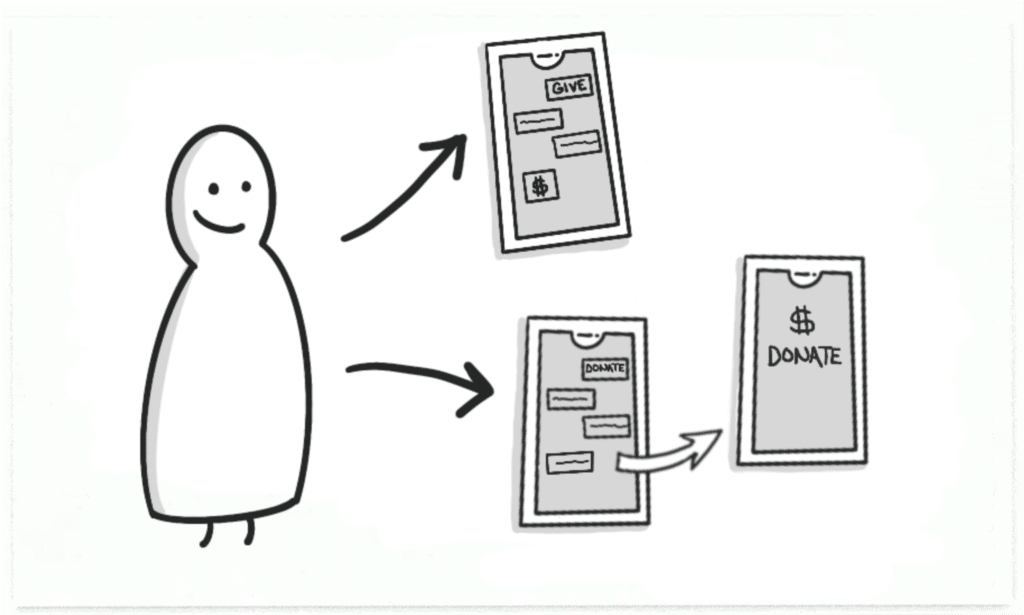
    Illustation of a person with arrows pointing toward two mobile phones with the text-to-give and text-to-donate workflows on them

    Old school: SMS

    Even before mobile phones could access the internet, there was SMS. Decades later, it’s easy to overlook SMS in favor of websites or mobile apps. But SMS can provide a familiar avenue to help funnel users into your donation process. Using SMS to turn users into donors presents both opportunities and challenges.

    SMS alone is insecure

    SMS is a point-to-point communication tool. Even so, there is no security built into the communication, and text messages should never be used to transmit financial information. As such, SMS alone is insufficient to process donations. You still need to invest in other donation solutions and use SMS as a way to reach your donors.

    The two primary ways to use SMS are “text-to-give” and “text-to-donate”. The approach you choose depends on the size of your ministry and whether you wish to focus on the donation or the donor.

    “Text-to-give” is simple, but also complicated

    If you’ve ever seen or heard a large mobile giving campaign, especially around a natural disaster, you probably already know roughly how “text-to-give” (T2G) works. Those campaigns usually sound something like, “Text ‘GIVE’ to 12345 to donate now!” It prompts you for an amount, and your phone bill reflects that donation. You pay your phone bill, and the phone company sends the donation part of your bill to the non-profit. This is how massive organizations cast an extremely wide net to prompt giving toward a cause. It’s easy, it’s memorable, and it’s effective.

    Unfortunately, T2G is not ideal for most ministries. The key benefit of T2G—its simplicity—means the donor uses their mobile provider to give money to the ministry. This practice introduces a mediator between you and your (potential) donor. This buffer makes it very difficult, if not impossible, for continued donor engagement with those who give via T2G.

    There are other challenges with the T2G approach. Those convenient 5- or 6-digit numbers (aka “shortcodes,” like “12345” above) are wildly expensive and require significant lead time to set up. In the past, organizations were able to rent these shortcodes through other businesses for a fraction of the cost. However, those shortcode “landlords” seem to have all but disappeared. This leaves ministries with the choice of paying significantly for a shortcode or pursuing a different approach.

    “Text-to-donate” is an investment that pays off

    The “text-to-donate” (T2D) approach starts off similarly to the T2G approach. With T2D, your users send an SMS keyword (e.g., “DONATE”) to a phone number, usually a local or toll-free 10-digit number.

    After that initial message, T2D begins to diverge from T2G. The T2D response includes a URL the user can click to open in a mobile browser to complete their donation.

    The donor then fills out the donation page on your site, including their credit card information and any account details with your organization. They submit their donation, and you receive it in near-real time. You can send a followup email or SMS thanking them for their donation, inviting them to further interactions, and so on.

    While T2D is slightly more complicated for your donors at first, it’s still preferable for almost all ministries. It costs far less to set up and maintain than T2G. Text-to-donate usually uses a donation page that (almost certainly) already exists on your website. It fosters direct engagement with your donors and ensures you have all of their information. This allows you to not only thank them directly for their gift but to contact them in the future. Direct contact will help encourage them to go from user to donor; ongoing contact will drive them from donor to advocate, bringing new donors of their own.

    “Text-to-donate” gives your donors more options for repeated gifts

    T2D also gives your donors a smoother path to repeat mobile giving via SMS. Where the initial contribution cannot happen entirely over SMS, follow-up donations can. If your donors’ phone numbers and credit cards are saved with their accounts, you can build a system that allows them to repeat a donation with a couple of SMS messages. For example, they might text “GIVEAGAIN” to your 10-digit phone number. Your system can respond asking them to send an SMS to confirm. Once confirmed, it charges their credit card the same amount as their last gift.

    This requires a little more engineering than even the initial T2D interaction where the system receives a keyword and simply returns a URL. Indeed, in some ways this might sound unbelievable or unattainable! But it’s well within the realm of possibility and only requires some investment. The payoff is giving your existing donors one more smooth process to donate on a mobile device when they are inspired.
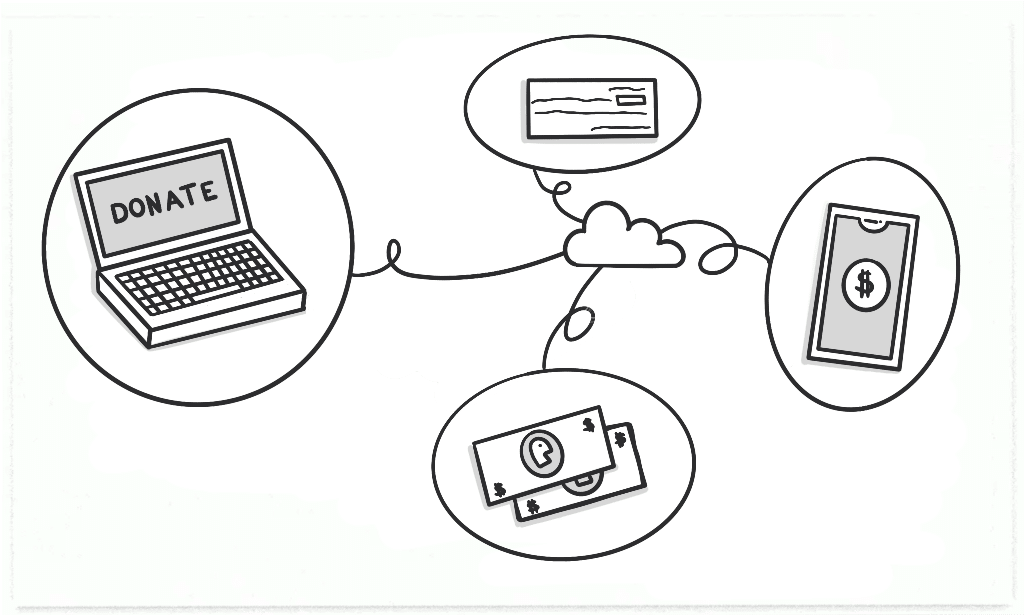
    Illustration of a cloud app that enables mobile, web, cash and check giving in one place

    Shoulders of giants: donation platforms

    As with most operational aspects of your ministry, you have the option to outsource mobile donations. There is a growing number of third-party tools that can help process donations and give your users mobile options for donating. The question comes down to what’s most important to you and whether there’s a good match in a provider.

    Options can be valuable, but overwhelming

    With providers like Tithe.ly or Donorbox, the feature list can seem nearly endless. If you’re looking for a comprehensive system that solves all sorts of problems, you might consider an all-in-one solution like these. But if you’re only looking for a mobile donation piece to drop into your existing setup, these could be a bad match. And they might also require that you use their other tools in order to use their mobile giving tool.

    The best way to navigate an overwhelming list of options is to contact the product’s sales team. They’ve often streamlined the evaluation process for ministries like yours to ensure they can provide only what you need. As an added benefit, you get a chance to work with their sales and solution engineering teams to get a good feel for their company.

    A focus on integration

    The best third-party service providers will have focused on how easily you can integrate their tools into your existing toolkit. They will also have a solution engineering team that can solve almost any new integration problem. They know their mobile donation feature is only a good solution for you if it will integrate into your workflow. Their experience with integrating their tool into many different environments gives them insight into how to best do that for you.

    General solutions can be weak solutions

    When someone else is providing the solution you’re using, they may not have the same goals or requirements as you. A general tool meant to serve tens of thousands of users might not provide exactly the functionality you need. When you’re looking at donation platforms, you might end up running into some of these weaknesses.

    Maybe accepting eCheck donations is important to your ministry, but a platform’s mobile donation solution doesn’t support them. Maybe the mobile app they supply isn’t customizable and gives your users a generic experience. If the app is unreliable for you but functional for other customers, the vendor may not be invested in fixing the problem. When it’s someone else’s tool you’re using, you’re at their mercy to develop and maintain it.

    Donation platforms often offer other features beyond mobile donations: a website, event management, an SMS sending platform, and more. These extra features may not be “best in class”; they can leave you frustrated, yet more “locked in” with a vendor’s bundle of tools. You should evaluate the mobile offering outside of any other features to get an accurate sense of its value to your ministry.


    The question of whether to offer your users options for donating via mobile is settled. With an ever-increasing percentage of donations coming from mobile, your ministry is missing an opportunity without a mobile donation strategy. If you’re not sure how to develop your mobile donation strategy, or if you’re not sure if yours is effective, don’t panic. It’s never too late to get started: contact Agathon below and we’d love to discuss it with you!
  • 8 Technology Trends Ministries Should Be Paying Attention To

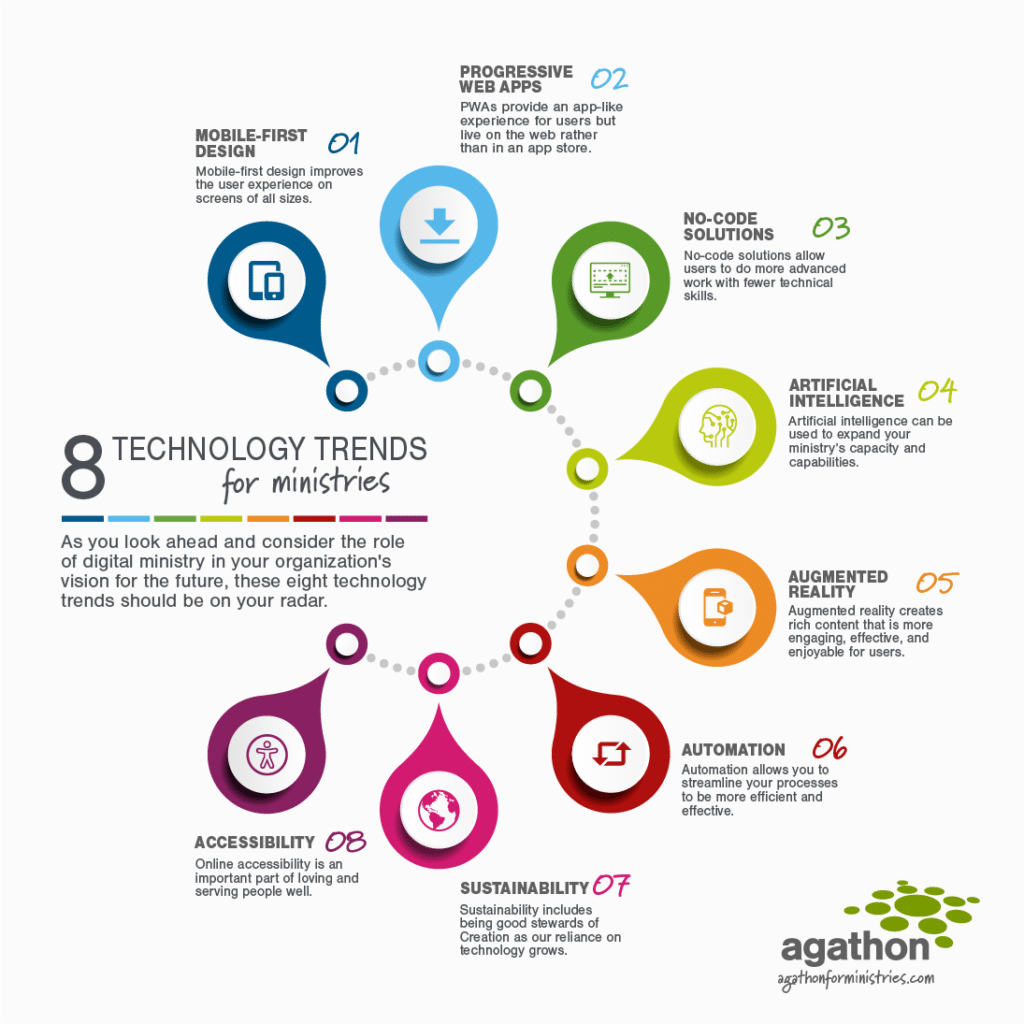
    A colorful infographic highlighting 8 technology trends for ministries with the caption: As you look ahead and consider the role of digital ministry in your organization's vision for the future, these eight technology trends should be on your radar.

    In 1965, Gordon Moore posited that the number of transistors per microchip would double every year. While this prediction has changed over time, it continues to guide forecasts for hardware development. Hardware isn’t our specialty here at Agathon. But it’s easy to see how we can extrapolate Moore’s Law to the advancements in software as well. Just consider the technology available to most home users 30 years ago, 10 years ago, and today.

    For ministries, the past few years meant the accelerated adoption of much of this technology even further due to the challenges and opportunities presented by the COVID-19 pandemic.

    As you look ahead and consider the role of digital ministry in your organization’s vision for the future, we’ve identified eight technology trends that should be on your radar. This is not a call to implement every one of these today. Rather, it’s an opportunity to begin thinking about which ones might impact your ministry in the future.

    Table of Contents
    1. Mobile-First Design
    2. Progressive Web Apps
    3. No-Code Solutions
    4. Artificial Intelligence
    5. Augmented Reality
    6. Automation
    7. Sustainability
    8. Accessibility
    Mobile-first design improves the user experience on screens of all sizes.

    1. Mobile-First Design

    Mobile-first design is a design philosophy that aims to create better experiences for users by starting the design process from the smallest of screens: mobile.

    What does mobile-first design mean for digital designers? Inside Design

    A few years ago we would have called this section “responsive web design.” We knew mobile was important, but it was still secondary to desktop.

    But as the use of smartphones and tablets has become ubiquitous, we’ve realized a responsive design isn’t enough. Instead, it makes sense to design websites for the smallest screen first. Many features that improve the mobile experience—lots of whitespace, large tap targets, etc.—are also beneficial on larger screens.

    This hasn’t always been realistic, especially for ministries working with tight budgets. In the past, web and mobile technologies were decidedly separate and would need two separate development projects. Today, tools such as React and Flutter allow developers to code for several platforms at once. This makes it easier for you to build mobile first while still stretching your digital ministry budget.

    This “write once, deploy everywhere” approach is also beneficial for the teams working on these products. It allows a single team member to service many technologies and creates redundancy across larger teams.

    [contentupgrade id=”2406″]

    PWAs provide an app-like experience for users but live on the web rather than in an app store.

    2. Progressive Web Apps (PWA)

    Progressive Web Apps use modern web capabilities to deliver an app-like user experience. They evolve from pages in browser tabs to immersive, top-level apps, maintaining the web’s low friction at every moment.

    Getting Started with Progressive Web Apps, Google Developers

    While we’re on the topic of mobile, it makes sense to consider progressive web apps (PWAs) as well. PWAs are websites that function like apps on desktop or mobile. These aren’t for simple informational websites but for interactive tools, account management, or internal applications.

    Native apps can be expensive, time consuming to update, and are subject to various app store rules, while creators have complete control over their PWAs. Like a traditional app, users can download PWAs to the home screen of their phone or tablet. And they function like a native app. They also allow push notifications and function better with poor internet. Plus, there are no app store fees to pay. And because they’re built on the web, you can update the content in real time.

    Because there is no central marketplace for PWAs, the app store may still be the answer for public-facing apps. Internal applications, on the other hand, should always function as PWAs. Similarly, apps that are paying exorbitant fees, or those that receive constant updates, may do better as PWAs. And ministries concerned about censorship or the rules governing their app may also find PWAs to be the right solution.

    No-code solutions allow users to do more advanced work with fewer technical skills.

    3. No-Code Solutions

    A no code development platform is a tool for building software applications without coding; a popular and promising alternative to traditional software development for non-technical business users hoping to build their own full-fledged applications.

    What is no code? Codebots

    No-code solutions are around us already: WordPress plugins add functionality with one click; tools such as Airtable or Zapier optimize your communication, processes, and workflow; and website builders like Webflow and SquareSpace allow you to quickly build a site without technical skills.

    The terminology itself can be confusing. “No code” doesn’t mean there is no need for human involvement at all. Rather, these platforms often function through a drag-and-drop interface. This helps team members to do more advanced work with fewer technical skills. Which, of course, allows your ministry to accomplish more with fewer resources and a lower learning curve.

    Does that mean agencies like Agathon will no longer be needed in the future? We sure hope not! Developers will continue to be on the leading edge of these advances. And as good as no-code solutions have become, they aren’t the solution to every problem. We will continue to augment internal teams and guide organizations with strategy and user experience tools to help them best serve their users.

    Artificial intelligence can be used to expand your ministry’s capacity and capabilities.

    4. Artificial Intelligence

    Artificial intelligence leverages computers and machines to mimic the problem-solving and decision-making capabilities of the human mind.

    What is Artificial Intelligence, IBM

    When we hear artificial intelligence (AI), we often jump right to the sci-fi idea of robots taking over the world. But that reality is a lot further off than most people imagine. However, AI in its current form can be a useful tool for the work of most organizations.

    In fact, you’re probably using AI already in your daily work. Think of things like your phone or email’s autocomplete feature, Grammarly’s writing feedback, or your bank’s transaction verification tools. AI is increasingly integrated in our everyday life, and it’s not going anywhere.

    Although there may come a day when ministries build their own AI, you can begin by taking advantage of existing tools now. For example, Answer The Public helps organizations understand what users are searching for on the internet. There are numerous programs that help create blog posts and other content. Tools such as Tableau help organizations jumpstart their reporting efforts by identifying anomalies and reporting against data. And others can help predict or forecast what’s to come based on data trends.

    This type of artificial intelligence helps ministries expand their capacity and capabilities, augmenting their current staff rather than replacing them.

    Augmented reality creates rich content that is more engaging, effective & enjoyable for users.

    5. Augmented Reality

    Virtual reality and augmented reality accomplish two very different things in two very different ways, despite their devices’ similar designs. VR replaces reality, taking you somewhere else. AR adds to reality, projecting information on top of what you’re already seeing.

    Augmented Reality (AR) vs. Virtual Reality (VR): What’s the Difference? PCMag

    Like, AI, virtual reality (VR) and augmented reality (AR) may bring to mind the most extreme examples of these technologies such as “attending” church from home through a virtual reality headset.

    Actually, augmented reality is much more accessible. It can be used, for example, to add interactivity to visual content, whether in-person or digital. (Many of us are familiar with the Pokemon Go craze of a couple of years ago!) This type of rich content is more engaging and can increase both the effectiveness and the appeal for users.

    Imagine the groundbreaking for a new facility, where people can hold up their phones to see an artist’s rendition of the building. Or picture the Bible Project videos brought to life in your living room. Imagine helping your donors experience the sights and sounds of the communities they’re supporting. Or envision online study tools that feel almost like real books and Bibles. It’s hard to anticipate all the ways this technology will be used in the years to come. But you should expect to see many of these ideas brought to life!

    Automation allows you to streamline your processes to be more efficient and effective.

    6. Automation

    The dictionary defines automation as “the technique of making an apparatus, a process, or a system operate automatically.” We define automation as “the creation and application of technology to monitor and control the production and delivery of products and services.”

    What is Automation? ISA

    Automation in general is not a new trend; however, it’s application to digital ministry will continue to increase over time as tools and best practices develop:

    Marketing automation

    You’re probably already familiar with marketing automation: a welcome series for new newsletter subscribers, a drip campaign during fundraising drives, or a tool to manage and schedule your social media messages.

    As this technology advances, you will be able to do even more to personalize the experience of your key stakeholders—whether donors or constituents—based on their demographics and the actions they take.

    Business process automation

    Marketing automation allows you to reach out more efficiently and effectively; business process automation helps you streamline your workflows internally. This includes things like a customer service workflow to help agents route and respond to emails. But it could also include time tracking tools, integrations to streamline data entry, etc.

    Test automation

    Finally, since we’re talking about digital ministry, it’s worth including test automation within this section. Whether developing software or publishing content, every human action creates an opportunity for error. Test automation can reduce friction and human error by scheduling and making processes predictable, automating things such as accessibility check-ins, and facilitating security checks for accountability.

    Sustainability includes being good stewards of creation as our reliance on technology grows.

    7. Sustainability

    Sustainable practices support ecological, human, and economic health and vitality. Sustainability presumes that resources are finite, and should be used conservatively and wisely with a view to long-term priorities and consequences of the ways in which resources are used. In simplest terms, sustainability is about our children and our grandchildren, and the world we will leave them.

    What is sustainability? UCLA Sustainability

    Tech trends often compete with the more human side of ministry. Or, if they don’t compete, they certainly present tradeoffs. We’ve seen this acutely in the last two years: Zoom and other digital platforms provided a way for churches to meet their congregants’ needs during pandemic lockdowns. But this remote access also presented challenges in reconnecting communities as lockdowns ended.

    Sustainability might seem like a strange topic to include on a list of trends. In reality, your ministry cannot ignore the growing importance of sustainability as a whole.

    John Elkington coined the phrase “triple bottom line” as a sustainability framework to measure an organization’s economic, social, and environmental impact. To simplify it in the context of ministries, a sustainable organization will:

    • care for both the people they serve and the people who serve
    • responsibly manage donations and expenses
    • be a good steward of creation

    Sustainability for ministries

    In the context of digital ministry, there are real implications of understanding the energy usage of your systems, websites, and apps. You may not have control over the infrastructure or bandwidth powering your tools. But understanding your site’s consumption and how you can offset that allows you to work toward a more sustainable future.

    For example, there are tools that will tell you what type of resources your site requires just to load. They can even go so far as to make recommendations (e.g., white screens use more energy to render than dark screens) and help you understand the implications of various design decisions.

    While sustainability is a bit nebulous to define, being good stewards of people, planet, and profit (or donations) is likely to become more important—not less—as time passes.

    Online accessibility is an important part of loving and serving people well.

    8. Accessibility

    Web accessibility is the inclusive practice of ensuring there are no barriers that prevent interaction with, or access to, websites on the World Wide Web by people with physical disabilities, situational disabilities, and socio-economic restrictions on bandwidth and speed. When sites are correctly designed, developed and edited, generally all users have equal access to information and functionality.

    Web accessibility, Wikipedia

    At Agathon, we believe accessibility is an important part of loving and serving people well. We also believe accessibility is good for everyone.

    Accessibility impacts:

    • Your ability to provide services,
    • How you connect with supporters and donors,
    • Whether your digital ministry feels welcoming, and
    • How well you can spread awareness of the work you’re doing.

    This is no longer something you can ignore or put off for tomorrow; the importance of building accessible websites and apps is only going to increase.


    It’s unlikely your organization will dive into all of these trends at once. But an important part of setting your ministry’s digital strategy is understanding the big picture trends and envisioning how those might help you to be more effective in ministry.

  • 5 Reasons Web Accessibility Matters for Ministries

    5 Reasons Web Accessibility Matters for Ministries

    A white handicap parking symbol on a blue background

    It’s 2021, and web accessibility is no longer a “nice to have” feature of your website or mobile app. By now, we know how poorly designed software impacts users with a variety of limitations or disabilities. And ongoing court decisions show the expansion of the Americans with Disabilities Act (ADA) to include online accessibility is coming sooner rather than later.

    But for ministries, avoiding litigation isn’t the primary reason you should be thinking about accessibility on your digital properties. We firmly believe loving and serving people well means accounting for these needs as you’re building websites and apps. We’d even go so far as to say ignoring these needs deliberately snubs those who need accommodations and harms the gospel message.

    We’ll dive deeper into why accessibility is important to your ministry plus some easy steps for improving accessibility. But first, let’s talk about what web accessibility means.

    What is Web Accessibility?

    Web accessibility is the inclusive practice of ensuring there are no barriers that prevent interaction with, or access to, websites on the World Wide Web by people with physical disabilities, situational disabilities, and socio-economic restrictions on bandwidth and speed. When sites are correctly designed, developed and edited, generally all users have equal access to information and functionality.

    Wikipedia

    As humans, our skills, abilities, and intellect cover a wide spectrum. Small type on a page or highly animated websites work for those toward the middle of the spectrum. But they can pose challenges for those with visual or cognitive disabilities. Similarly, users who rely on screen readers can struggle to navigate a site that isn’t properly built for this technology, making the content impossible to access.

    If your ministry is delivering services or content digitally, accessibility simply can’t be ignored. It’s easy to think your site is performing just fine if you’re not hearing from people otherwise; however, it could be people are simply clicking away in search of those resources elsewhere. In this way, you may be creating an echo chamber of the average person while ignoring the needs of those outside the average.

    Areas to consider for web accessibility

    There are five primary areas of impairments to consider for web accessibility:

    • Visual—a loss of vision beyond what can be corrected by glasses or contacts, including blindness, loss of central or peripheral vision, blurriness, light sensitivity, haziness, color blindness, etc.
    • Auditory—the partial or total inability to hear, whether constant or fluctuating, including deafness, tinnitus, trouble hearing specific frequencies, sounds that are muffled, soft, or too loud, etc.
    • Neurological—conditions impacting the brain or nervous system, including autism, epilepsy, migraines, etc. that may be exacerbated by visual or audio stimulation.
    • Cognitive—conditions that impact how people process and comprehend information, including ADHD, mental health disorders, dementia, learning disabilities, etc.
    • Motor—weakness or limitation in motor skills or muscular control, including tics or tremors, amputation, arthritis, carpal tunnel syndrome, etc.

    Web accessibility guidelines

    To help address these areas, the Web Accessibility Initiative has published the Web Content Accessibility Guidelines (WCAG). These guidelines are the leading authority on accessibility and are organized around four principles:

    Perceivable: Can users perceive the content? Just because something is perceivable with one sense, such as sight, doesn’t mean all users can perceive it.

    Operable:
    Can users use UI components and navigate the content? For example, someone who can’t use a mouse or touch screen cannot operate something that requires a hover interaction.

    Understandable:
    Can users understand the content? Can users understand the interface and is it consistent enough to avoid confusion?

    Robust:
    Can a wide variety of user agents (browsers) consume the content? Does it work with assistive technology?

    These principles, and the accompanying questions, can help guide the accessibility conversation as you look for practical ways to make your site more accessible.

    A woman in a yellow blouse sitting in a wheel chair at a table while using her laptop

    The 5 Reasons Accessibility Matters for Your Digital Ministry

    Loving and serving people well includes building accessible digital properties. But let’s dive deeper into the other reasons accessibility matters for your ministry:

    1. It’s necessary for providing services

    If you’re serving people through content, services, or tools on your site, it’s imperative those be accessible to the people who need them. Here are three questions to ask yourself:

    Can users engage with the content? For broadcast ministries, such as Truth For Life, the content is their ministry. Video captions, transcripts, and easy-to-use video and audio players remove barriers for the vision- or hearing-impaired as well as an older audience that may not be as proficient with technology.

    Can users interact with the services? Similarly, if your ministry is offering teaching, counseling, online small groups, or other services, how accessible are those services? They should be easy to navigate. Buttons and other interactive elements should function on a variety of screens. This includes creating target areas that are easy for people to click regardless of their device.

    Can users request assistance? If your ministry provides tools and resources—for example, a ministry that facilitates housing for an at-risk group—the process should be accessible for those with special use cases. The instructions and workflow should be easy to understand and navigate. Forms, applications, and other resources should work with screen readers or when the screen is zoomed.

    2. It allows you to connect with supporters and donors

    In addition to facilitating your ministry, an accessible site also helps you connect with supporters and donors. Many nonprofit ministry organizations rely on volunteering and donations. Accessibility concerns can create barriers for those who want to support the work you’re doing.

    Incorporating third-party tools such as a volunteer management app is one way to ensure the tools on your site are accessible. Similarly, accessible forms facilitate donations. This means providing clear instructions, labeling and validating form fields, and providing clear success and error notifications.

    3. It creates a welcoming environment

    While it’s almost certainly not your intention, when you ignore accessibility concerns, it projects the idea that you’re not interested in serving or partnering with those with special needs. If you haven’t added captions to videos, formatted pages to work correctly with a screen reader, or made the font size and contrast easy to read, you’re turning away people who need those accommodations.

    And the opposite is true as well: paying attention to accessibility concerns and incorporating those into your user interface (UI) tells visitors your ministry values people from across the spectrum. Which leads us to number four…

    4. It helps spread awareness of your ministry

    When your tools are accessible, the people who need those accommodations can and will share them with others in their communities. Rather than narrowing your appeal to those with average abilities, you widen your circle. This opens the door for more people to benefit from and partner with you in your work.

    5. It’s better for everyone

    And finally, accessibility truly is better for everyone. The tools we rely on for accessibility don’t only enhance the experience for those who need them; they make websites and apps more usable for everyone.

    For example, a focus on readability might include a larger font; lots of white space; short, left-aligned paragraphs; high contrast; etc. Those accommodations make the content accessible to those with visual or cognitive impairments. But they also make the reading experience more pleasant for everyone, preventing eye strain and enabling skimming.

    Investing in accessibility can feel like a sunk cost that may or may not reach additional people. But when it’s done right, you’re serving all of your users. So how do we do this?

    A young man with down syndrome sitting on a bed wearing headphones and using his laptop

    3 Ways to Improve Your Web or Mobile App’s Accessibility

    The good news is there are easy ways to make your web or mobile app more accessible. Just like the needs we’re addressing, accessibility is a spectrum. Each step you take to make your site more accessible moves you forward toward this goal.

    The WCAG define three positive ratings: A (the very minimum you should strive for) to AAA (perfect accessibility). Realistically, the painstaking work required to reach an AAA rating means many sites won’t see the benefit of seeking this top-tier rating. But if you aim to start at A or AA and continue to iterate as new technology and practices become available, you’ll be serving your users well.

    1. Use HTML the way it’s meant to be used

    HTML is inherently good for accessibility. When you use HTML properly, the structure and tags enable your site to be accessible. This includes telling screen readers how to progress through the content and labeling different elements appropriately.

    Your first step is to make sure you’re using HTML the way it’s supposed to be used. You can do this by auditing your existing digital properties via automated tools or by hiring a consultant. As you’re building new features or properties, there are also tools that will audit as you build and at the testing stage.

    2. Ensure keyboard friendliness

    Once you’ve verified your HTML structure, you can test this by attempting to navigate your website with just your keyboard. This helps you experience the site in the same way people using assistive technologies do. When you get stuck, either because tab takes you to a different place than you were expecting or you can’t access a button with your keyboard, you’ll know where improvements are needed.

    3. Build for responsiveness and zooming

    Responsive web design and mobile-first development are good for SEO, usability, and accessibility. They naturally include generous button sizes, touch functions, and accommodations for browser squashing.

    To test your site’s responsiveness, zoom in using the keyboard (CTRL-+ on PC and ⌘-+ on Mac) and see if things break. Are elements where they’re meant to be? Is all of the content still on the screen? Are you needing to scroll in unexpected places?

    Start with the three items above and you’re well on your way towards a more accessible and welcoming site.


    When it comes to accessibility, the perfect truly is the enemy of the good. Trying to overhaul everything to reach an accessibility goal is understandably overwhelming. But that shouldn’t stop you from making beneficial changes right away. Start today by asking yourself how accessible your site is right now and how you could realistically improve. And then push yourself to go just a little bit further to serve more people!

  • What COVID Means for the Future of Ministry

    What COVID Means for the Future of Ministry

    A photo inside an empty church with beautiful stained glass windows

    A year ago, COVID-19 was declared a worldwide pandemic. Schools, churches, and other organizations were shut down. Work moved online. And life as we knew it changed drastically.

    At the time, most of us thought we were looking at a few weeks—possibly a couple of months—of these shutdowns. As it became clear they would last much longer, churches and ministries realized they needed to adjust their approach. They needed to innovate in order to continue to advance their mission.

    Some did this quickly, moving services, small groups, and other initiatives online. Others took a little bit longer but eventually made the same changes.

    We’re starting to see some things return to normal in 2021. But technology has been changing our culture for many years—the pandemic simply accelerated those changes—and the trends we’ve seen over the past year will undoubtedly continue to impact your ministry moving forward.

    Let’s look at some of those trends and the lessons they hold for churches and ministries in the future.

    COVID-19 Presented Challenges for Ministries

    And let us consider how to stir up one another to love and good works, not neglecting to meet together, as is the habit of some, but encouraging one another, and all the more as you see the Day drawing near.

    Hebrews 10:24-25 (ESV)

    Ministry is relational and traditionally happens face-to-face: Missionaries live and work among the communities they serve. Churches meet together for worship and prayer and fellowship. Faith is strengthened through relationship with other believers.

    When state and local governments responded to the pandemic with limits on in-person gatherings—and many individuals and families chose to stay home—it impacted ministries of all shapes and sizes. They had to figure out what connection and service might look like without being able to gather physically in the same space.

    Similarly, and perhaps even more urgently, organizations had to adjust abruptly to the need to work remotely. Like for-profit companies, they had to navigate the waters around remote communication, video meetings, and working with kids underfoot.

    When your staff is suddenly working remotely, your in-person conferences have been canceled, and gatherings are limited to a handful of people, how do you stay connected? How do you fuel genuine relationships without face-to-face interaction? How do you keep people from slipping through the cracks?

    Churches, ministries, and other nonprofit organizations faced these challenges and more throughout 2020.

    A photo of a laptop screen with a Zoom call open

    But It Also Presented Opportunities

    While it’s easy to focus on the restrictions and challenges around COVID-19, these also presented opportunities. Internally, we often say “constraints fuel creativity.” With the disruption of all that was familiar, and a limited number of options remaining, organizations were forced to think outside of the box. They needed to innovate to continue connecting with their staff, their donors, and the individuals they serve.

    Live streaming

    Live streaming is not a new concept, and many churches were already streaming their services online before the pandemic. But stay-at-home orders meant more people were looking for an online service to attend each weekend.

    In fact, in the early days of the pandemic especially, we knew people who listened to multiple services or “visited” new churches each week. We’ve seen churches cite online attendance stats that outpace what they saw during in-person services pre-pandemic. And churches have had a unique opportunity to reach individuals and families who were not comfortable visiting church in-person or who lived well outside of their geographic area.

    In a season of uncertainty, fear, and loneliness, the availability of online teaching and worship presented a beacon of hope for many people.

    Small group gatherings

    Campus ministries like InterVarsity and Cru suddenly saw all their students sent home for online learning, disrupting their small groups and Bible studies mid-semester.

    The restrictions didn’t just impact campus ministries, though. Bible Study Fellowship had been reluctant to embrace an online platform, focusing their ministry on in-person gatherings instead. But they found themselves needing to pivot in March of 2020 to move their classes online. This allowed them to finish out the 2019-2020 year online. It also provided an opportunity for groups to meet in-person or online for the 2020-2021 year, depending on local restrictions.

    Along with just about every other organization in the world, small groups, Bible studies, youth group, and more moved to platforms like Zoom. While no one would claim it was ideal as the sole mode of communication, it provided a way for these groups to continue to meet “face-to-face” at a time when people needed connection and encouragement most.

    Online events

    Conferences such as Bayside Church’s Thrive Leadership Conference went virtual in the summer of 2020. Organizers recorded sessions via Zoom and uploaded those for participants to enjoy at home or in small group settings.

    On the other hand, If:Gathering has always been a virtual event, encouraging women to gather groups of friends in their homes or churches to watch the livestream together. Last month, If:Gathering 2021 continued much the same as it always has, with more of a focus on individual viewers. With a strong social media presence to enhance individual online viewing, they’re clearly leading the way in this type of event.

    More robust digital communication

    Facebook groups, email newsletters, and text updates aren’t new. But the pandemic provided the impetus many churches and organizations needed to adopt these tools “now” rather than “someday.”

    With the limitations introduced by COVID-19, many organizations moved their communication away from paper bulletins and bulk mailing to digital communication instead. Email, social media, and text can help churches and ministries connect with congregants and donors in real time, across geography, and with more personalization.

    Online giving

    In March and April of last year, churches and ministries saw a sharp drop in giving. Based on trends we’ve seen during previous economic downturns, many organizations prepared for the worst. Surprisingly, by June, giving had returned to its previous level or increased for two-thirds of all churches and ministries. This giving was fueled by the ease of digital giving, the growing needs in our communities, and stimulus checks.

    A photo of a young man with sleeve tattoos looking thoughtfully at his phone

    What This Means for You Moving Forward

    As life continues to return to normal, your organization will have to figure out which of these tools and strategies will remain part of your ministry toolbox and which will be discarded as you return to more traditional approaches. These things aren’t going to stop being important, even once things return to normal. COVID shone a light on the role of digital ministry within your broader mission.

    Using digital media to enhance in-person events

    Incorporating digital resources into physical events is not new. EveryCampus launched an online app as part of their campaign to cover every campus in the U.S. in prayer. The app included a digital guide participants could use while they prayer walked their way around campus. (In 2020, they shifted to digital prayer walks.)

    Churches and other ministries can enhance in-person events with technology. This includes things like incorporating church prayer chains into your mobile app, setting up digital kiosks in place of weekly bulletins, or connecting with conference attendees on social media. Facebook groups, weekly newsletters, and video messages are all ways your organization can use digital communication to strengthen relationships.

    Meeting people where they’re at

    Many church communities are anxious to return to in-person services. At the same time they’re also juggling concerns about the risks presented by these gatherings. And the newly developed online communities still provide a valuable avenue to ministry.

    For those who are not able to return to in-person service (for myriad reasons, whether it’s concerns about COVID or being otherwise housebound), virtual services with online chat options have provided a way for them to stay connected to their congregation on Sundays.

    And still other churches have built thriving digital ministries. Restore Community Church in Kansas City is an example of this. Seeing the fruit from their online services, they recently hired a digital pastor to continue to lead this area of ministry even as they return to in-person services

    Don’t forget accessibility

    In the early days of the pandemic, your first priority may have simply been getting things online. Accessibility might not have been on your radar as you scrambled to get something in place. But, there’s no excuse for overlooking accessibility concerns at this stage. At its core, paying attention to accessibility is a way to care for people. It doesn’t just benefit those with disabilities or unique needs; accessibility makes the internet better as a whole.

    Online giving is a necessity

    In 2021, there’s no reason your church or organization shouldn’t be able to accept credit cards through your website, app, or even text. This means making the process easy and seamless and offering a full range of transactions such as automatic recurring donations. While the idea seemed foreign 15-20 years ago, digital transactions have become a normal way of life thanks to apps like Venmo, CashApp, and Zelle. Supporters expect the same ease of giving for their tithes and donations.


    We continue to look forward to the day that life returns to normal. But even as that happens, digital engagement is only going to get more important. 2020 was a year of connecting with friends, family, and organizations using digital tools. Those same tools and strategies can continue to enhance in-person interactions. Now’s the time to take all you’ve learned this past year and build on it to create a well-rounded, robust ministry in the future!

  • Building an Accessible Web

    Building an Accessible Web

    Hanging accessibility signs for the WC (bathroom)

    The internet is built on the notion that information should be accessible, shareable, and open. The information superhighway connects us with people and ideas at an unprecedented rate. As technology advances, building an accessible web depends on our vigilant effort to build sites and apps that enable everyone to connect with the resources available.

    What is accessibility?

    In the context of a website or app, accessibility refers to technology that enables all users to interact with the content, with special attention for those with a disability.

    If you’re living without a disability, it can be easy to forget there are many people who use technology in a very different way than you. For some users, this means navigating with software that reads the navigation and content to them. For others, it means navigating without a mouse or touchpad, or without being able to hear. When we build accessible websites and apps, we build in a way that supports these different use cases.

    Glasses with clear frames sitting on the edge of a laptop

    Why should we care about building an accessible web?

    It may be tempting to think that just because the majority of your users don’t use assistive technology or interfaces, there isn’t much benefit to building your site or app with those minority users in mind.

    However, accessibility is becoming a standard, not an afterthought, and we believe it’s worth pursuing now for several reasons:

    Accessibility benefits everyone

    Web accessibility is essential for people with disabilities and useful for all.

    https://www.w3.org/WAI/perspective-videos

    An accessible web makes everyone’s experience better. Accessibility ensures sites are still usable when CSS fails to load. It also keeps video content relevant even with the sound off and increases the readability of content in less-than-ideal lighting conditions. And it allows users to use their keyboard to navigate the site, often much quicker than they can with their mouse or touchpad.

    Accessibility is good for SEO

    Accessibility improves navigability and usability not just for disabled people but for everyone, and it can be tremendously beneficial for SEO (Vox).

    When we build with accessibility in mind, we fuel SEO content with relevant information. If the site and content makes sense for assistive technology, it will also make sense to the machines at Google, Microsoft, and Yahoo.

    Accessibility is the law

    The number of website accessibility lawsuits … filed in federal court under Title III of the ADA exploded in 2018 to at least 2258 – increasing by 177% from 814 such lawsuits in 2017 (ADA Title III).

    If you operate a physical place of business, you’re well aware of the implications the Americans with Disabilities Act (ADA) has had on your business. However, many businesses aren’t aware of how this legislation affects their online presence. Beyond user experience, lack of accessibility could expose your organization to legal risk.

    A laptop screen showing CSS code being edited

    What can I do to increase accessibility?

    The ADA itself doesn’t provide measurable criteria for what it considers accessible. However, we can take cues from how others have been measured in the courts. This is where the Web Accessibility Initiative (WAI) comes in. The WAI’s guidelines—the Web Content Accessibility Guidelines (WCAG)—lay out measurable ways to accommodate users with a disability.

    If your organization interfaces with the federal government, you should also be familiar with Section 508. These laws outline the success criteria for building accessible sites that are used by the government.

    Making sure your site, app, and content are accessible can feel overwhelming. The WAI is a great place to start. There you’ll find tools and references for both content creators and developers. These will walk you through how to evaluate your current technology. The Web Accessibility eValuation Tool (WAVE) can also help you assess your current site for potential issues.

    In our experience, there are several quick fixes that can have an immediate impact on the accessibility of your site or app:

    • Add alt attributes to img elements
    • Add Skip to content links near the top of the page
    • Use heading tags (H1, H2, etc.)
    • Adjust contrast for text

    However, while some of the items on this list may be easy to address, it only scratches the surface of what building an accessible web entails. Beyond the quick fixes, the WCAG covers a wide range of considerations; you may need to work with a developer to get your site or app up to current accessibility standards.


    Accessibility standards change alongside changing technology, and it can be overwhelming for organizations to keep up with these. We’d love to help you assess your technology and build a game plan for meeting the criteria today and moving forward!

  • Five Signs It’s Time to Redesign Your UX

    The digital experience you offer your users should be central to your organization’s strategy. And this is true whether you primarily share free content or offer products and services for sale. Because the internet and the way people interact with it are always changing, redesigning your user experience (UX) over time is inevitable. And knowing when to invest the time, effort, and resources into redesigning your UX should be a calculated endeavor.

    Here are 5 considerations that might indicate it’s time to redesign your UX:

    1. Brand growth

    Illustration of a growth chart with a seedling, bud, flower, and question mark along the growth line

    Your brand grows and responds to cultural shifts, new technology, and organizational focus. For example, there has been a dramatic increase in the number of organizations adopting a humanitarian or sustainability focus as a key part of their brand over the last 15 years.

    Whether your organization is mission-driven or a traditional business, the same principles apply. Brand growth informs how you present and communicate your brand to users. And this has an outsized impact on the digital experience you offer them. These milestone in your brand’s evolution are often drivers of new organizational capabilities, new narratives to share with the world, and a new user experience to support it all.

    2. Performance erosion

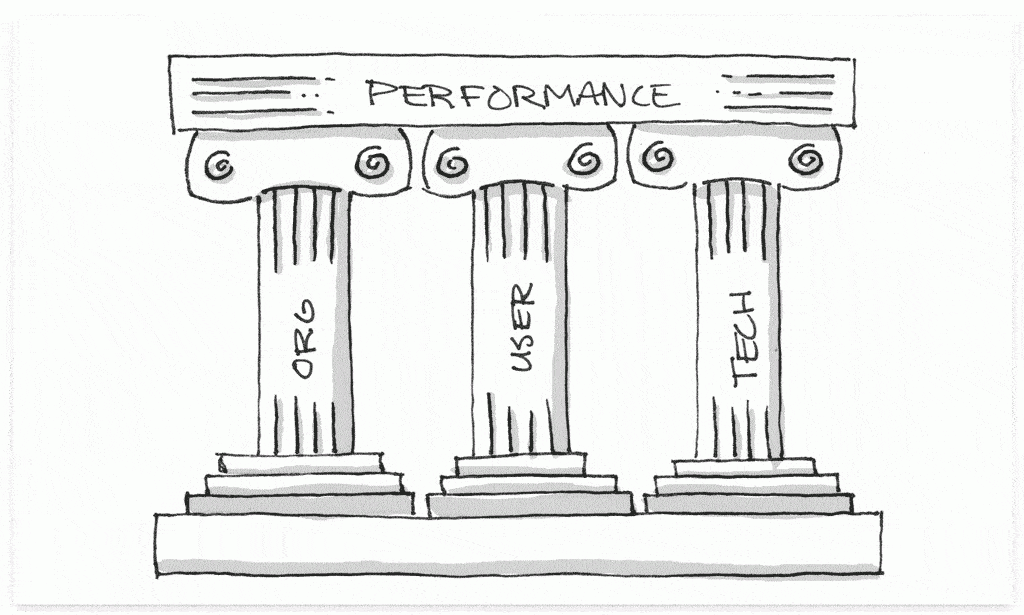
    Illustration of three pillars— organization, user, technology—holding up performance

    You can evaluate your users’ digital experiences through 3 lenses. Any (or all) of these lenses might be a catalyst to redesign your UX:

    Organizational performance

    • Does the UX support our organizational goals? (i.e., Does it facilitate the interactions that impact how we measure the health of the organization?)
    • How can we get more return on investment from the UX? (i.e., Can we move users closer to taking the desired action?)

    User experience performance

    • Does the UX meet the user in the right place, at the right time, and in the right way? (i.e., Does ubiquitous connectivity and mobile context change the types of goals we reach for in UX?)
    • Have there been broader changes in the way users interact with technology that impact the UX? (i.e., Can voice assistance, artificial intelligence, location awareness, or virtual reality improve the UX?)

    Technical performance

    • Are there development changes we could make that would improve the UX? (i.e., How can we speed up the delivery of new features, while reducing the number of bug fixes?)
    • Have technical capabilities increased to the point where a technical change could increase the quality of the UX? (i.e., Can we take fuller advantage of browser capabilities or mobile apps?)

    3. Feature alignment

    Illustration of an abstract person with a frown standing in front of squares that represent features—they start out organized on the left side and become chaotic and scattered on the right

    Sites and apps add new features to the UX over time. These new features get bolted onto the preexisting interface, often without evaluating how new features impact the old ones. Users are grateful for the new features, but before long the UX becomes complicated and hard to navigate.

    Growth naturally requires pruning now and then. It requires time to zoom out, reassess how the features align with your users, and make tough choices about how to prioritize the experience.

    4. Difficulty of updates

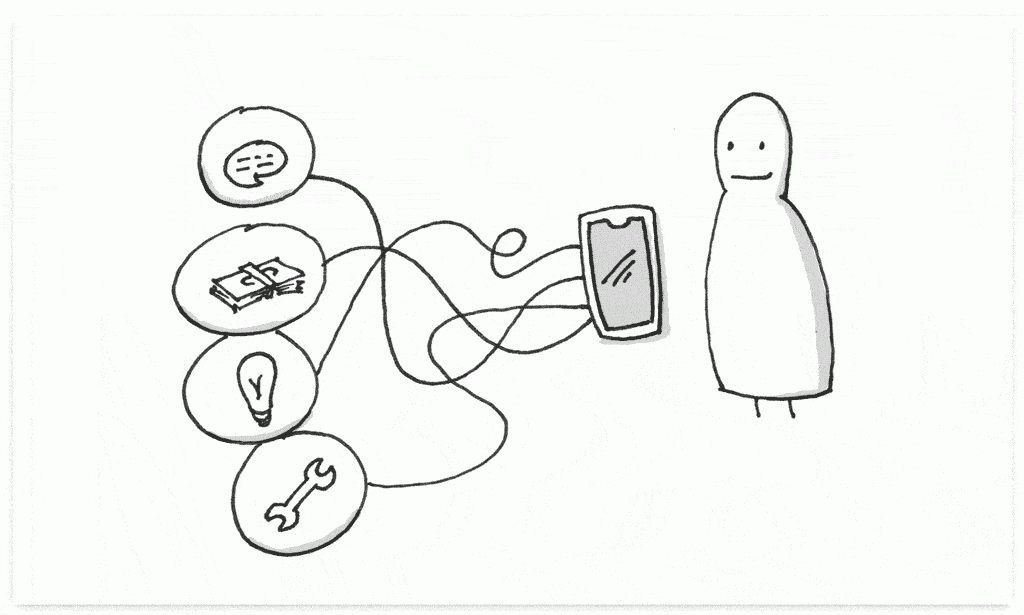
    Illustration of an abstract person with a smile looking at a phone with tangled wires leading to four thought bubbles: a chat bubble, a stack of money, a lightbulb, and a wrench.

    Updates often become difficult for two reasons:

    1. As new products or different types of content become available, these changes can be tricky to integrate with the current experience. This can be due to a limitation of the technology or the current user interface itself.
    2. As your company facilitates more organizational capabilities digitally, the integrations with user-facing technologies become more complex.

    Updating content and features doesn’t happen as often as it should when it becomes difficult. It’s important to step back and evaluate ways to streamline the update process so users have more and better access to the services they expect.

    5. User expectations

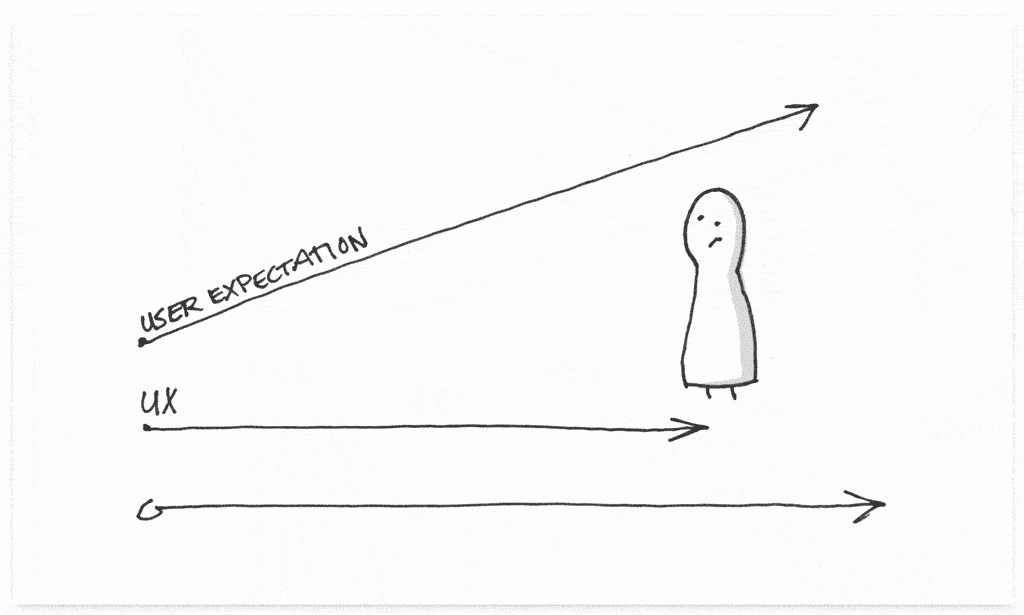
    Illustration of an abstract person with a confused expression looking at a growth chart that shows UX running along the bottom and user expectations trending up and to the right

    As users become more digitally savvy—which isn’t to say that they’re not already—they want more access to organizational capabilities. Users want to be able to access information when and where they want to, to be able to self-service common tasks, and to have more transparency when it comes to their involvement with an organization.

    These expectations grow over time, which requires organizations to build new tools to facilitate new experiences, perform new functions, and reduce friction.


    An effective UX aligns the needs of the user with organizational priorities and technical capabilities.

    Every line of code is a commitment to the future. This goes beyond security updates and technology upgrades. The user experience is built on top of code. As your organization grows, performance erodes, features come and go, updates become harder, and user expectations change over time, the UX must grow and change along with those expectations.